

I was reading the Investor’s Chronicle1 last weekend and came across an article titled ‘How do I grow my £118,000 portfolio and retire early?’. I usually skip the financial planning & education segment of this publication, but found myself second-glancing at the piece because of the bemusing composition of the individual’s portfolio. Investors tend to exhibit a level of financial ethnocentrism when it comes to discussing how others ought to invest their money. Those who approach matters with a rational mindset understand the folly of such a narrow view; there are many roads to Rome. There is a spectrum of behaviour amongst individual investors. This spectrum does not represent a linear progression from “wrong” to “right”; it's a range of distinct yet interconnected states, where each point embodies a unique set of characteristics and values.
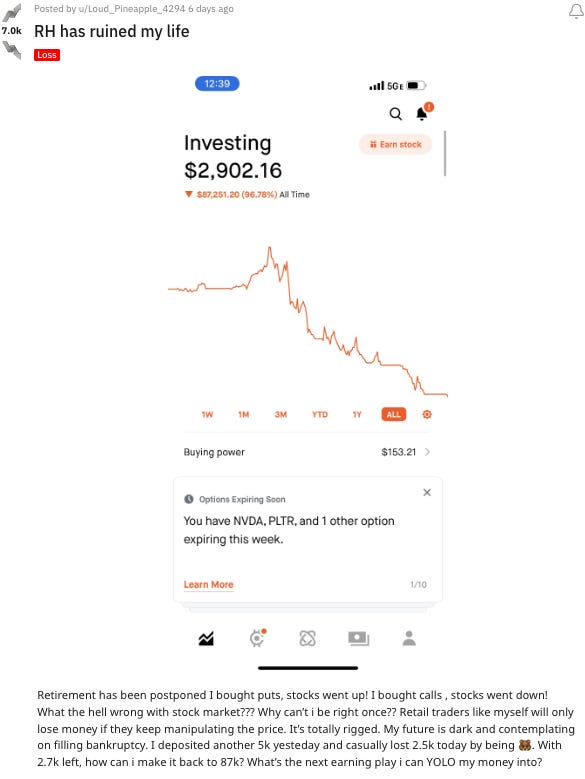
On one point of the spectrum, we find investors who Yolo into derivatives on momentum stocks, lose everything2, and lament the market as being rigged. At other points of the spectrum, we find investors who are vastly more sensible and well-meaning but not without their own set of misfortunes. The anonymised submission to the Investor’s Chronicle, a portfolio operated by “Nick”, is illustrative of such misfortune. Before reading on, have a glance at the portfolio and think of a few things that stand out.
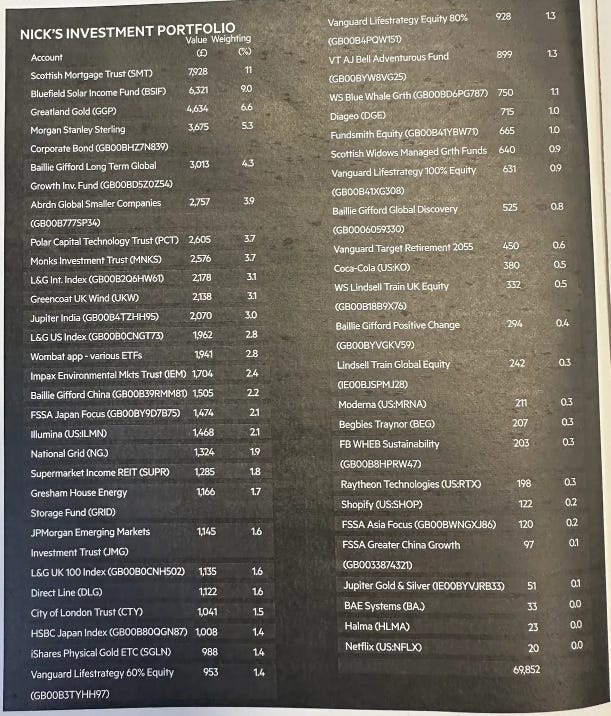
Nick, aged 37, is a resident of the UK who works for the NHS and wants to retire in 13 years (aged 50). His salary is £30,600 and his portfolio is valued at ~£118,000 between a stocks & shares ISA (28%), pension accounts (19%), general taxable accounts (13%), cash (40%) and other (1%). While his salary is modest, his outgoings appear to be low (single, renter, no plans to have children or buy a home) and his time horizon (“20 to 30 years”) is long. His investment rate as a percentage of income is solid too. Nick claims to invest between £6,000 and £10,000 per year across his accounts. Before-tax, that’s around a quarter of his income at the midpoint. Assuming he sticks to ~£8,000 invested each year and earns ~7% compounded annually he’d end up with ~£450,000 by the time he’s 50. After inflation (an arbitrary guess of 3%) it could end up being worth ~£300,000 in real terms. There are lots of moving parts here that could influence the end result. He could see modest salary increases, he could see significant pay increases with another role, inflation could be higher or lower than expected, he may allocate more or less each year, and there are varying tax consequences between the accounts he uses. The use of both the ISA (which has a £20,000 annual tax-exempt investment limit) and the pension3 is wise.
Addressing the advisors of the “portfolio clinic”, he suggests that he wants to:
Beat inflation
Consolidate his portfolio
Retire in 13 years
Move abroad
Allocate some inheritance he recently obtained
The portfolio, while absent of the typical single-stock concentration or popular momentum-fueled fancies of individual investors, is a mutual fund manager’s wet dream. Fees, fees, and more fees. Nick’s portfolio sufferers from a severe case of diworsification. The mish-mash of mutual funds and duplication of exposure adds unnecessary expenditure to the portfolio. With ~60 positions (19 of which are weighted below 1%) consolidation is a prudent decision. The contents of this portfolio, in addition to what I assume is a demanding job at the National Health Service, tell me the owner wishes to remain a somewhat passive investor. This can be easily achieved with a significant reduction in the number of funds held, thus reducing fees paid. He can likely do this without losing much of his diversification.
“I have some paper losses in my holdings – is a portfolio restructure a good idea in this case?”, he asks. Loss aversion is a serious drug. In this case, Nick ought to avoid succumbing to the disposition effect; whereby you feel more comfortable selling profitable investments and reluctant to realise ones that are in the red. This will give him clarity on restructuring a portfolio he can be proud of and will help him meet his goals. The monster cash position of £47,000 (~40%) echoes the conservative nature of most Brits. This young man is 37 years old and has a portfolio packed with cash, bonds, and mutual funds. Having such a large cash position contradicts his desire to beat inflation over time. If there is an asset that certainly won’t do that over the long term, it’s cold hard cash. And finally, retiring at 50 is an admirable goal, but there is room to stretch the time horizon there. Maybe it’s because I am now approaching 30, but 50 seems young to me. I have a more long-winded and controversial view of retirement. I think the goal of escaping the necessity of work is great. Leaving the rat race behind to work on things you enjoy, that challenge you, and most importantly keep the brain active and your faculties in good shape. But the thought of a placid, conventional, retirement spent lounging around is my idea of a first-class ticket to an early grave. Maybe a discussion for another time.
I know what would do if I were in Nick’s position, but I am not qualified to offer financial advice and have no intent on doing so. But I did ask some of you what you’d do to fix Nick’s portfolio, which you can read here. Some of the replies that tickled me include:
“The mutual fund industry would like to thank him for his donations”.
“Marry into money. Way easier”.
“I'd add 60 more index funds. You can never be too careful these days. Rates n all”.
“They have 3 different Lifestrategy funds, 100, 80 and 60. What’s the point? Trying to make Lifestrategy 78.75%?”.
There were some sensible replies too, I swear. The crux of the advice from the advisors at Investec and Lumin Wealth was as follows:
Overly broad and lacks consistency, suggesting having 2% to 5% in each position.
Increase exposure to stocks in favour of bonds, and readjust as he draws closer to retirement with added exposure to gold.
Reposition to growth assets due to young age.
Both advised reducing cash position “significantly”.
Deploy inheritance and cash using monthly cost averaging to smooth out extreme points in the market.
Reducing individual stock holdings until the portfolio reaches £500,000, then focusing on quality fund managers.
Advises investing in funds rather than individual stocks for better diversification and lower trading costs.
Consolidate to cheaper funds and eliminate duplicated exposure.
While I disagree with some of these suggestions, this seems like suitable advice based on Nick’s apparent orientation, goals, and risk tolerance. Financial advisors get a bad rep sometimes. It’s not hard to understand why. The job pays well and relies upon the concept of information asymmetry. Not necessarily concerning what the market is going to do 12 months from now; rather an understanding of how to marry goals with long-term financial planning and the possession of specialised knowledge and expertise on the stock market.
Here’s a tweet4 from the author of the popular newsletter, Of Dollars and Data, Nick Maggiulli.
“Don't pick individual stocks. Besides the possibility of underperformance, the real issue with stock picking is that it could take you years, if not decades, before you know if you're any good”.
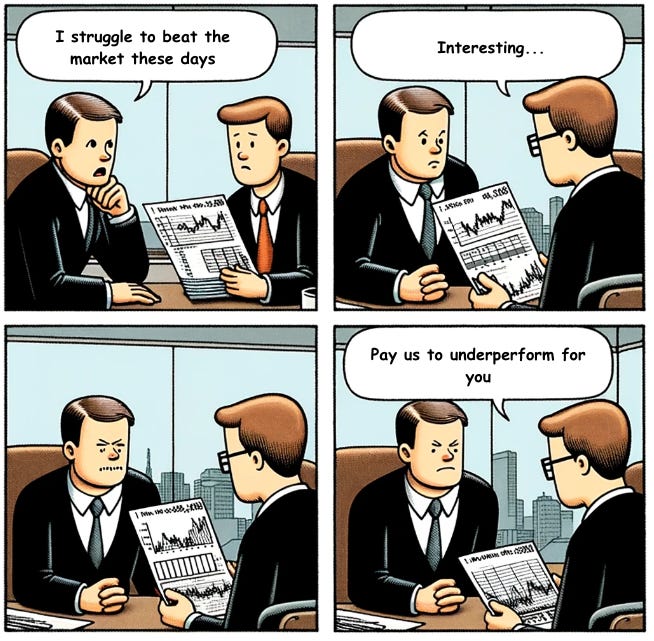
Nick also happens to be the COO of Rithotlz Wealth Management. While his title suggests he may not have the day-to-day operations of an advisor, this quote is taken straight from the financial advisor’s handbook. Everyone talks their book and Nick is singing from the hymn sheet. Advisors don’t want you to pick stocks and learn how to invest, they want to do it for you, some might say. They do this to protect you, others might say. It might even be triggering to some. “How dare you tell me I can’t beat the market”.
The contrary point of view, and I think it’s a fairer one, is that most investors would benefit from having the experience of an advisor. Not everyone with wealth cares about the world of investing. Some just want to earn a return on their money and pass the responsibility of doing so to someone else. As stock pickers, we exist in a bubble. Sure, there is a touch of arrogance to believe we can accomplish our goals on our own. But the ordinary individual who wants to invest their money is not spending their afternoon reading a 10-K. They don’t have the time, stamina, or understanding to manage their portfolio. Peek just a little outside of your bubble and you’ll realise that, on a global scale, the level of general education about the stock market, investing, and finance, is pretty low.
I am curious to hear your thoughts about what you would do to consolidate and improve Nick’s portfolio. If you have a perspective, feel free to drop it in the comments below.
Thanks for reading,
Conor
FYI, the Investor’s Chronicle is a Financial Times publication that is published every Friday. It’s focus is coverage of UK-listed companies. Particularly useful for those looking to turn over rocks in that region and who enjoy thoughtful commentary.
The article didn’t specify what kind of pension accounts these are. SIPPs, personal pension plans, workplace pensions, and state pensions all have varying tax consequences.

It's weird I just wrote about this here (promise I'm not pumping my stuff ;)
https://investorsjournal.substack.com/p/a-lament-for-personal-finance
I was an advisor for over a decade. Most people really struggle with saving enough. Once you get above a 10% savings rate, people just really push back. And saving the 20-30% required to retire early is just way beyond most people.
Despite that, one of the most frequent questions I got was, "Can I retire early?"
Most times it was, "You have like $5 in your back pocket and that's it. What do you expect to retire on?"
Discalimer: I had a really small firm and very limited client base. I worked in California. So my experience is surely biased.
Simple answer. What he does with the portfolio doesn't matter much. He doesn't have the time to learn stock picking and even if he did, squeezing out an extra 2% annually won't be the difference.
It comes down to this. Nick's goals don't match his actions. Let's say he has 300k in real terms when he turns 50. Can he afford to retire? Only if he's terminally ill. Otherwise, that retirement won't last and he will be back in the labor force at a lower wage than he left.
So what can he do?
First step is that he needs far more cash going in each year. To have any chance of retiring in 13 years, he needs to be putting away vastly more.
But his expenses don't seem crazy. The issue is that his income doesn't work for retiring at 50 unless he started younger and could live with his parents and eat their food (near zero expense).
That's the cold hard truth. In 13 years, compounding won't be enough unless he gambles and wins. That's stupid because most people who gamble in their stock choices end up losing.
So the best advice possible for him right now is to get a much higher paying job doing something he actually likes. Then he can put more money away and do it for longer. He has to do at least one of those things. If he wanted to retire at 60, there would be some conversation about doing it with a bit more income. But it's absolutely not happening him at 50 unless he gambles and wins.
Clearly sitting in cash (if he isn't getting interest on it) is not going to work. But the biggest shortfall in this story is the difference between his income and the amount it will cost to retire for 40 years starting in 13 years.