


Hey, you are reading the guest segment of Investment Talk, where I invite friends of the newsletter to share thoughtful essays, conduct interviews, and collaborate.
Today’s guest essay comes from Edmund Simms , author of the Little Book of Big Bubbles, a fund manager, and owner of the Valuabl newsletter. Edmund is someone I’ve had the pleasure of interacting with for years now. He has a wealth of experience across public and private markets, having worked in hedge funds, mutual funds, and venture capital, and I have come to appreciate his sharp wit and deep knowledge of markets and accounting. If you find Edmund’s work valuable, you might be interested in the interview I conducted with him back in 2022 where we discussed what “value” really means, correlation and standard deviation, luck & skill, the delivery business, bubbles, and a lot more.

Value works, even if you’re unemployed and live with your parents
Value investing has fallen out of favour. It's time to remake the case for going against the grain
Edmund Simms

George Constanza, the bald one in Seinfeld, makes lousy choices. "Every instinct I have, in every aspect of life, be it something to wear, something to eat—it's all been wrong." But George turns his life around, within minutes, by resolving to always do the opposite. He scores a date, mixes up his wardrobe, and gets a job with the Yankees. Investors should follow his lead. All red-blooded, money-hungry, stock pickers want to beat the market. Punters and professionals alike spend hours scouring screens and testing strategies. But following the crowd and instinct leads to poor results. Instead, if you're an active investor, you should be a value one, buying stocks for less than their intrinsic value. This strategy works. It outperforms and is the soundest approach. It's also countercyclical as it uses our innate cognitive biases to help rather than to hurt us.
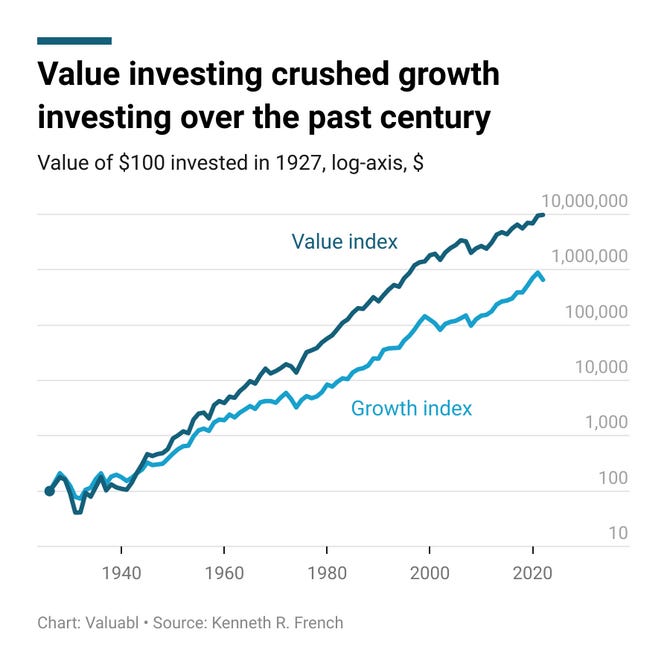
Value investing has a long track record of outperformance. Over the last hundred years, value stocks consistently outperformed growth ones. Ken French, a distinguished American finance professor, shares data on this topic. It shows that if you had put money in a low price-to-book (PB) value index in 1927, you'd now have 15x more than if you'd put it in a high-PB growth index. While these ratios aren't perfect representations of value or growth, they are instructive. The result reveals that value investing, as a broad-based approach, works.
Further, top-performing funds tend to be value-oriented. In a 1984 article, Warren Buffett, one of history's wealthiest men, demonstrated this. He proposed that if the market were efficient, no one should be able to beat it in the long run. Therefore, if many long-run winners all had the same strategy, their success must come from that, not chance. The funds he looked at beat the market by an average of 11 percentage points per year. A striking result. Buffett then explained that the only thing these funds had in common was that they were value-based. Sure, he may be biased, and one of the funds he covered was his own. But it's hard to argue with his results, either. Berkshire Hathaway, his investment firm, has returned more than 3,800,000% since 1965. Value investing works.
A value-oriented strategy is countercyclical. It uses humankind’s innate behavioural biases to the investor’s advantage. Our brains crave the safety of the herd—high and rising prices signal that. Subconsciously, we want to buy high and sell low. But a value strategy forces us to do the opposite by making us buy low and sell high. In 2011, a researcher, Todd Feldman, showed that investors are too anchored to the current environment. His research showed they're afraid of losses and of missing out. They can't look to the future because they're trapped in the now. As a result, they underperform. He found that investors buy when things look good and sell when they look bad—the opposite of what does well.
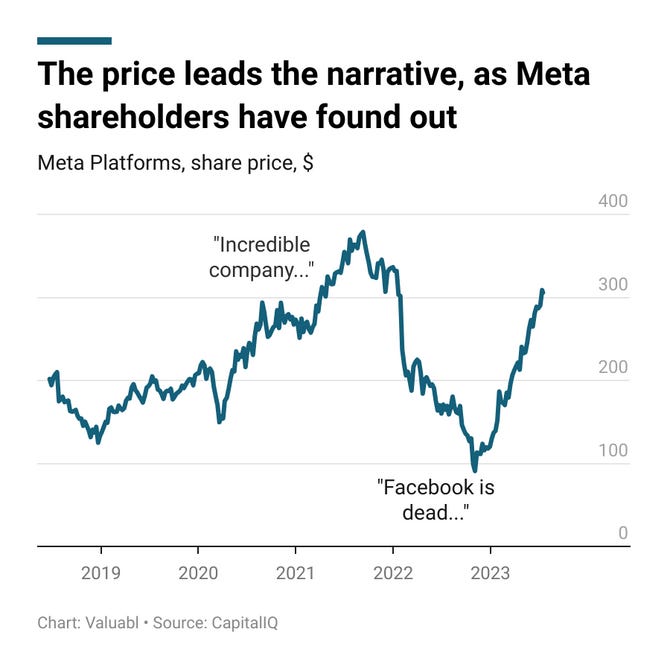
By swerving against our natural biases, value investing helps us avoid those traps. Last year, shares in Meta, Facebook's parent company, fell 75% from their peak. Investors wanted nothing to do with the firm as the monthly average users fell for the first time. Talking heads said it was the beginning of the end for the social media behemoth. But the stock has tripled since then, and investors are singing the firm's praises and piling in. When markets have shot up, that's when they're most likely to be overvalued. But that's when our gut tells us to buy. Then, when prices drop, our gut tells us to sell—another savage betrayal.
A money-printing machine
Value investing is the soundest approach because price and return are inverses. For the same future cash flows, the lower the buy price, the higher the return. But if the price goes up, the expected return goes down.
For example, imagine you're in a store that sells a machine that prints out a crisp $100 note each year. That's all it does. The sticker price is $1,000. Not bad. You'll get a 10% annual yield. But, a clerk who works there tells you the store is having a half-price sale next week. If you wait, you can buy it for $500 and double your return. This will also cut your risk. Instead of staking a grand to get the annual $100, you only have to put up half.
Unlike our money printer, stocks are usually slices of firms whose profits are growing. If a larger amount of money came out of the box each year, the machine would be worth much more. Old-school value investors have done a lousy job of accepting this. They have often ignored growth and intangible investments like branding, training, and research. But they need to take these into account or get left behind. Still, that doesn't change the fact that the less you pay compared to what the asset is genuinely intrinsically worth, the higher your return.
"If every instinct you have is wrong, then the opposite would have to be right." — Jerry Seinfeld.
Thanks for taking the time to read Edmund’s work today. If you, or someone you know, would be interested in creating an essay for the Investment Talk audience, don’t hesitate to reach out.
Thanks for reading,
Conor
I hope your readers find this essay interesting
I love this. Great collaboration you two!