

Hey, you are reading Investment Talk. If you’d like to join the 21.2k other readers learning about life, the stock market, and the companies within it, subscribe below. You can check out my other articles and follow me on Twitter too. If you enjoy today’s article, then feel free to share it, it helps a lot. Now let’s begin.
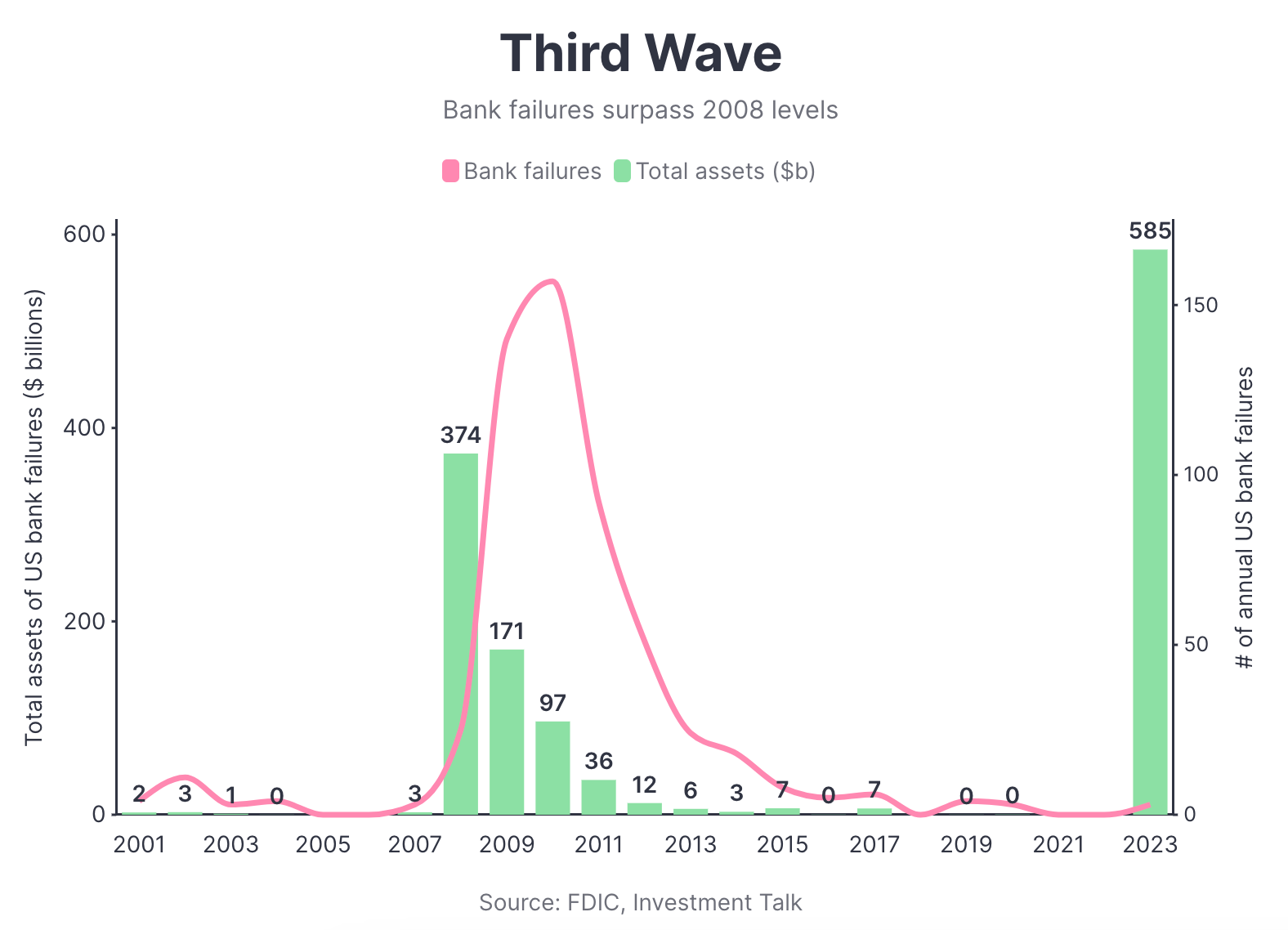
There have been 564 US bank failures since 2001 and three of the largest have occurred since March 2023.
Just yesterday, I discovered a fabulous Starbucks-like coffee chain here in India called Third Wave Coffee. Utilising a blend of beans from North Karnataka, the Bangalorian-borne enterprise started up shop in 2016 and now has ~90 stores across six Indian states. In my opinion, the coffee and menu variety is superior to that of Starbucks; which has 311 franchises across the country.

The opportunity for businesses like Third Wave and Starbucks in India is palpable. While Starbucks may only have hundreds of stores today, it’s not difficult to imagine a world that stretches into several thousand. My stumbling across the aptly named coffee franchise may have been the world’s attempt at humour. For, on the same day, 2023’s third wave of US bank failures was cemented into history.
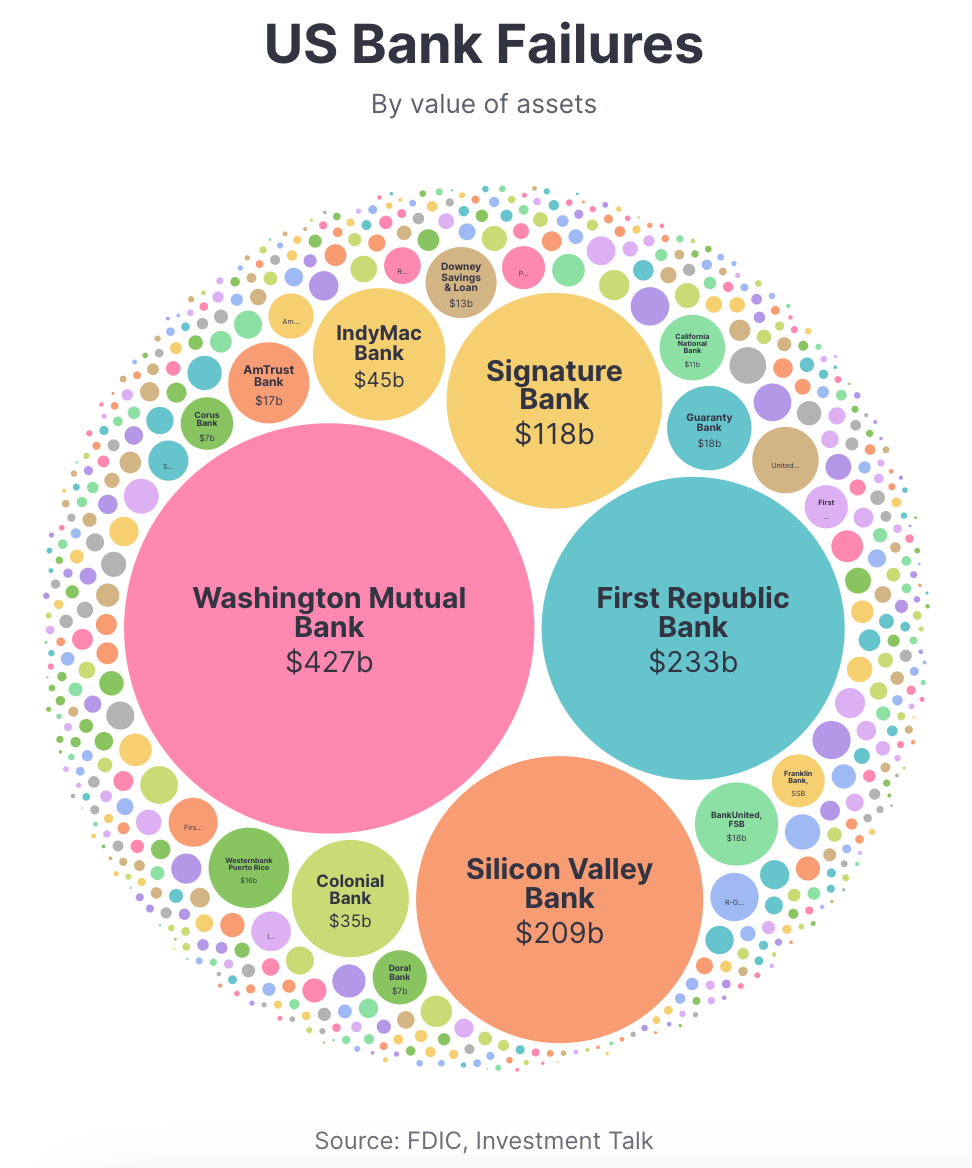
On May 1st, after a week of speculation on the outcome of First Republic Bank, US regulators accepted a bid from JPMorgan’s Jamie Dimon to acquire to latest casualty of the US banking sector. In doing so, they will assume all deposits (including uninsured deposits) and substantially all assets of First Republic Bank.
Uncle Jamie’s Land Grab
To Jamie Dimon, the acquisition of First Republic Bank is like scoring a spare when you are left with a split after your first bowl. In one light, JPM gets to be seen as the saviour in a time of crisis. In another, the deal serves the interests of America’s largest bank and its shareholders. JPM is absorbing a relatively quality asset, for a price unimaginable at the beginning of 2023, which will strengthen their already dominant position in the US.
In accordance with the acquisition:
JPM acquires the majority of First Republic Bank’s assets, including $173 billion of loans (marked down to $150 billion), $30 billion of securities, and $92 billion of deposits, including $30 billion of large bank deposits.
JPM repays $25B of deposits from large banks, eliminates a $5B deposit on consolidation and will not assume First Republic’s corporate debt or preferred stock.
First Republic branches opened yesterday as usual, including digital and mobile banking capabilities.
JPM is expected to incur ~$2 billion in restructuring charges between now and 2024.
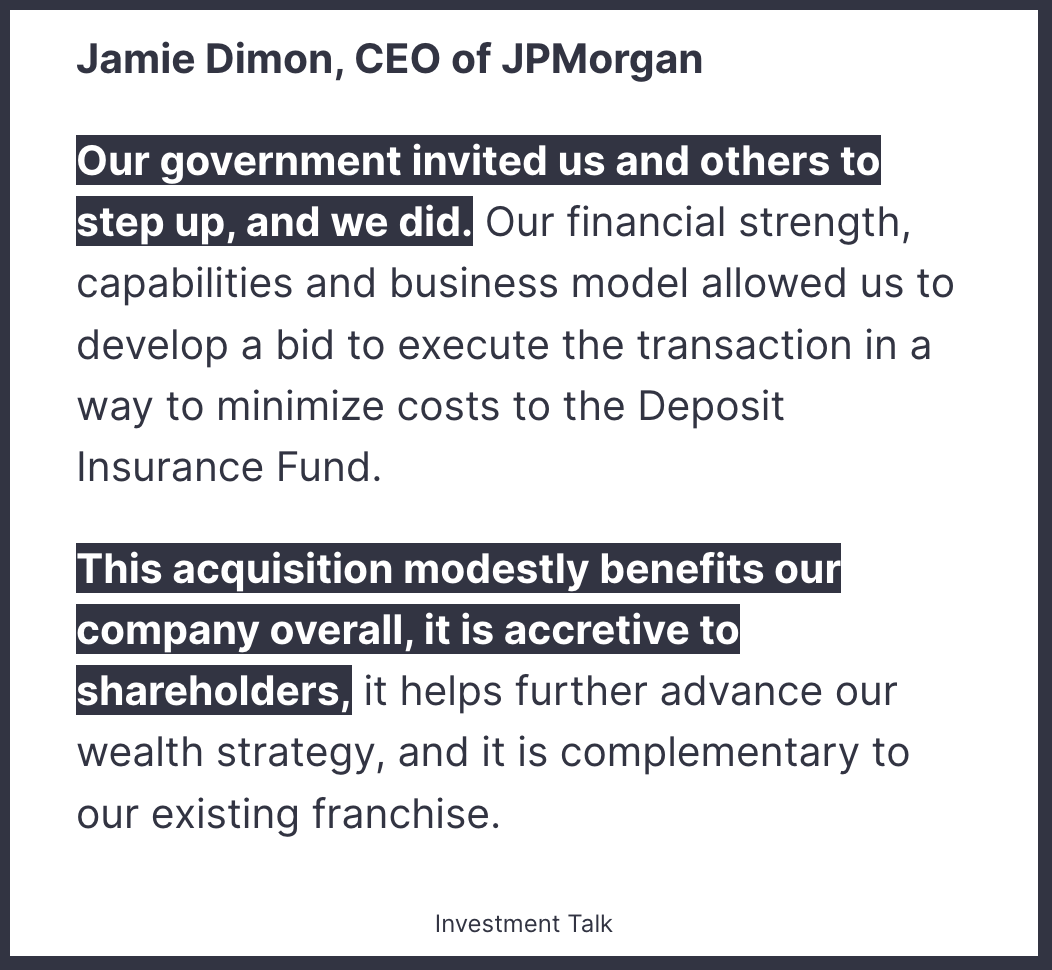
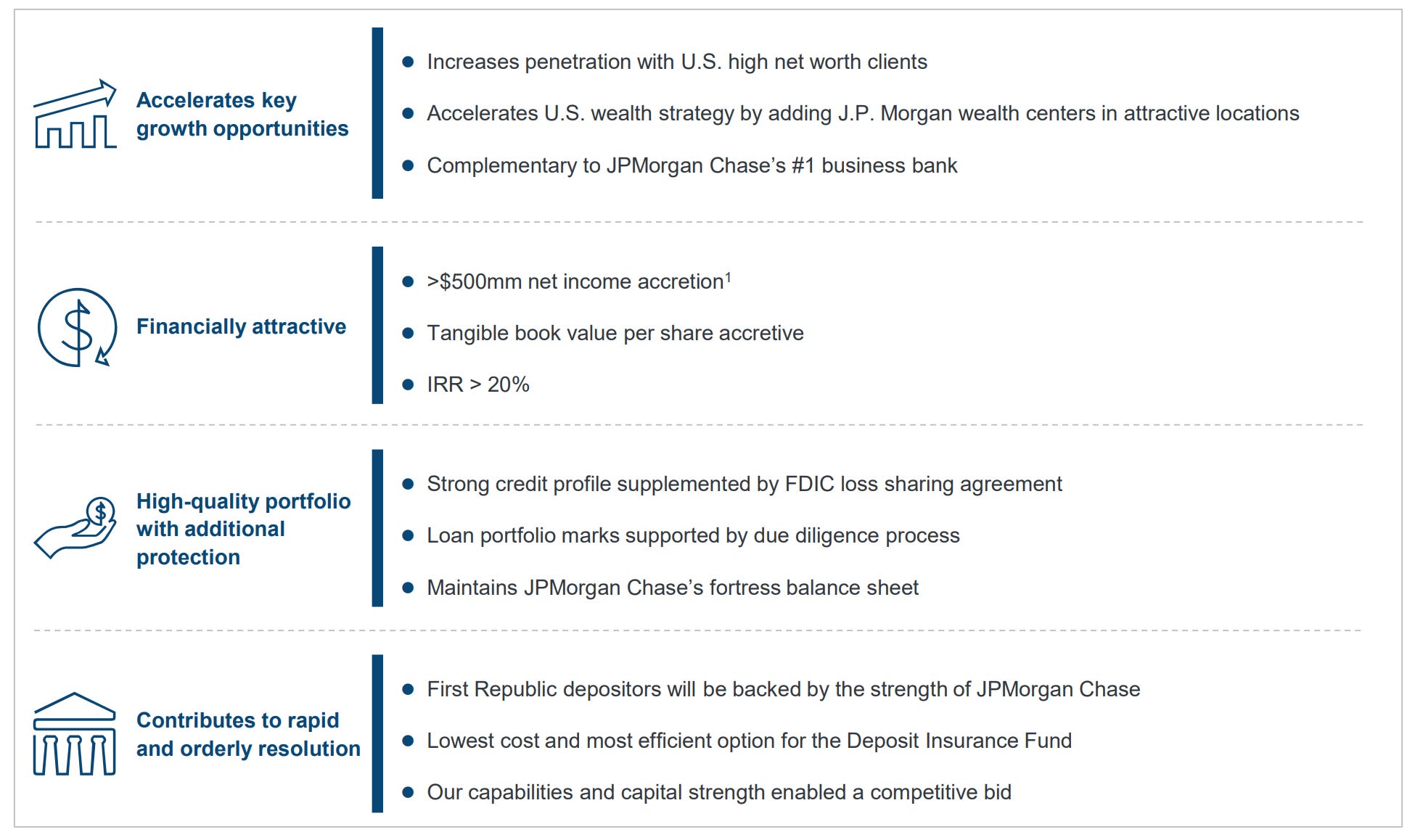
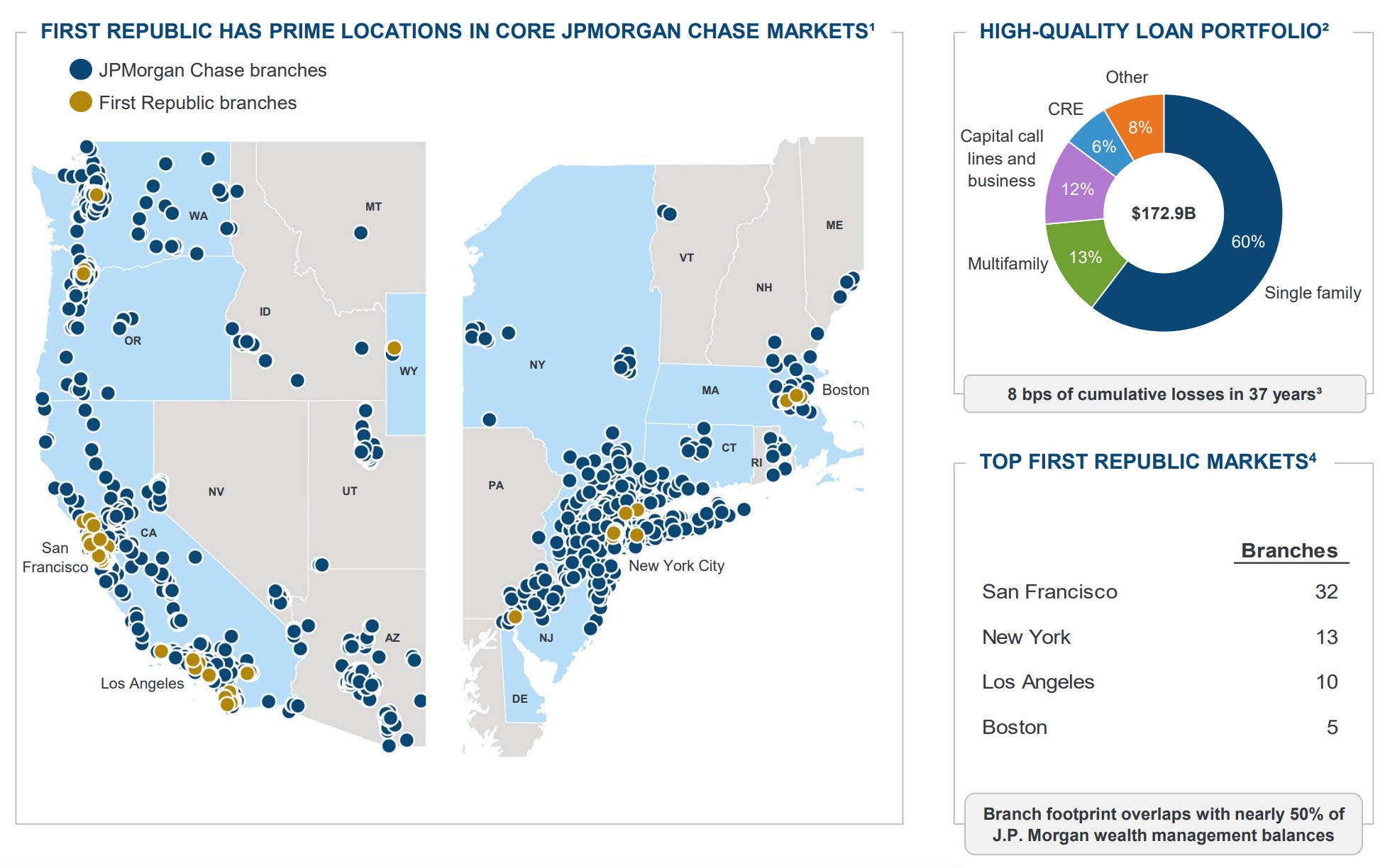
Dimon suggests the deal was JPM stepping up to answer the government's call to stabilise the economy. This may well be true, but it’s not as though their only incentive was that of a good Samaritan. Observing the post-closing balance sheet table in JPM’s presentation1 they are acquiring $18 billion in net equity for a payment of $10.6 billion to the FDIC. What's more, the acquisition is said to be instantly accretive to the bottom line ($500 million) and will grant JPM an immediate one-time $2.6 billion post-tax gain from the transaction (ex-restructuring).
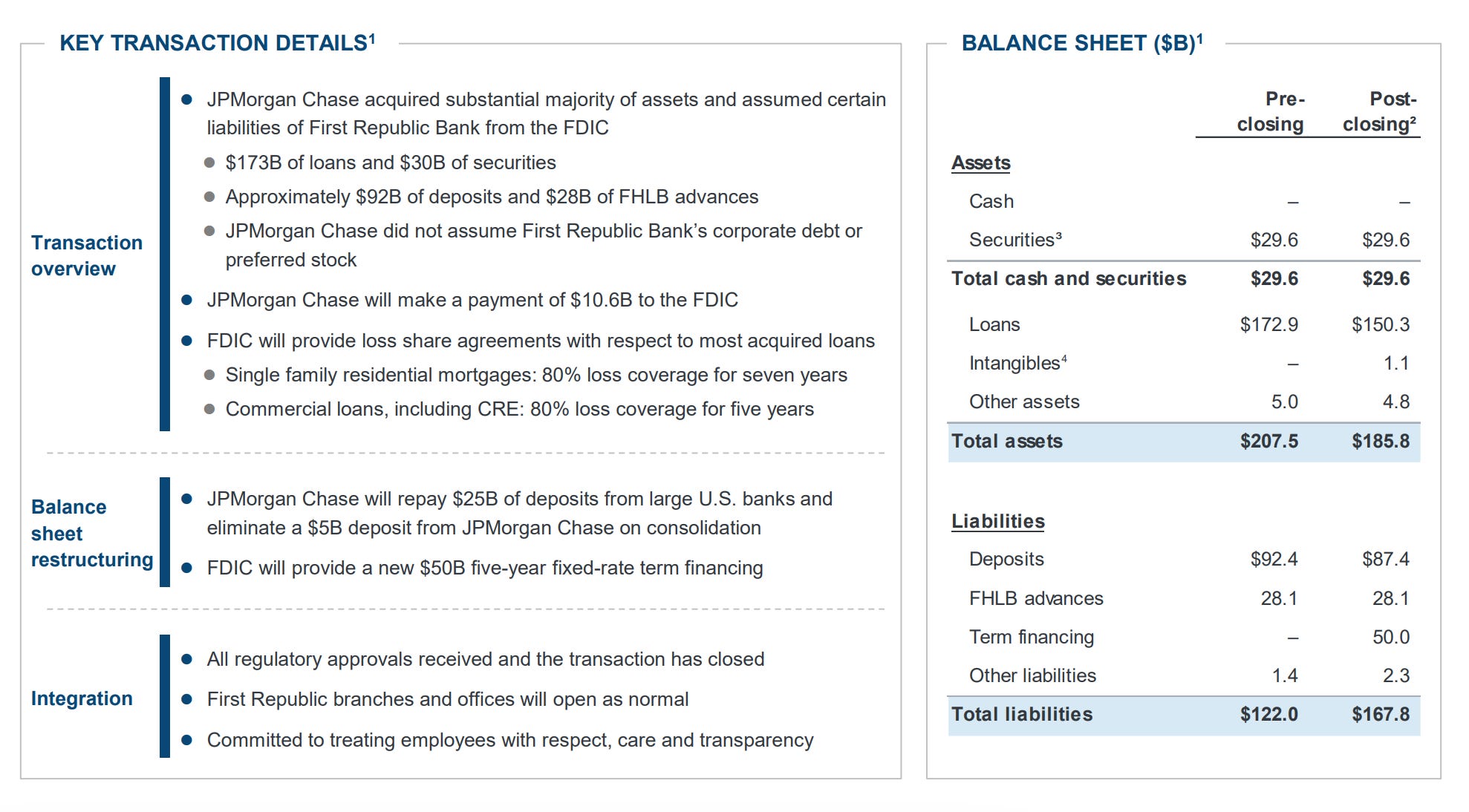
JPM will also be granted a $50 billion fixed-rate, five-year term financing to support the balance sheet, and the FDIC will provide loss share agreements covering acquired single-family residential mortgage loans and commercial loans. In short, the FDIC is covering the vast majority of the downside, while JPM is exposed to all of the upside. Once the dust settles, JPM’s penetration with high net-worth clients across the country will be bolstered and First Republic’s platforms, operations, and branches will all be rebranded over time2. Soon the world will forget about First Republic Bank and JPMorgan will have been the benefactor.
The Horizon
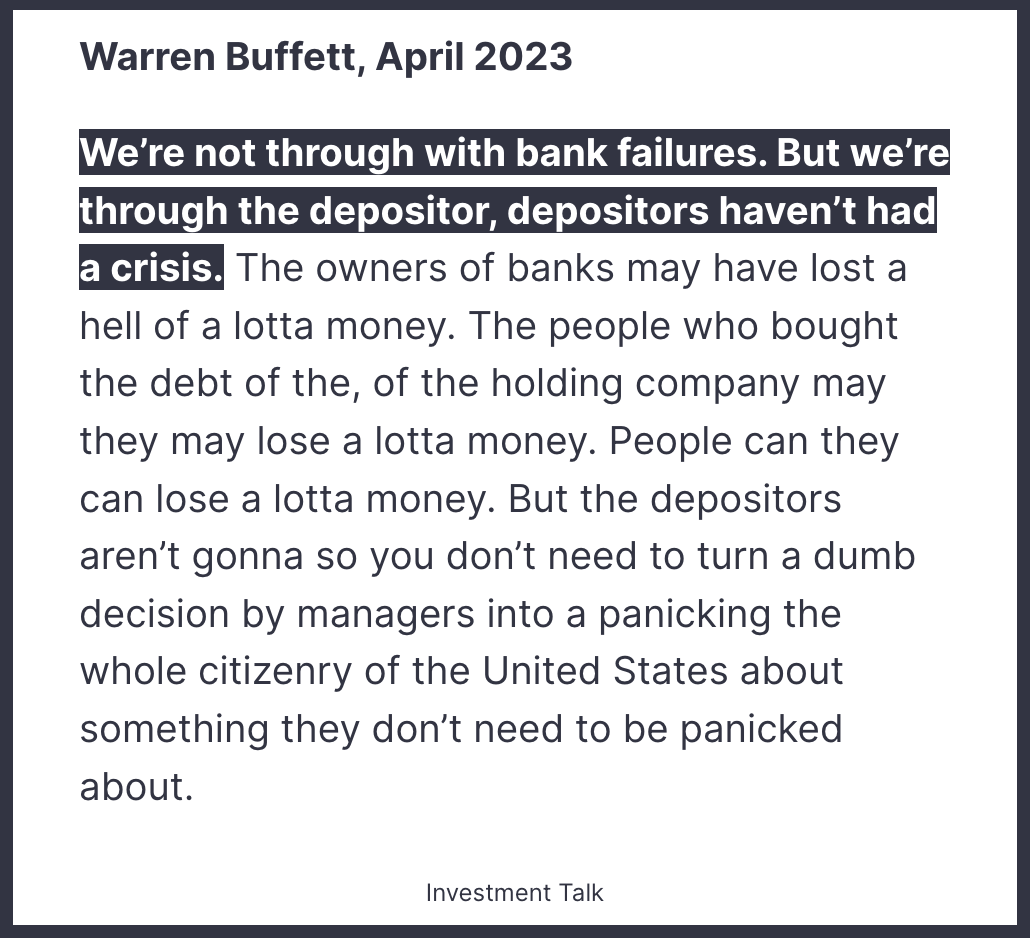
Only last month Warren Buffett implied banking failures are not over, despite being confident that America would be okay in the long term.
While the number of failures in 2023 (3) remains small compared to the GFC era, the asset values in this year’s calamities are significant. Between 2008 and 2010, 322 banks failed according to the FDIC. While there were sizeable individual failures, because of the litany of smaller-scale bank collapses the mean value of assets per failure was ~$2 billion. Even when adjusted for inflation, it’s minuscule when compared to the average $195 billion demonstrated in 2023.
Rewind back to the summer of 2022 and Dimon was talking about storm clouds. Remarking that “right now it’s kind of sunny, things are doing fine” but that a “hurricane is down the road coming our way”. Yesterday, his tune changed; claiming that “this part of the crisis is over”. He reaffirmed that rates going up, recessionary fears and the real estate market remain concerns, but that we should take a breath for now. CitiGroup’s CEO, Jane Fraser, expects that we see continued consolidation in the banking sector.
It's always a sad day when you see a bank fail but we are all very pleased to get the major source of uncertainty that was remaining from the recent bank turmoil addressed. And that is a good thing because fundamentally the US financial system is sound. This is a case of a small handful of banks that were poorly managed and getting this addressed is very important.
I am anticipating there will be some more consolidation - we do have over 4,500 banks and it's likely that the minimum efficient scale will rise.
CitiGroup CEO, Jane Fraser
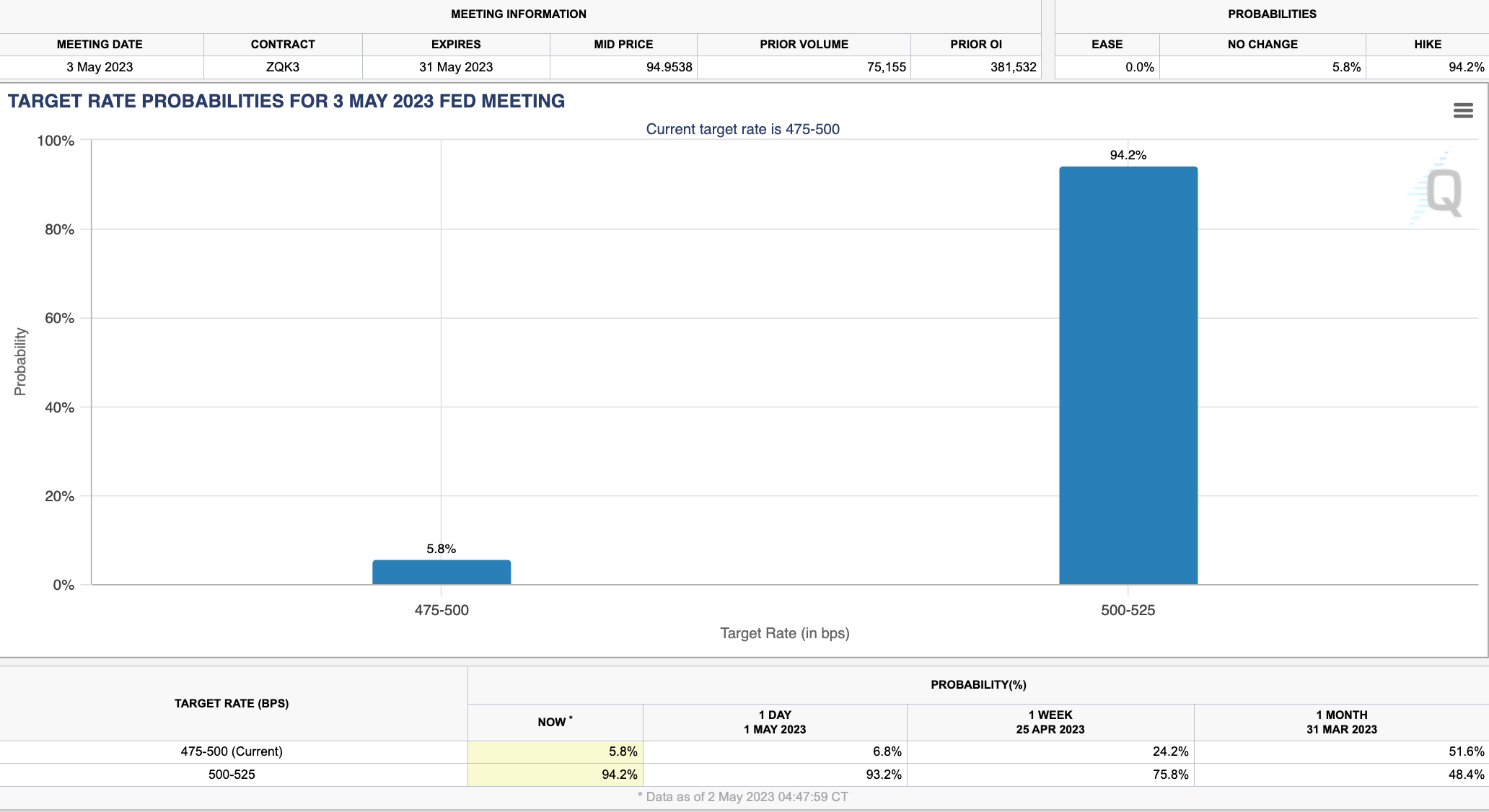
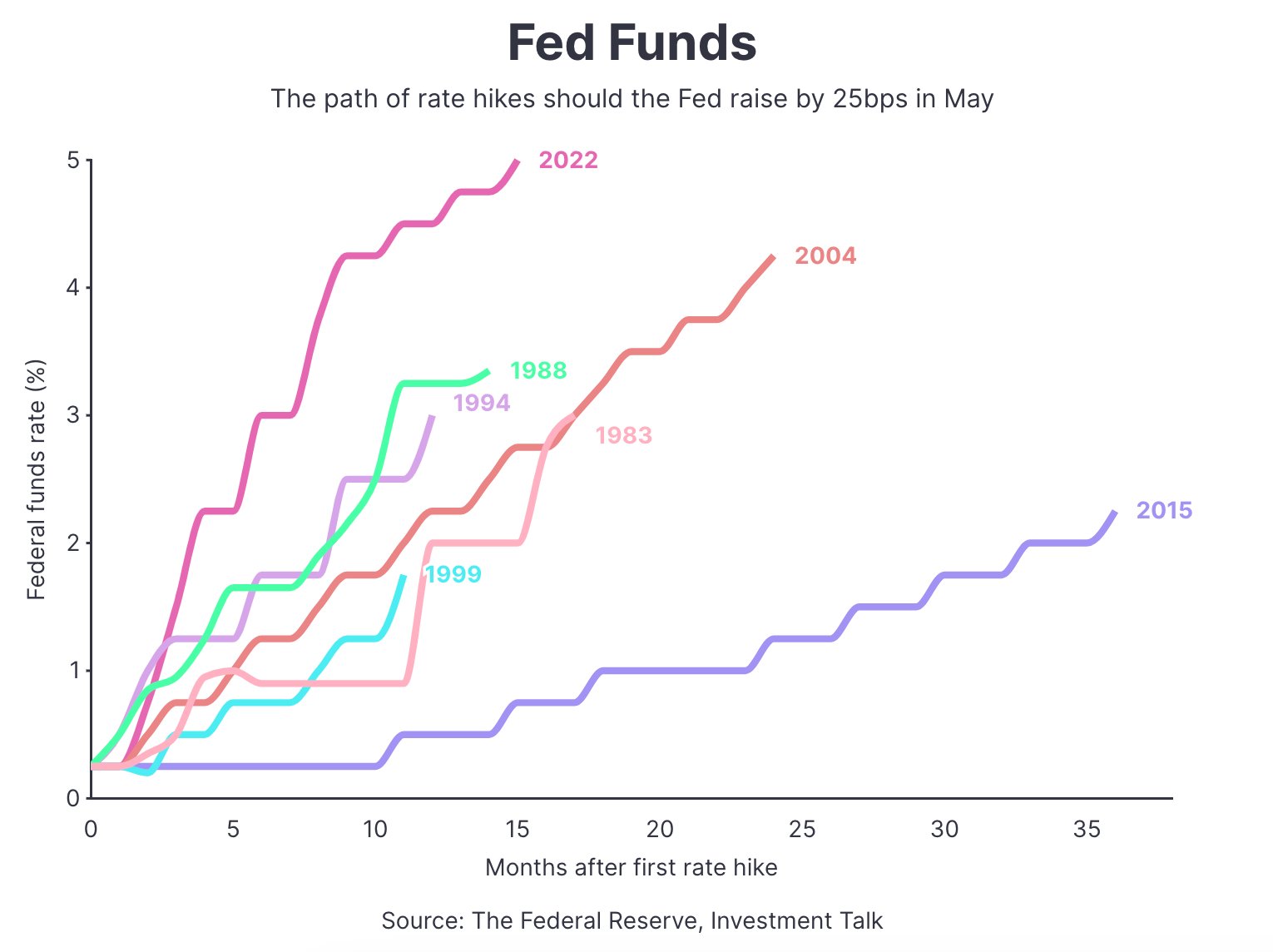
With the Federal Reserve’s interest rate decision set to be unveiled tomorrow, Wednesday 3rd, it will be interesting to see how Powell addresses First Republic in his remarks, as he has done with the two prior failures. From the last rate decision in March, where the Federal Reserve hiked by 25bps, the consensus has gradually migrated towards an expectation of a further 25bps tomorrow.
Until then.
Thanks for reading,
Conor
In addition to this, from the presentation:
• First Republic clients may bank as usual, and feel confident that their deposits are backed by the strength and security of JPMorgan Chase
• Committed to treating employees with respect, care and transparency, using employee redeployment efforts to minimize job losses
• First Republic’s platforms and operations will be converted to Chase and J.P. Morgan brands and technology over time:
• Certain First Republic branches will be converted into new J.P. Morgan wealth centers
• First Republic clients will gain access to our leading capabilities
• First Republic’s loan portfolios will be transitioned to JPMorgan Chase’s business segments and technology systems, primarily in CCB and CB
• First Republic’s private wealth management platform will become part of J.P. Morgan Advisors