

If you would like to reach this as a webpage, and not an email, click here
Many of you have likely heard about the concept of an investor’s ‘circle of competence’.
Many of you probably already know that this idea of an investor sticking to investment ideas within their circle of competence originates from Mr Warren Buffett.
In Berkshire’s 1996 Annual Letter, Warren stated the following:
“What an investor needs is the ability to correctly evaluate selected businesses.
Note that word “selected”.
You don’t have to be an expert on every company, or even many. You only have to be able to evaluate companies within your circle of competence. The size of that circle is not very important; knowing its boundaries, however, is vital.”
- Warren Buffett
Here, Buffett is suggesting that working within pockets of the market (whether that be specific industries (or themes) that you are most knowledgeable about or comfortable with, is more conducive to a successful investment process.
He concludes by suggesting that the relative scope of your ‘expertise’ is less of an importance.
Of most importance, is the investor’s ability to ‘know what they don’t know’, and focus on the areas that they have the most knowledge in, relative to their total knowledge base.
Buffett’s right-hand-man, Charlie Munger, puts it another way:
“You have to figure out what your own aptitudes are. If you play games where other people have the aptitudes and you don’t, you’re going to lose. And that’s as close to certain as any prediction that you can make. You have to figure out where you’ve got an edge. And you’ve got to play within your own circle of competence.”
- Charlie Munger
As an investor, and in life generally, you should never be afraid to say “I don’t know”.
The power of saying “I don’t know” will allow you to become more honest with yourself, and increase the velocity of your learning curve.
Masking your knowledge gaps typically acts as a roadblock to your ability to further understand that empty space.
But anyway, back to investing.
Buffett relates this idea of circles of competency to a book published by Ted Williams in 1970, titled ‘The Science of Hitting’.
In this book, Williams would explain how to become a better batsman in the sport of baseball. Amongst other things, Williams would suggest that one of the most important aspects of the game was the search for a good ball to strike.

The now-famous picture, which you can see above, was included in The Science of Hitting, whereby Williams categorised the batter’s ‘strike zone’ into a number of individual segments.
The idea here was that the batsman should only be swinging for the pitches that they can most reasonably knock out of the park.
Williams laid emphasis on avoiding the pitches which you would have greater difficulty in making a good connection. Should the batsman attempt to hit a ball in the lower corners of the strike zone, they may only get a clean hit 23% to 25% of the time.
Should they attempt to hit the ball on the upper corners of the strike zone, they may get a clean hit 30% to 31% of the time.
But, if the batsman waits for the opportune moment, and attempts to strike the ball at the optimal moment (the centre of the strike zone) then the likelihood of a clean strike increases to 40%.
Thus, it’s simply a matter of waiting for the right pitch and playing the odds over the long-term of a batter’s career.
“The trick in investing is just to sit there and watch pitch after pitch go by and wait for the one right in your sweet spot. And if people are yelling, 'Swing, you bum!' ignore them.” -Warren Buffett

Seems fairly simple, right?
Stick to what you know, try to remain honest about your knowledge gaps, and avoid areas that you are not yet fully competent in.
Many of us, through our lives as consumers, likely have a good idea of how some businesses operate.
Take Starbucks for example
I am sure many of us have at least visited a Starbucks store before.
Understanding how the business operates is fairly intuitive.
Without knowing much about the filings of the company, we could guess that they generate revenues from the sale of beverages and food, as well as other trinkets in their store.
We could assume that their primary costs are therefore related to that inventory, labour, store growth, and a batch of other typical corporate expenses (G&A, marketing, and so on).
We may also reason that their ability to improve revenues and earnings stems from their ability to continue to expand their store count, and maintain a positive brand influence via the experience they deliver to customers.
These are all very rudimentary assumptions.
Should we then continue our investigation, and read some SEC filings for this company, we would later discover more insight into their company-owned and licensed store model.
It would be fairly easy to discover that under the licensed model, Starbucks receives a margin on branded products and supplies sold to the licensed store operator along with a royalty on retail sales. As such, these units come with lower gross margins, but considerably lower operating expenses on account of the licenced store owner taking care of them.
Not too difficult to understand for a novice investor.
However, what if we were to ask the same person about how businesses within the cloud computing, payments, or cybersecurity space operate?
Without having worked in those industries, or undertaking considerable research, it would not be as intuitive to an investor how those companies operate, collect revenues, or allocate their capital.
Thus, to a lay investor, these firms may be outside of their inner circle of competence.
Here’s where things get a little bit sticky.
The idea of the circle of competence is often misunderstood, perhaps with people latching on, too closely, to when Buffett states things like:
“Everybody's got a different circle of competence. The important thing is not how big the circle is. The important thing is staying inside the circle.”
- Warren Buffett
Simply put, Buffett is saying it doesn’t matter how big your area of expertise is, the importance is understanding that you are better suited to remain within it.
This is typically misinterpreted as suggesting that investors should avoid the areas they know little about, and instead focus only on the areas they feel they understand best.
Now, I don’t think that’s what Buffett actually means when he states things like that.
This is often backed up by Peter Lynch’s claims that investors should “invest in what you know”.
This is also typically misinterpreted.
The way both of these claims are misunderstood is that investors will take both at face value and avoid activities that would expand their circle.
The Trichotomy of Competence Circles
Over time, you should be aiming to expand that “circle of competence”, as well as expanding the field of companies which "you know”.
Ian Cassel puts it this way:
“I view it as two circles, one within the other.
Big Circle - Learning Circle - Circle of competence of learning should always be expanding.
Smaller Circle - Investing Circle - Smaller than the learning circle. You don't have to invest in everything you are learning.”
- Ian Cassel, MicroCapClub & Intelligent Fanatics Capital Management
In this instance, we can think of a small circle in which the investor has relative comfort in their understanding and a much larger circle outside of that which represents the potential for new “investing circle” space.
Once an area of the learning circle is understood sufficiently, it becomes part of the investing circle, thus expands the latter, and reduces the former.
The folks over at Ensemble Capital, in response to my original tweet, strengthened this idea by suggesting:
“The key is to your define circle of competence not by what you already know, but by what you have the competency to learn.”
- Ensemble Capital
I decided to take Ian and Ensemble’s comments and augment them slightly, adding a third outer circle to the picture.
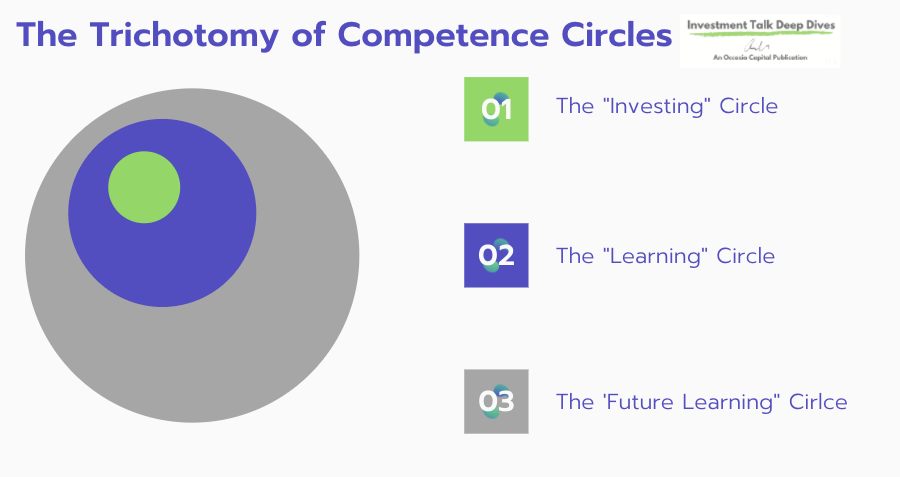
I tend to think about the idea of competency circles as a mental model which contains three circles.
The Investing Circle
The investing circle is simply the areas of the market that an investor feels most comfortable with, as an investor or a consumer.
I would expect the markets or industries within this space to be areas that an investor has studied at length, allowing for an understanding of the market structure, competitors, competitive forces, regulatory matters, relative pricing powers, barriers to entry, and so forth.
It’s an area of your relative expertise.
Imagine that cybersecurity is an area in this wheelhouse, and a new market entrant goes public.
It would be reasonable to assume that you already understand, after studying the entrant, how they might fit into the market. You likely already have studied the competitors in the space, and understand who the market leaders are, and what potential opportunities a new entrant may capitalise upon.
If something is within your investing circle, I would think the time taken to decide whether or not you wish to purchase a position is considerably shorter.
The Learning Circle
The learning circle is mostly an extension of the investing circle but is surrounded by pockets of the market that you are yet to fully understand to such a level that you would say you have some relative expertise.
The learning circle is typically populated with areas of the market that you are most equipped to be able to understand in the near term.
This is where the biggest opportunity to expand your investing circle lies.
Say that Starbucks is within our investing circle. We have followed it for years, we understand the competition, and the marketplace well.
Now imagine we wish to study a Sushi franchise, something like Kura Sushi USA.
In this instance, we may have a solid understanding of other food & beverage franchise models (think Dominos, Starbucks, McDonald’s), but what we lack is a relative understanding of the sushi industry.
So, whilst we do have a strong understanding of these types of companies operate, and the competitive pressures, there are still some knowledge gaps which we are left to fill.
In this case, if we already have a substantial level of insight into the type of business that a sushi franchise is, then it would be far easier to make the jump from a coffee franchise to a sushi franchise than it would be to go from something like Starbucks to a global Oil & Gas business.
I like to think of the learning circle as areas that are “within reach” based on our current knowledge base.
The Future Learning Circle
We could alternatively call the future learning circle the “I have no idea about this” circle, but I wanted to put a more positive spin on it.
This space, which is by far the largest and always will be, represents the fields of research, or industries, that are entirely outside of the investor’s wheelhouse.
However, these also stand as areas that can, in future, be pulled into the learning circle.
Expanding The Circles
So, back to the points, I was discussing earlier.
The common interpretation of the Buffett and Lynch philosophy is that we should remain within our investing circle.
People typically take their words to suggest as such and stick with it.
I find that to be a poor translation, however, and I am sure both Buffett and Lynch would agree.
I agree that we should, ideally, be sticking to our investing circle, but we should also be looking to continually expand that circle as time goes on.
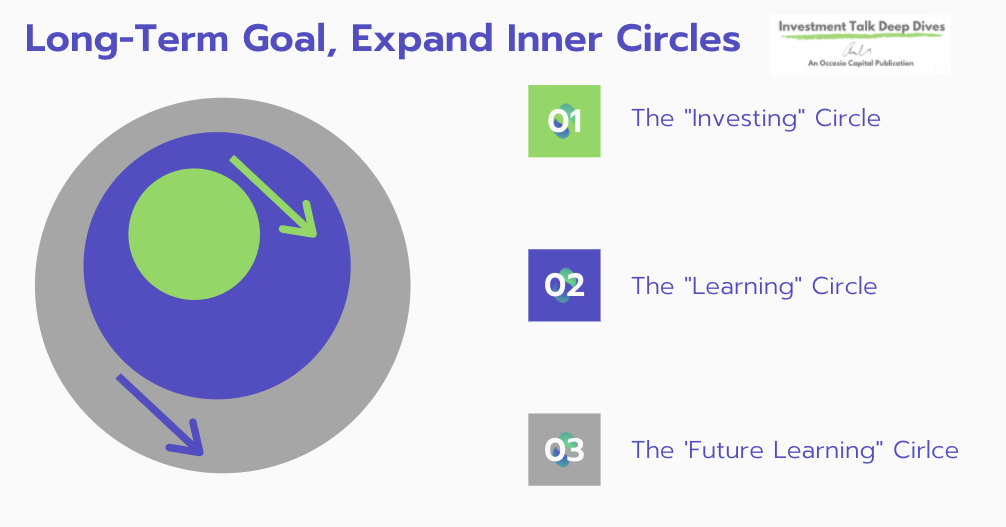
To do otherwise would be limiting ourselves and cap our ability to reach a larger basket of potential opportunities.
Sticking within your circle won’t let you grow your potential investing universe.
Now, clearly, there is some weight towards the argument of being a generalist, or a specialist. As one continues to learn about more spaces, they are then spreading their time across a larger surface area of industries, and possibly diminishing their ‘speciality’ over time.
That’s really up to the individual and how they view that.
For me, as a retail investor looking to accumulate long-term wealth through the vehicle that is my PA, I want to understand a greater portion of the market.
The simple way for an investor to expand their inner circles of competence is through the study of new businesses they are not familiar with.
Analysing a new business, in detail, each month, will create a compounding effect whereby you expand your learning circle each year, eventually enabling you to expand your investing circle.
All whilst reducing the size of your future learning circle. Although, I must state this will always be huge. If you are intellectually honest with yourself, you should understand that even after a lifetime of study, there will still be a huge world of things you know nothing about. Especially considering the rate of change in the financial markets.
One way that I expand my own investing circle is through the practice of studying one new company, in-depth, each month.
After one full year, I will have explored the entirety of 12 new companies. After ten years, that will be 120 new companies, at a minimum.
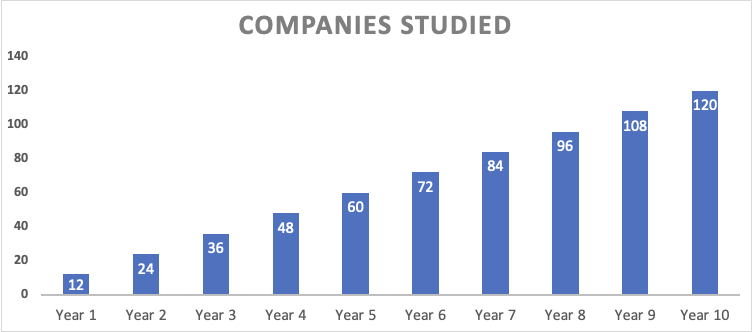
A few things to consider here:
As you begin to study more companies, there will eventually be spillover effects, whereby your studies in previous months/years enable you better understand future research projects.
As you progress, you will eventually create a mental ‘database’ of ~50 to ~100 companies that you know really well. It is not enough to simply know your own portfolio well. It is a huge advantage if you understand a larger range of businesses to the extent that you can revisit a business quarters or years later, and already have a rough idea of where you are. This may incur a small ‘catch-up’ period if you haven’t visited the company in a while, but the base layer of understanding is already there.
It is worth noting that the average lifespan of a public company (in this case, the S&P 500) has fallen from ~60 years to ~20 years in today’s climate.
As such, it is more than likely that a small handful of the companies you study may no longer be around after that 10 year period.
Fear not, for after having studied those companies, it is more likely that you:
A) Understand why they failed and;
B) Have a better understanding of the respective market they failed within
In short, the time spent does not get wasted.
This is a super powerful way to take advantage of the compounding effect of knowledge.
It also relates nicely to developing a routine for consistent exploration of new ideas and will assist in your investment journey.
Conviction is born from understanding what you own. That’s hard when you don’t understand the dynamics of a particular sector.
Recognising if something is within your investing circle, or your learning circle will allow you to understand whether or not you will have the conviction to hold something if it falls 30%.
At the minimum, within the investing circle, you will have the best understanding of the risk you are underwriting.
This is something I use often in my weighting decisions.
For me, the largest positions in my portfolio typically don’t amount to those which I see the most upside in but, rather, those which I feel the most comfortable in regarding the downside.
It’s mostly a search for a risk/return that I feel is best suited to me and my goals.
When buying Facebook at $750 billion, I did not think it would 5X over the following 3Y-5Y, as I might with some of my other positions.
I did, however, feel comfortable with the downside, knowing that if it were to fall to $500 billion I would be likey to buy more.
On the reverse, I felt like it has a strong chance to be able to at least 2X to 3X over the next 3Y-5Y, which in my book is still a great return.
In this way, I feel my relative conviction is stronger.
Something to consider when weighing your portfolio.
Today, I will leave you all with this quote from Phillip Fisher.
“Buying a company without having sufficient knowledge of it may be even more dangerous than having inadequate diversification”
- Phillip Fisher
New to the newsletter? Sign up here.
Want to learn more? Browse the about page.
If you have any ideas related to the information you’d like to see each week, or perhaps where you feel it could improve, please reply to this email, or drop me a DM on Twitter @investmenttalkk.

Conor,
Lead Analyst at Occasio Capital Ltd
You can also reach out to us here:
Twitter: @Investmenttalkk & @TheITNewsletter
Commonstock: Investment Talk
Facebook: @TheInvestmentTalkNewsletter
Pinterest: @InvestmentTalkkk
Email: Investmenttalkk@gmail.com
This might be one of my favorite, yet!