

Hey, you are reading Investment Talk. If you enjoy today’s article, feel free to share it, or become a supporter and receive additional essays. Now let’s begin.
Top Heavy
You might have heard the news that Nasdaq Inc announced1 a “special rebalance” for the Nasdaq 100; an index which tracks the largest technology stocks across a range of America’s sectors. This reshuffle seeks to “address overconcentration in the index by redistributing the weights”; specifically the weightings of the Big 7 (Google, Microsoft, Apple, Nvidia, Amazon, Tesla, and Meta) who, together, account for ~54% of the index. The rebalance will be based on the shares outstanding as of July 3rd, and changes are expected to be announced on July 14th; taking effect by July 24th2.
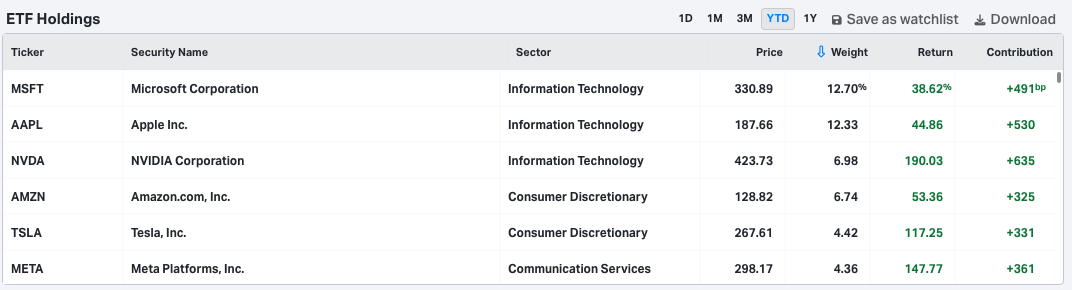
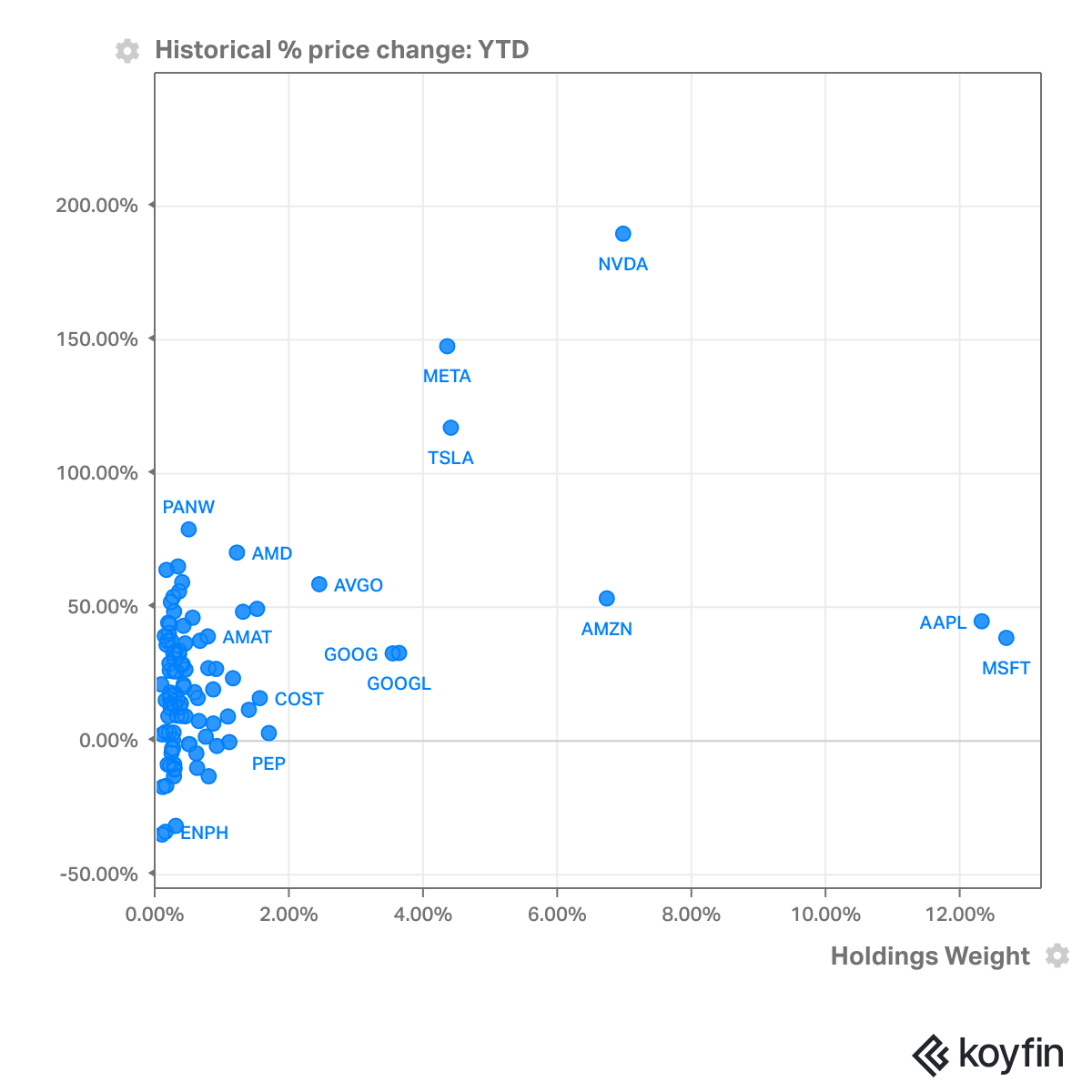
There has been a lot of talk about the dominance of the Big 7 this year. I am sure you have all seen various charts illustrating the contribution of these 7 companies relative to the rest of the S&P 500 or Nasdaq 100.
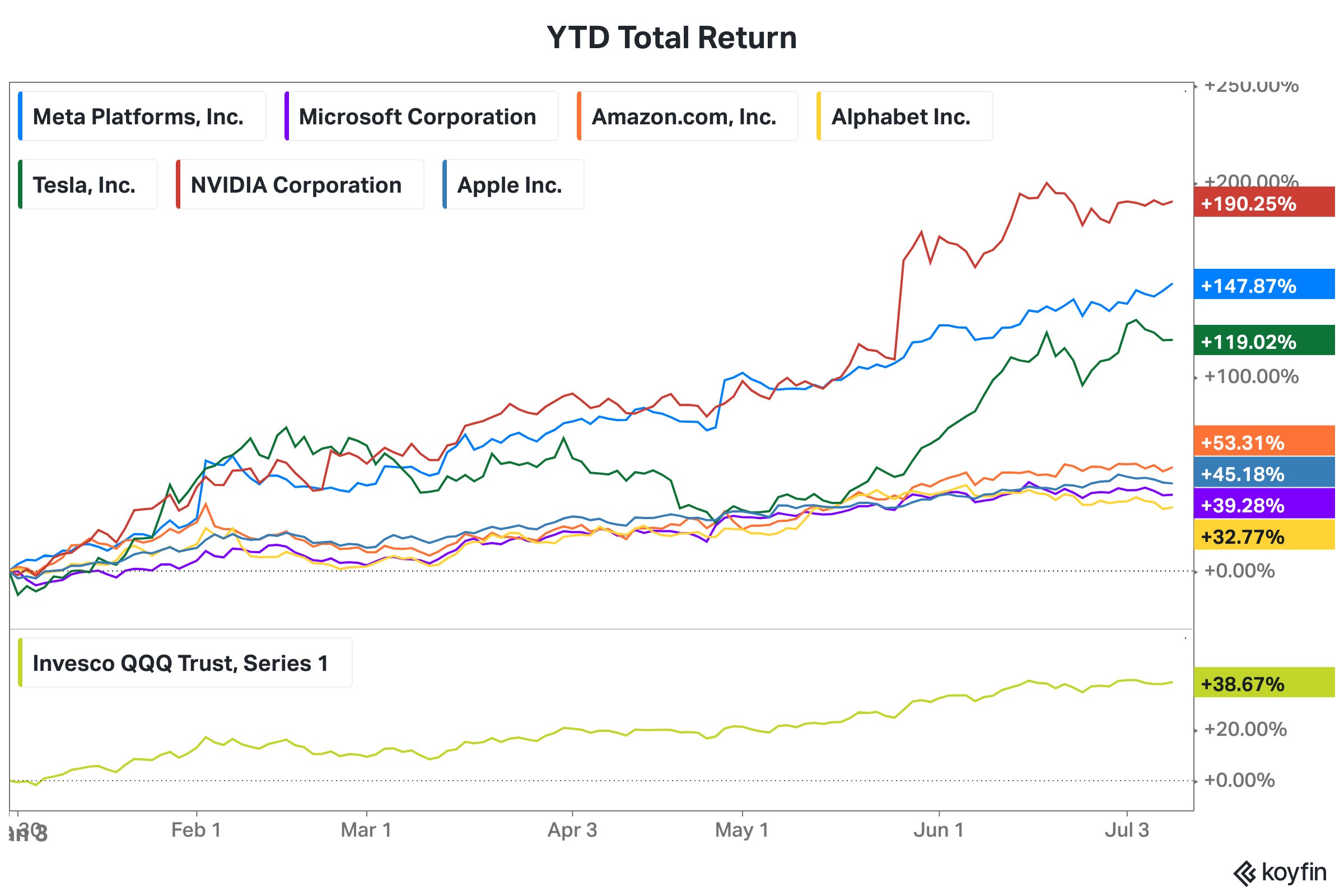
As of Monday close, 11th July, 2023:

• Nasdaq 100 is +38.67% YTD
- The big 7 account for 29.39% of those returns
- Ex-Big 7, the index is +9.28% YTD

• S&P 500 is +16.57% YTD
- The big 7 account for 11.90% of those returns
- Ex-Big 7, the index is +4.67% YTD
The Nasdaq’s rebalancing methodology stipulates a special rebalance may be conducted at any time based on the weighting restrictions stipulated below3:
If a single security is greater than 20% weighting or;
If the aggregate weight of all securities with weights exceeding 4.5% exceeds 48%.
The rebalance should reduce the weighting of the big 7 to below 40% of the index. Typically, no component outside of that top 5 is allowed to exceed 4.4% weighting. Meta, the smallest weighting in the Nasdaq (4.36%), will therefore not be directly impacted by the rebalance. Peter Garnry, head of equity strategy at Saxo Bank, believes the reshuffle should theoretically have minimal impact:
“As with stock splits and dividends, these events do not change the underlying equity valuation of the securities and thus new stories yesterday suggesting the top five technology stocks in the Nasdaq-100 Index were down due to the announcement is a bit silly. Given the underlying value has not changed any front-selling of shares in advance of the special rebalance should theoretically be met by bids as the underlying value has not changed. Despite this obvious fact one could still make the case that forced selling by passive ETFs tracking the Nasdaq-100 Index could move the market”.
While it may hold no theoretical grounds for a significant impact, I’ve seen enough odd behaviour following stock splits (which also, theoretically, should have no impact) to know that anything can happen. If you are fortunate enough to be a young sprout, you may not have experienced something like this before. It might feel pretty novel. I am here to tell you that you are not special. This has happened numerous times before; in 2011 and 1998.
Back in 1985, the same year that Coca-Cola created the infamous “New Coke”, the Nasdaq 100 was born. It was also about ten years after a little software start-up called Microsoft was founded. By 1998, that little start-up had become so large, that it dominated more than 25% of the Nasdaq 100 weighting. This violated Nasdaq’s, then, policy of not permitting any individual security to exceed 24% in weighting. In order to reduce the impact of Microsoft’s presence, Nasdaq conducted its first special rebalance.
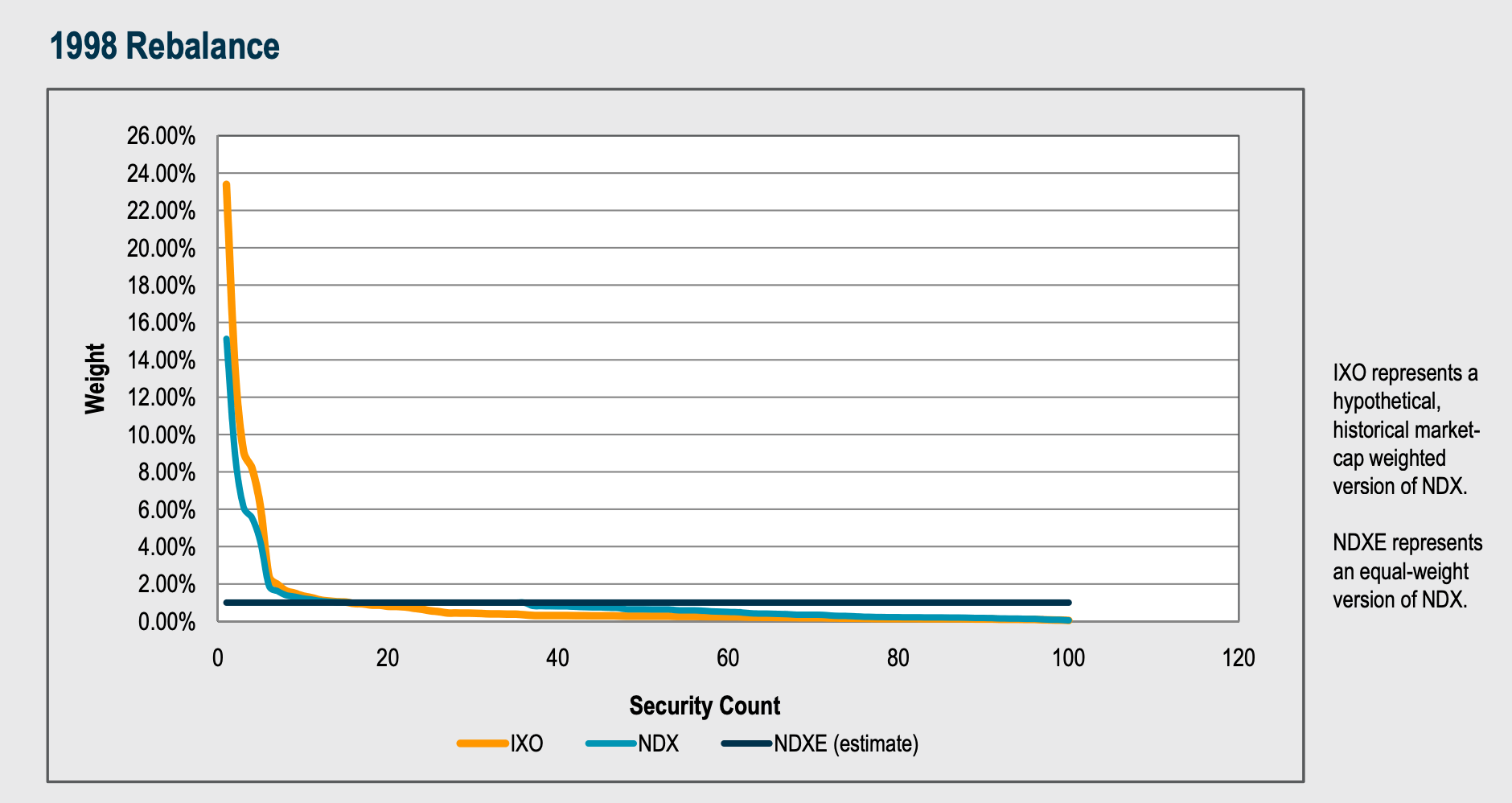
There were other factors at play in 1998 too. Prior to the adjustment, the Nasaq 100, then commonly referred to as NDX, would have failed to meet the diversification standards set by the IRS Regulated Investment Company (RIC). Adherence to the RIC rules allowed the index to “become the premier representation of US large-cap growth stocks for investors around the world” and become the basis of thousands of products or their underlying billions of assets.
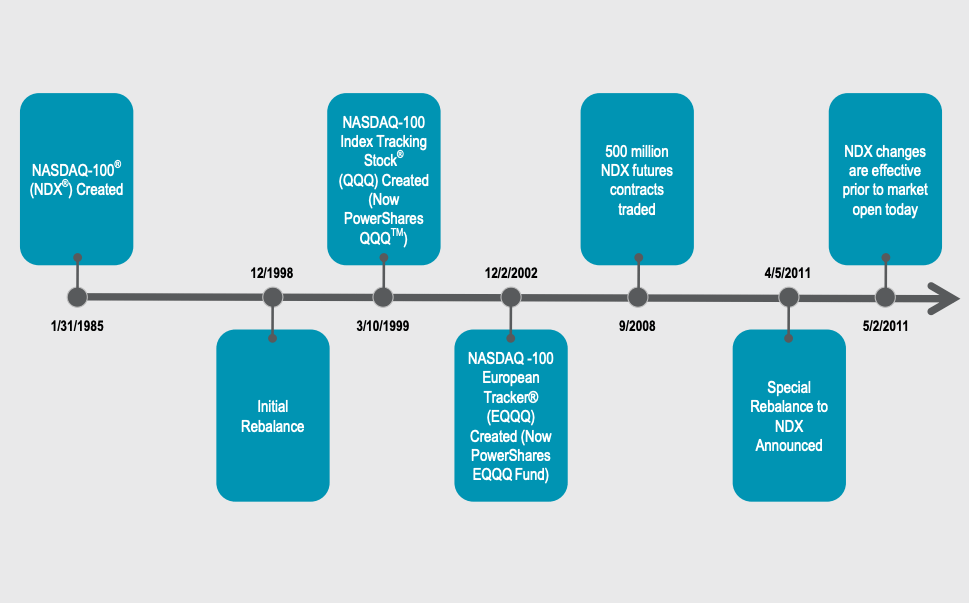
The following year, the Nasdaq 100 tracking ETF (QQQ) was created. The year after that, the European equivalent (EQQQ) was born. Looking back on the security’s 20th anniversary in 20194 Dan Draper, then Managing Director of Invesco ETFs, recounted:
“When QQQ was launched in 1999, most investors were just learning about index-tracking investment products, and the transparency offered by an ETF was novel. It is interesting to look back 20 years later at how relevant and well-regarded the Invesco QQQ remains, even as much of the ETF landscape has changed”.
One enormous tech bubble and a global financial crisis later, the Nasdaq would undergo a special rebalance once again, in 20115. This time, to bring the weights of the Index Securities closer in line with their actual market capitalisations.
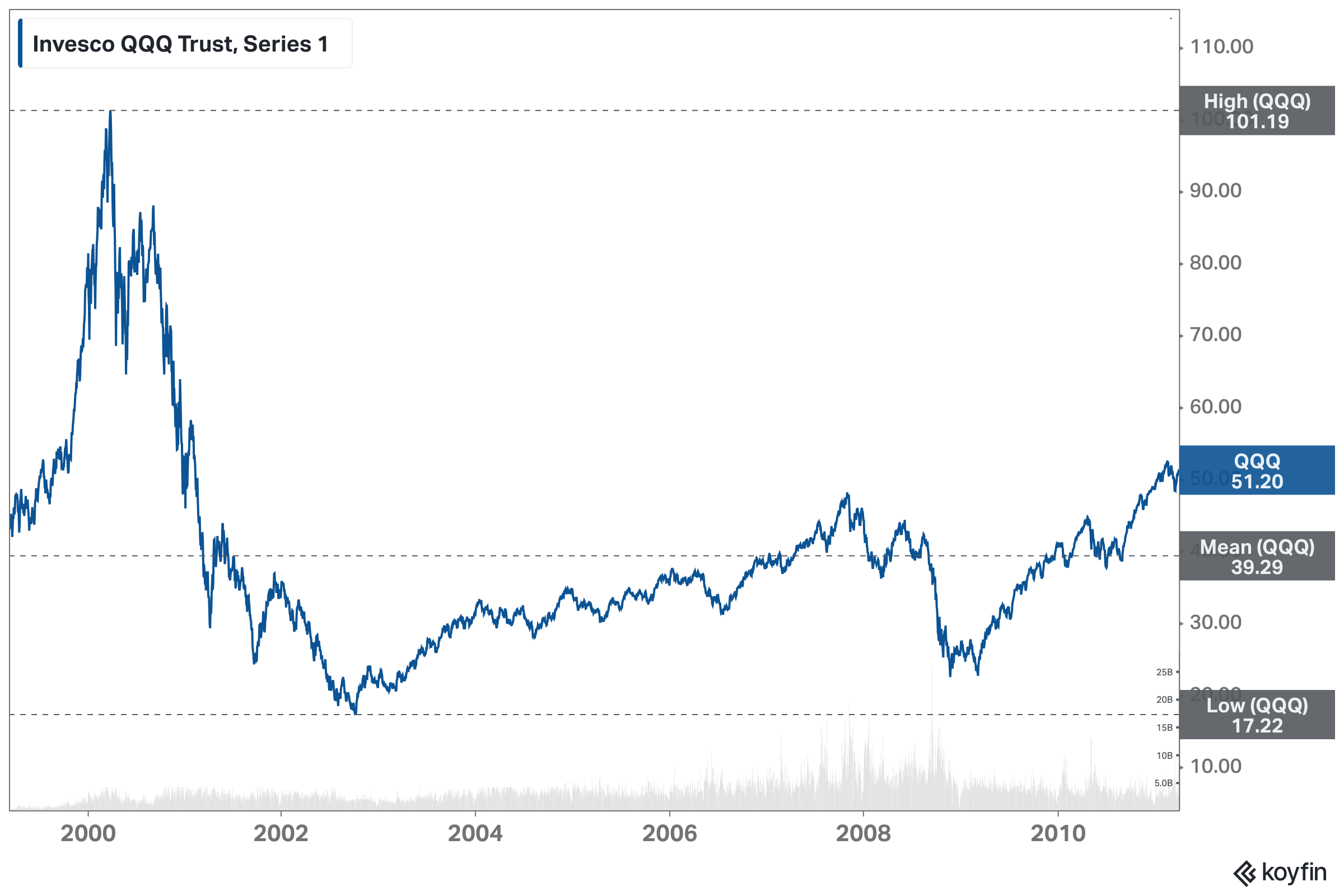
It was deemed that through routine market performance, the adjustment factors chosen in 1998 in order to reduce the weights of the top index securities, created a scenario where index weights no longer aligned with actual market capitalisation weights. Back when the first rebalance was made in 1998, the index securities remained in the same relative order when compared to their respective actual market capitalisation. In other words, the 1st stock by weight unadjusted, was also the 1st stock when adjusted. By 2011, that was no longer true; as shown by the light blue line in the below chart.
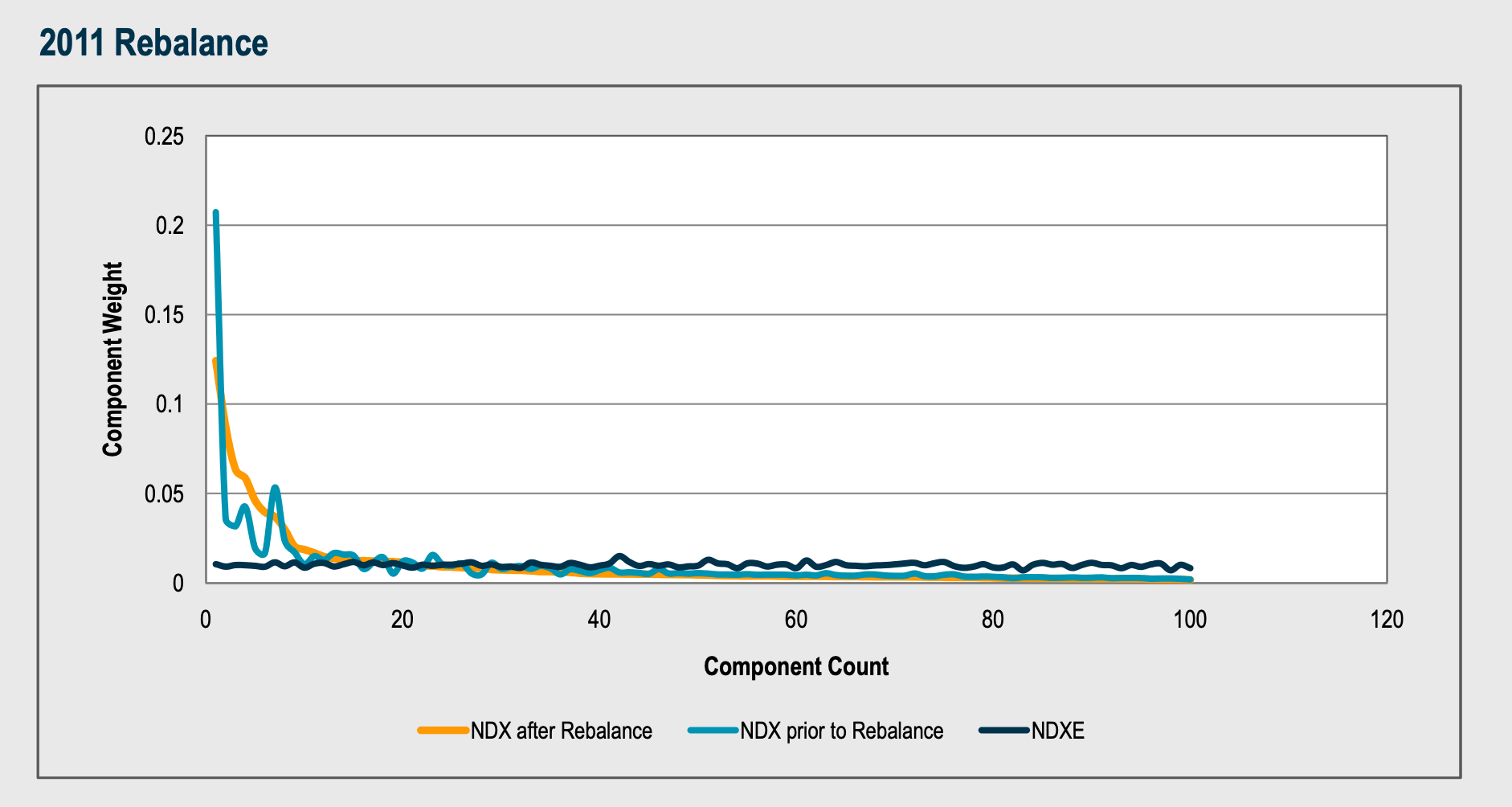
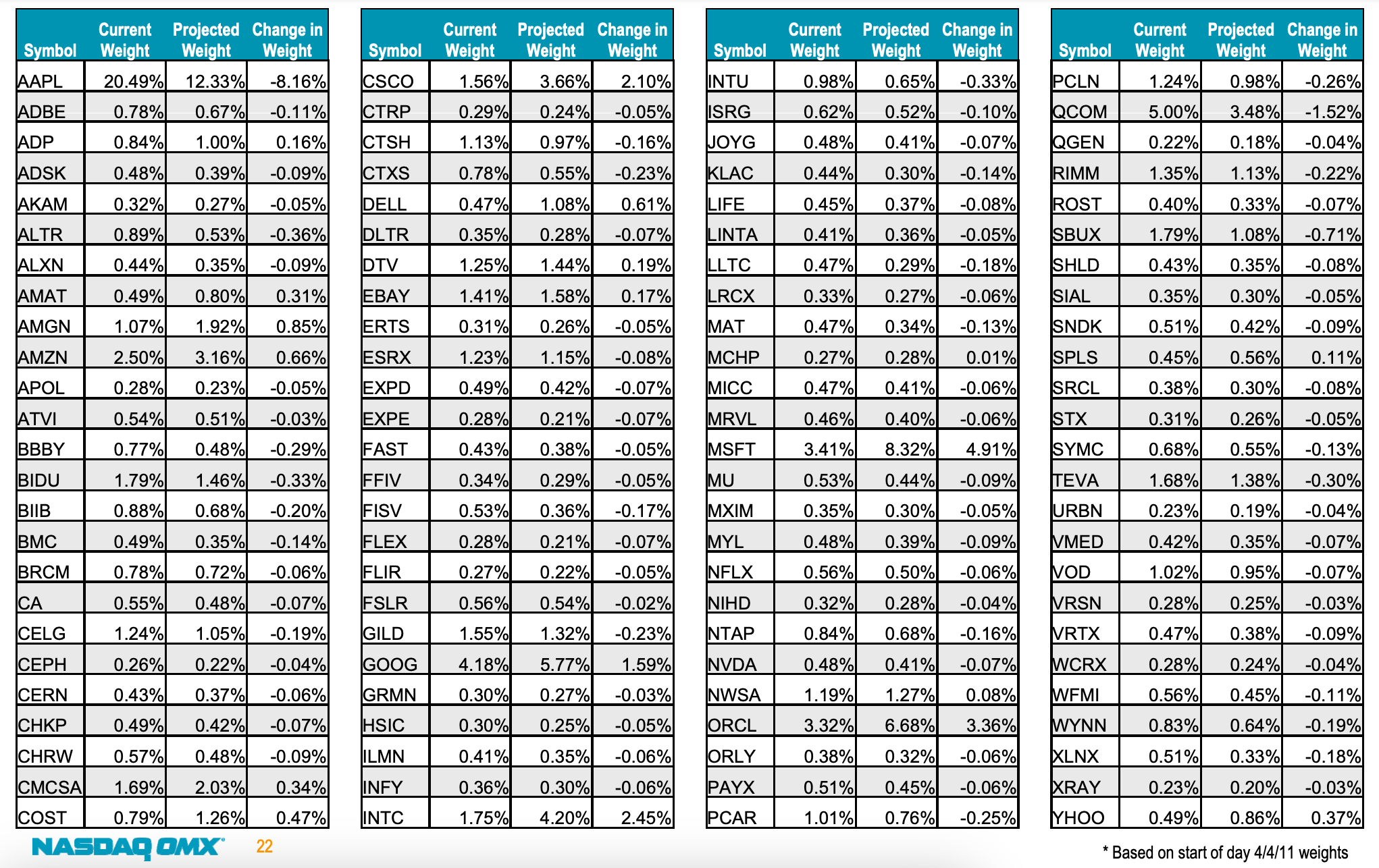
As a result of the change, 82 securities experienced a slight reduction in weighting within the index; averaging ~0.376% on an absolute basis. Just for fun, let’s take a look at the constituents of the Nasdaq 100 back then. The table below shows the weighting before and after (projected) the rebalance. The largest security at the time was Apple, then valued at ~$315 billion, dominating 20.5% of the index. Other notable names include Google at 4.2% and a market cap of ~$190 billion, Intuit at 1% and a market cap of $16 billion, and poor old Yahoo.
This all goes to say that this is not uncommon. Indexes are shuffled around all the time; sometimes those shuffles are deemed to be “special” because they fall outside of the typical rebalancing cycle. I dare say if you search “Nasdaq rebalance” in Google, you will find a lot of headlines alluding to which stocks are set to benefit or be punished by the rebalance. I have already seen some alluding to the price action of the Big 7; which since the announcement has ranged from a drawdown of 2.6% to +2.16%. Below you can find some perspective on the insignificance of that.
Perhaps there will be headlines along the lines of “what does this mean for you?!”. In reality, to the regular individual investor, it means quite little. That’s not to say nothing will happen later this month. The stock market can be odd at times, but at best this ought to serve as a distraction to a long-term perspective. Instead of adding to that distraction, I wanted to lather in some historical context to the conversation in the hope that you leave this essay a touch more informed. Perhaps it can serve as an entertaining dinner party story. If so, I feel sorry for your poor guests, in advance.
Thanks for reading,
Conor
There are various alternatives to these stipulations, dependent on whether or not the rebalance coincides with the reconstitution. To keep things simple, I stuck to the terms which apply here.
Thanks for the insight! Appreciated
Timely piece! I was wondering what was going on with the Nasdaq. So, does rebalancing mean that these index are shedding some shares off their books to reduce some stocks’ overweight? How does that work if these index merely tracks stocks? Or am I missing something? Haha