

If you wish to read this as a webpage, and not an email, then follow this link.
Many say that the hardest decision in investing is deciding when to sell.
On the face of it, one might assume that each of the three core components to an investment decision are equally difficult.
When faced with a buying decision, an investor has tens of thousands of options to choose from when searching for a potential new position for their portfolio.
Should they narrow this down to various buckets (low multiple, high growth, sectors, trends, themes, and so on) then it is quite likely that those tens of thousands become thousands, or perhaps hundreds.
An investor who has some idea of what they are looking for will typically be able to widdle down their full, undisturbed, spectrum of choice relatively quickly.
The reality of investing is, that buying, holding, and selling, are all hard.
Each has its own process, specific to the investor, and each conjures up a great deal of consideration.
For the purpose of this piece, where I evaluate the rationale for selling, the title was appropriate. So, don’t take me so literally.
I think, before I continue, it’s important to stipulate that this body of work more so relates to the mindset of an investor who engages in the medium to long term holding of a company. I don’t use stop losses, and I don’t care all too much about price action during a holding period.
The differences in posing the question of ‘when to sell’ to someone like that and to someone who is perhaps more technically orientated (lets price action and volume lead their trading) are quite different.
I will be making no effort to distinguish when an investor might be better suited to selling a stock if they are technically inclined. Quite simply, because I have no insight into that way of doing things.
With selling, there are some unique considerations. The incurrence of potential capital gains taxes, the opportunity cost, the potential sin of market timing, commissions, and the abstraction from Munger’s mantra of never interrupting compounding unnecessarily.
I could cherry-pick a number of examples here, but I feel that’s been done enough already in other bodies of work.
Peter Lynch states that:
“Selling your winners and holding your losers is like cutting the flowers and watering the weeds”
We can think of a ‘winner’ as a stock that is going upwards and to the right, whilst a ‘loser’ is something that trades sideways or downwards to the right.
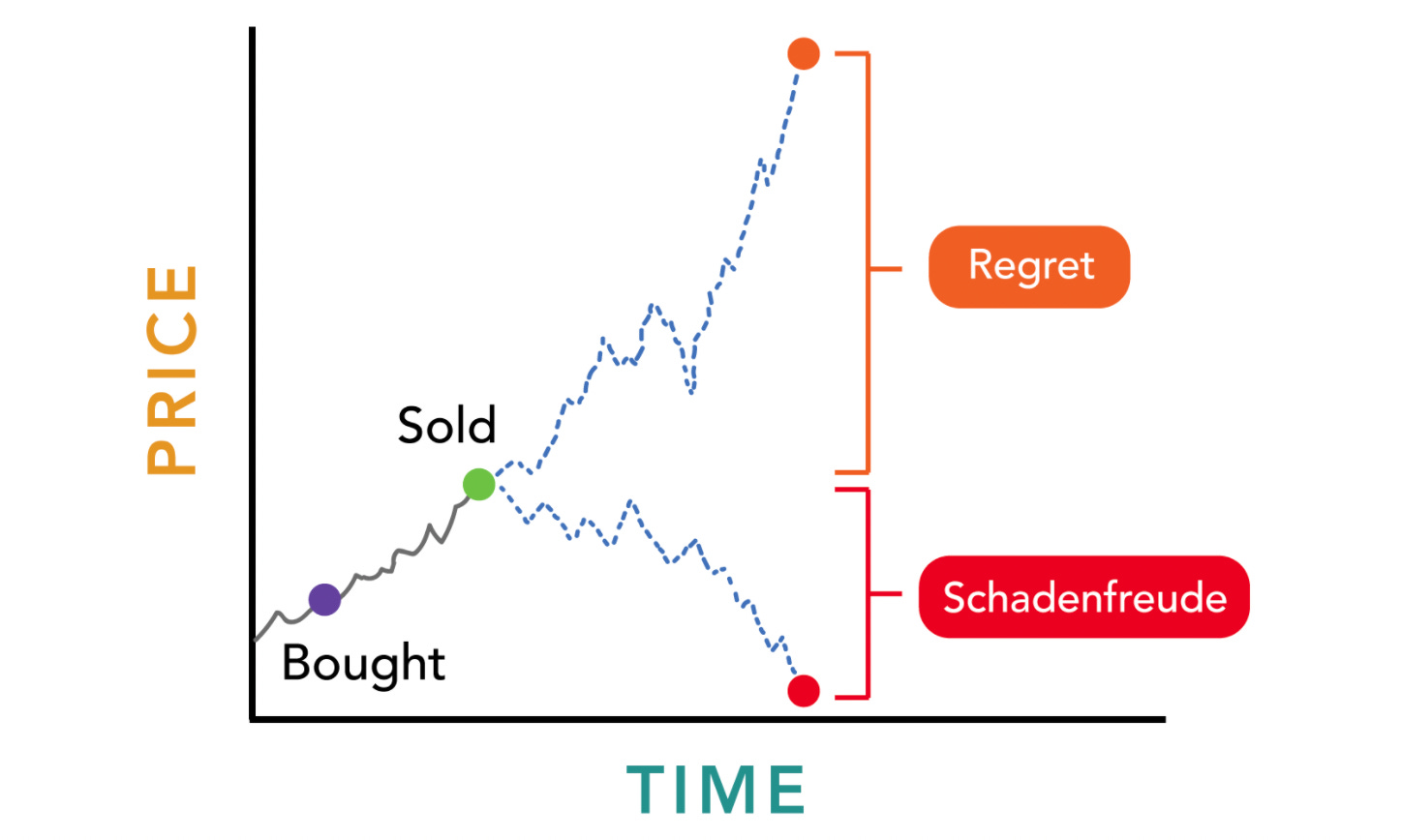
When we sell a ‘winner’ it creates this crossroads of potential outcomes (as shown below).
Source: (More to That)
Should the investor sell a position that continues to rip, they feel the burn of that opportunity cost (assuming the vehicle in which they re-allocated capital to generated inferior relative return). This causes regret.
Should the position go the opposite way, after the sale, there is a tendency to feel content with your decision and, in some cases, a sense of schadenfreude (a german word which suggests pleasure being derived from another person's misfortune, in this case, those who are still shareholders).
As much as it may seem contrary to the consensus on platforms like Twitter (which has a highly engaged financial community), you should ideally know when (or why) you are going to sell before you buy a stock.
A great deal of the emotional angst that relates to buying, holding, and selling, can be combated by knowing why you buy, why you would hold, and when you might sell.
You will find that, often, the rationale for each activity will help guide your decision-making process, and remove a portion of the emotions that typically flare up when deciding when to act.
Let me walk you through a personal example.
MGM Resorts May 2020
My typical investing style is to buy companies that I feel will; a) continue to dominate their field and earn an attractive return or b) disrupt their field or the market leaders and earn an attractive return.
There are occasions when I bend my typical approach, and try and locate “special” situations, or diversify the themes in my PA.
At this point in time, May 2020, I was leaning heavily into tech, SaaS, payments or however you wish to label it.
My thesis was that I wanted to be overweight names that would continue to prosper (and even accelerate) during lockdowns. I had no idea how sharp the recovery would be, or how long we would be in lockdowns.
To offset some of that exposure, I wanted something a little less correlated. I believed these tech names would do well during lockdowns, so was searching for something which might do well after lockdowns.
At this moment in time, MGM Resorts was about to lose more than 90% of its revenues in a single quarter.
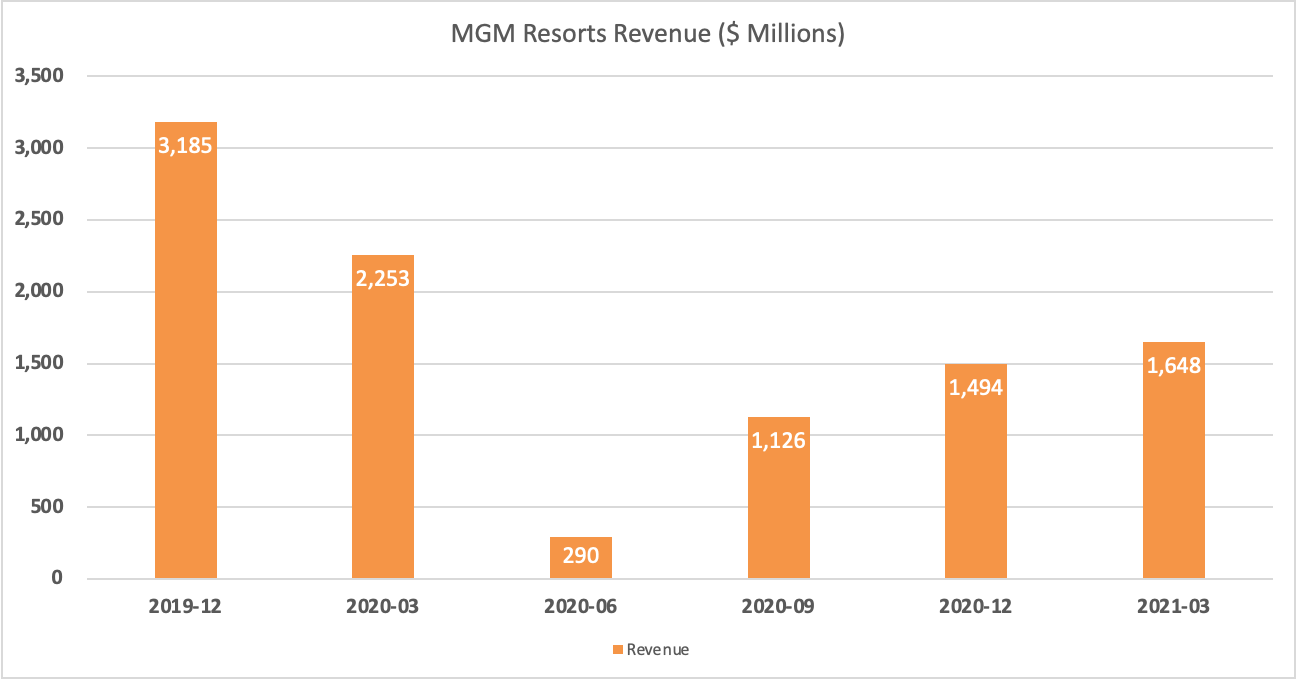
It was a solid business, brand, and one which had a fairly liquid balance sheet with no maturing debt until 2023 (If I remember correctly). They had taken the necessary steps to ensure they would have ample liquidity to tide them over.
I also took a position in MGM Properties at this time, a REIT whose primary tenant was the cash-rich MGM Resorts. A story for another time.
After the March crash, MGM Resorts share price had fallen from the mid $30s to lows of ~$6. I started to become interested shortly after.
After studying the business for a few weeks, I decided I wanted to buy a position.
On May 21st, I acquired about 60% of a full position at $16.34 per share. The following week, I filled the remainder at $17.84.
Prior to taking the position, I had told myself that I would be selling this position, ideally within 3 years, once it had regained the market cap that was lost during the March crash. It also provided some “re-opening” narrative protection to the rest of my holdings which, at the time, were leaning towards the “lockdown” narrative.
This was how I viewed the situation at the time, and it could have very well gone badly. I didn’t want to be too far into either camp.
At the time of purchase, I was picking up MGM Resorts at cents on the dollar in terms of sales. Rightly so, sales were about to vanish. I think I paid maybe $0.69 per dollar of revenue on a TTM basis.

The thesis was as simple as “here is a liquid, solvent business, with a considerable portfolio of tangible assets that will likely be useful after covid that is trading for half of what I think it should be worth in a normal environment”.
I would be largely content with holding the stock, at any price, throughout the desired holding period (~3 Years) so long as it remained able to pay creditors, showed signs of revenue recovery, and was able to fund its operations in a satisfactory manner.
In a piece titled ‘Reflections on Noise’, I stated that “Conviction is born from understanding what you own”.
Thus, so long as my rationale for holding stayed true, I didn’t really care what the stock price was. If it went back to $6 per share, I would have still held it.
I had no idea when the market would eventually re-rate the stock, but that was my goal.
I knew why I was buying, why I would hold, and when I would ideally sell.
That moment came a lot sooner than I imagined.
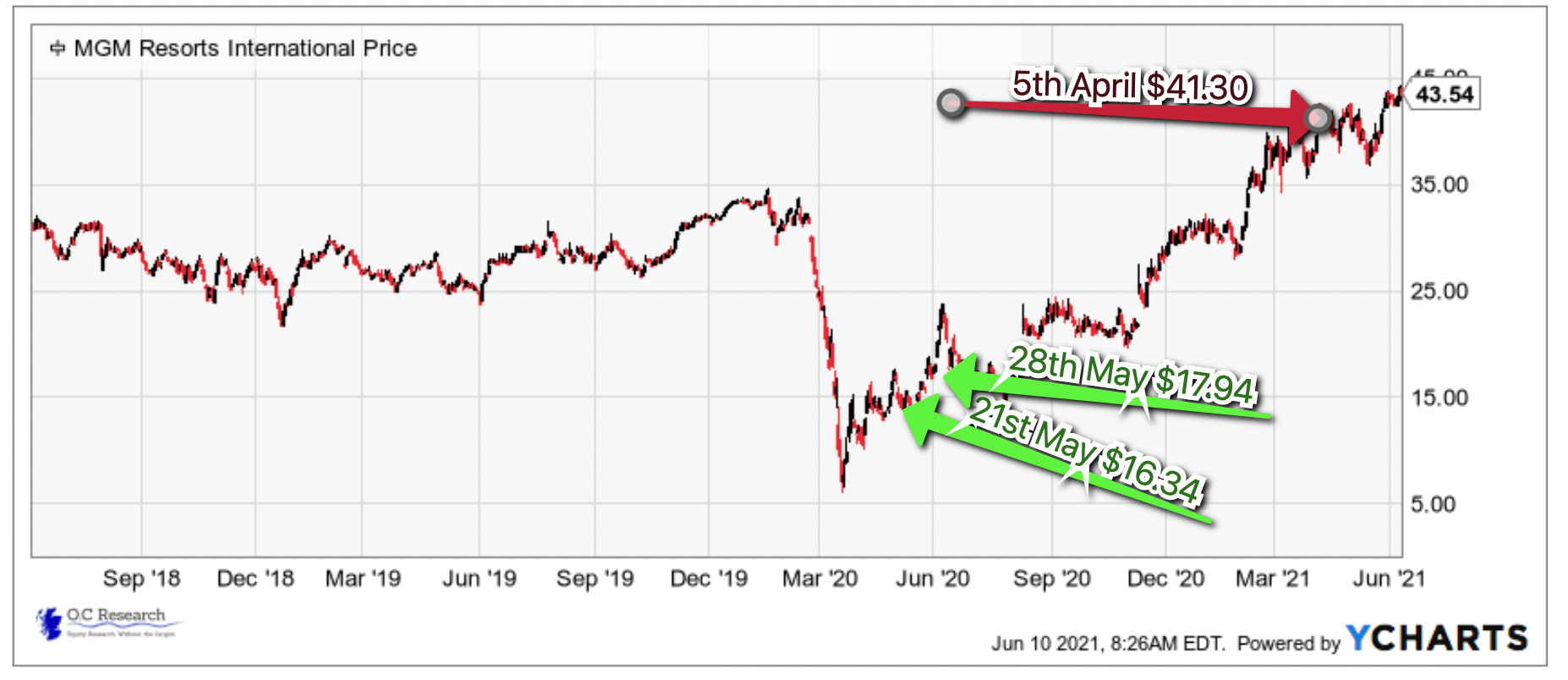
By April of 2021, the stock has retraced all prior losses, and on April 5th, I sold the position at $41.30.
I think any investment which generates over 100% in returns within a year is a great one, and I didn’t get too hung on whether the stock could go higher.
In fact, it does now trade higher and has held up relatively well against some other names in my PA this year. So, on the composition side, that’s something to consider, but as for the investment in isolation, the job was done.
If, at that point, when I made my returns (as previously plotted) and decided not to sell, then I would be guilty of being greedy.
If you are investing for a re-rating or a recovery, then get out when that event takes place or unfolds. Lingering around won't be good for you.
This is what I tell myself.
In isolated situations, it might be better, sometimes, to continue to hold. In other times it might be better to do what I did and sell.
On the aggregate, however, I prefer to keep these types of investments strictly aligned to the purpose.
If the situation is truly unique, then I could potentially deviate, but for consistency, the rule is to sell.
Ian Cassel, once wrote, in 2014, that:
“When you know you should be selling it’s normally too late. Through the years I’ve found that when I start to see cracks form in my investment thesis, I should be selling. When I start thinking about selling, I should be selling. When I start to rationalise holding a position, I should be selling. When I feel management has lied to me, I should be selling. Listen to your gut.”
If you know you should sell but are greedy for more gains, then you are playing with fire. Sometimes, discipline will save you from making costly mistakes.
He also, rather hilariously, stated:
“When I start to really get over confident, basically when I turn into an asshole, I need to start selling. Several years ago when I was vacationing with my wife and in laws, a position I was in was up 1,000% in 6 months.
I made some sly remark to my wife one morning at breakfast in front of her family. My wife said, “Ian, don’t be a dick”. I immediately went and sold half my position. Two months later the stock was down 60%. Believe it or not, but my over-confidence has pin pointed some amazing exits over the last several years.”
Ian then continues to list four reasons why he would sell a stock:
Sell when you find something better. You want to always evaluate new opportunities against what you already own. When you find an investment that is much better than a current investment you sell.
Sell when the story changes, and I try to know the companies better than anyone so I can spot the changes before anyone.
Sell at the first sign of management incompetence or unethical behavior. Sometimes management teams make a decision that is so bad you have to sell. The reason is because of the cockroach theory. When you see one bad decision there will be more that follow.
Sell when the company gets very overvalued. I’m a long-term investor but there are cases where the stock price gets way too far ahead of the business. Evaluate the current valuation against your three or five year expectations-estimates.
This MGM Resorts case was but one example, in an attempt to explain what I mean by knowing why you are buying, why you might hold, and when you intend to sell.
For some positions I hold, I honestly don’t have much of an inkling as to when I might sell.
That’s the truth.
So, you might say I am not eating my own oatmeal.
This begs the question.
How do we navigate the art of selling when this appears to be the case?
If we don’t have a target, how can know when to sell?
My answer, which is probably not the most efficient way of doing things, is to have a pre-defined set of rules which would allow me to consider selling a long position.
For me, in most cases, I know why I am buying and why I will continue to hold.
The selling part is usually implied.
Implied, as in, I will hold this position until there are compelling reasons to sell.
I am going to share this list shortly, but first, let’s talk about Phillip Fisher.
Phillip Fisher’s View
Phillip Fisher, author of the popular: ‘Common Stocks and Uncommon Profits’ wrote extensively about his own views on well to sell in the aforementioned book.
I am assuming some of you have read this book. For those of you who have not, I suggest you do, it’s great.
In Fisher’s book, he only lists three reasons to sell.
The reality, however, is that one of those reasons is contingent on the failure of the stock to qualify for 15 points which Fisher suggested would make a stock a ‘good stock’.
So, before we get round to his reasons for selling, let’s take a look at what Fisher thinks makes a good stock.
Fisher’s 15 Points For a Good Stock
According to Fisher, a company must qualify on most of these 15 points to be considered a good investment:
1. Does the company have products or services with sufficient market potential to make possible a sizable increase in sales for at least several years?
2. Does the management have a determination to continue to develop products or processes that will still further increase total sales potentials when the growth potentials of currently attractive product lines have largely been exploited?
3. How effective are the company's research-and-development efforts in relation to its size?
4. Does the company have an above-average sales organization?
5. Does the company have a worthwhile profit margin?
6. What is the company doing to maintain or improve profit margins?
8. Does the company have outstanding executive relations?
9. Does the company have a depth to its management?
10. How good are the company's cost analysis and accounting controls?
11. Are there other aspects of the business, somewhat peculiar to the industry involved, which will give the investor important clues as to how outstanding the company may be in relation to its competition?
12. Does the company have a short-range or long-range outlook in regard to profits?
13. In the foreseeable future will the growth of the company require sufficient equity financing so that the larger number of shares then outstanding will largely cancel the existing stockholders' benefit from this anticipated growth?
14. Does management talk freely to investors about its affairs when things are going well but "clam up" when troubles and disappointments occur?
15. Does the company have a management of unquestionable integrity?
In Fisher’s mind, should a company share a high proportion of these 15 points, then this would warrant a ‘good’ investment.
In a later chapter of the book, he lists his reasons to sell:
1) A mistake was made in the original decision to buy.
Fisher states that:
“This is when a mistake has been made in the original purchase and it becomes increasingly clear that the factual background of the particular company is, by a significant margin, less favorable than originally believed. The proper handling of this type of situation is largely a matter of emotional self-control. To some degree it also depends upon the investor’s ability to be honest with himself. “
He follows that up by explaining why the reluctance to sell at a loss is a naive decision to make:
“Furthermore this dislike of taking a loss, even a small loss, is just as illogical as it is natural. If the real object of common stock investment is the making of a gain of a great many hundreds per cent over a period of years, the difference between, say, a 20 per cent loss or a 5 per cent profit becomes a comparatively insignificant matter. What matters is not whether a loss occasionally occurs. What does matter is whether worthwhile profits so often fail to materialize that the skill of the investor or his advisor in handling investments must be questioned”
2) The stock no longer qualifies with reference to his 15 points
Quite simply, if the company no longer exhibits the traits that were a factor in the decision to buy, relative to the 15 points, then one should sell.
“When companies deteriorate in this way they usually do so for one of two reasons. Either there has been a deterioration of management, or the company no longer has the prospect of increasing the markets for its product in the way it formerly did.”
He follows up by suggesting that:
“Similarly it sometimes happens that after growing spectacularly for many years, a company will reach a stage where the growth prospects of its markets are exhausted. From this time on it will only do about as well as industry as a whole. It will only progress at about the same rate as the national economy does. This change may not be due to any deterioration of the management. Many managements show great skill in developing related or allied products to take advantage of growth in their immediate field.
They recognize, however, that they do not have any particular advantage if they go into unrelated spheres of activity. Hence, if after years of being experts in a young and growing industry, times change and the company has pretty well exhausted the growth prospects of its market, its shares have deteriorated in an important way from the standards outlined under our frequently mentioned fifteen points. Such a stock should then be sold.”
3) A more attractive stock is identified
“For those who follow the right principles in making their original purchases, the third reason why a stock might be sold seldom arises, and should be acted upon only if an investor is very sure of his ground. It arises from the fact that opportunities for attractive investment are extremely hard to find.
If the evidence is clear-cut and the investor feels quite sure of his ground, it will, even after paying capital gains taxes, probably pay him handsomely to switch into the situation with seemingly better prospects.”
Fisher’s Common Stocks and Uncommon Profits was one of the earliest books I read in my formative investing years. I think it was maybe one of the first 5 books I read on the subject of investing.
I have since re-read it a number of times.
A number of years later, when I had quit the classic pitfall activities of a green investor, I got my act together and fashioned my own Investing Policy Statement, as well as some reasons for selling.
These rules would guide my investing process, and act as the baseline to my decision-making process.
My Own Reasons to Sell
Below, I will run through an assortment of my own, personal, reasons for selling a stock. It should be noted that these are the reasons that I abide by, and are not necessarily appropriate for other investors who may adopt a different style of investing.
Investing is a personal pursuit, for the retail investor, and I find that these rules match my personality well.
It should also be noted that a great deal of these rules are inspired by the books I have read, the investors I have spoken to, and my own experiences.
There is nothing new under the sun.
1) I Was Wrong
How does one know when they are wrong?
That can be a tough rule to follow and a tough pill to swallow.
Humans are susceptible to an enormous amount of biases. So much so, that at times when we know we are wrong (deep down) we may kid ourselves and pretend that we are about to be proven right, at some point in the future. Holding on for our thesis to be proven.
I combat this by attempting to remain rational and avoid self-serving bias.
I will routinely speak to other investors who have a bearish or neutral opinion of the stocks that I own, both before and after I buy them.
Another way I might be wrong is that I was wrong in assuming I knew more about the opportunity or the industry than I once thought.
A more recent example would be my decision to buy Intel common stock earlier this year. From a valuation and fundamental perspective, I thought I understood this business.
Sure, it’s being disrupted, but it was cheap and had fresh management.
Within a week, I spoke to more seasoned investors in the space and realised I had a severe lack of understanding of the semi industry.
If a time came when the stock price tanked, I would have next to no conviction to hold.
Quite simply, I made a mistake with my purchase.
Granted, this was a small, starter-sized position, but I sold it sharply.
It did return a small 5% return, but I would have sold it should it have been (5%) either way.
Regardless of whether or not I would be proven right, I felt no comfort in holding the business as a result of my lack of understanding of the industry.
I was wrong to buy the position in the first place.
2) There is Some Pre-Defined Target for the Sale of a Stock
As discussed with the MGM Resorts example, if there is some pre-defined time horizon and rough price target, once the position reaches that feat, I will sell.
There is always a consideration at this point.
What has changed in the period that I owned the company?
Are there now more compelling reasons to hold?
Most often, the answer is no, and I will cut the position, take the returns, and move on.
3) The Thesis has Gone Astray
Similar to admitting I was wrong (Point 1) but slightly different.
It might be that my original thesis was wrong.
It might be that my thesis was right, but the company had begun to stray from that thesis, or simply not execute on it.
Take Twitter for instance.
I started accumulating shares in early 2020 under the assumption that the business would diversify its revenue streams, improve its ad product, and generally light a flame under its ass and get moving.
At the time, there were some breadcrumbs in the earnings calls that suggested big changes were coming.
In 2021 this was confirmed, and the infamous analyst day in February laid out the roadmap for a batch of new revenue products and some goals for FY23, which would see them attempt to double revenues and mDAUs (monetisable daily active users).
At present, the thesis still appears to be intact.
Should Twitter stray from that thesis, then I would have to reconsider what I am really investing in.
The business outlook which I allocated capital towards is different now, and an assessment of whether I want to partake in the new outlook has to be taken.
If I don’t see value in it, I will cut the position.
4) The Risk/Reward Becomes too Weak Relative to Others
There may be some instances where the valuation of a company has run up so high, that the forward returns have (in my opinion) been brought forward a number of years.
One need only reminisce over 2020 for countless examples.
If I feel that a stock may face prolonged periods of multiple compression, perhaps over several years, and there are compelling alternatives, then I will allow myself to sell.
This one can be somewhat difficult.
I may, at times, falls prey to the act of market timing.
I sold Crowdstrike earlier in 2021 for this reason, after 180%+ returns with a year, and re-allocated towards more fairly valued positions, which I felt had more upside over the next year or so.
I don’t mind holding expensive names, but if they become so expensive, that the medium-term returns are more attractive elsewhere, then I might be inclined to sell.
This is not something I like to do often, as I am mostly a big believer in letting winners ride, and not interrupting the effects of compounding.
5) Unattractive M&A Activity
There are a few tangents this rule could go down.
For the most part is largely relates to me not liking the merger or acquisition, from the perspective of the company I hold.
If I feel the deal will break my original thesis, I will take some time to see what the new (combined entity) thesis would be. If it’s not something I like, I will quickly sell.
A more recent example being Livongo Health and Teladoc.
I once held shares in Livongo Health, for the purposes that they were attacking a small niche in digital healthcare. They were fairly flexible, had a great management team, were nimble, and growing at a fast clip.
Teladoc came along and swallowed Livongo up.
Right then and there, my thesis was broken. I was not interested in owning something which was less niche than Livongo, despite Livongo assets still operating under the combined entity.
It was a whole new business I would be exposed to.
I cut my entire position on the day of the announcement, after making attractive returns, and moved on. No emotion.
I had the comfort of already having looked at Teladoc in the past, and not being interested, so I was able to make a decision fairly quickly.
I am sure the business will be great, but it was not was I wanted to originally invest in.
In general, a larger player (one that I own) swallowing up a much smaller business is something I can live with.
Etsy’s (I own shares) acquisition of DePop was quite large, relative to Etsy’s size, but I could see the rationale there. It was an expensive price, but a good business to buy. Etsy would not be deviating far from its core value proposition or competencies with that acquisition.
But when the size of the acquirer and the acquired are similar or I own the company being acquired, I take special consideration.
6) Position Size Has Exceeded Pre-Defined Limits
I typically don’t like a single position to dominate my portfolio too much.
If something were to grow to ~25% of my portfolio, I would trim the position a little. Not sell the whole thing, but reduce its size relative to my total PA.
Equally, if there is a position in my PA that is fairly unproven, but has gone on a significant run, then I would be willing to trim into strength.
Something like Peloton, which was once ~7% to 8% of my PA after doubling, would potentially be cut in half to reflect my conviction there. I remain confident about their prospects, but I don’t want it to grow to one-tenth or one-quarter of my PA.
Again, this might lead me to succumb to trimming the flowers and watering the weeds, but I am still learning.
7) Degrading Culture &/Or Weird Management Changes
This was one of the earliest and hardest lessons I learned as a green investor. I distinctly remember this point being the first one I wrote down when compiling my rules for selling years ago.
Sometimes the saying “when in doubt, get out” is appropriate here.
Management changes, on the whole, are not always a bad thing.
Sometimes people retire, or their purpose for being at the company is completed.
If the change makes sense, and I don’t mean fitting the narrative to your book, then management changes are okay.
If the management changes are weird, frequent, and unexplained (or lack a compelling explanation I should say), then this is a red flag for me to explore further.
I always wince back to my first year of investing. Blissfully holding a microcap after three CEO changes with 6 months. Safe to say, I got creamed on that one. It was small sums of cash, but that’s often the best way to learn.
On culture.
This is harder to ascertain, but there are third-party services, like Glassdoor, to examine the overall sentiment of employees and their feelings towards management.
Ex-employee interviews are good if you can get them but often contain obvious bias.
Elsewhere simply listening to the rhetoric of earnings calls and executive interviews are good leads for this kind of information.
It’s not an exact science, but sometimes, if I get the sense that a senior manager is fishy, I tend to stay away. Moreover, if they are all talk and no gumption, or if their promises frequently fail to come to fruition.
It can sometimes be a good exercise when assessing an existing (or new) position to look back a few years and check if management delivers on their outlook.
8) Overwhelming Opportunity Elsewhere
If there is an overwhelming opportunity elsewhere, I would consider trimming positions to be able to allocate capital towards that idea.
I will say, that for me, this is rarely something I will do.
In my own life, I have sufficient cash flows to continually invest in my PA. I don’t work on a fixed base of capital. As such, if there is a compelling opportunity elsewhere, I would likely use outside capital (from my bank account) to fund that idea.
9) Need Capital for Something Else
Again, something which has never happened yet (thankfully).
The money I place into my PA is capital I don’t need in my day to day life. The assumption is that it’s not mine, and I have no intention of ever withdrawing it.
However, life is weird, and be uncertain.
If there is ever a circumstance where I need capital outside of my PA, I would be open to liquidating positions to funding that.
10) Accounting Red Flags
Ideally, the due diligence prior to buying a position would be comprehensive enough for me to avoid purchasing the position in the first place.
Mistakes happen, however, and sometimes these red flags can occur during a holding period.
This could be anything from channel stuffing, consistent NI>CFO, and a host of other red flags which I am sure I could cover in a future article. If in doubt, get out.
This is something I try to weed out prior to ever taking a position. If an investor were to look at Luckin Coffee prior to their catastrophic F*** up, you would have noticed their cash flows did not add up to their rampant sales figures.
Cash is king, in that respect.
It is my hope that prudent financial analysis would prevent me from ever buying a company with substantial accounting irregularities.
This also stands true for my understanding of accounting. If there is a company that reports their financials in a way that I don’t understand, not necessarily fraudulent, then I tend to avoid them until I can understand them.
11) No Longer Interested in the Company
Lastly, I like to be interested in the companies that I follow. I have found that, in the past, when my interest begins to wane, my quality of due diligence on that company soon follows.
Not something which happens often, but when it does, I sell.
Engagement is an underappreciated aspect of following investments.
That covers the bulk of the rules I try to abide by.
I think I will conclude by acknowledging, that for me at least, emotions are the biggest drivers of my apprehension to selling, and investing activity in general.
Thus, for me, the act of removing that emotion helps me invest sanely.
A) Long-term investing is fine.
B) Speculation is fine.
When a long-term investor fools themself into believing they are doing A when they are doing B, that is troublesome.
Being aware of the fact you are doing B, your tolerance, process, mindset, all different.
Equally worse, is approaching an investment under the idea that it is a bit of a speculative bet.
Then, after some consolidation in share price, convincing yourself it's now a long term bet.
Moulding the narrative to fit the reality.
One has to be wary of noise too or, rather, have the ability to discern between noise and signal.
A recent example being the Peloton Treadmill recall fiasco.
As a shareholder, the news that Peloton would be recalling their treadmills en masse created a lot of commotion amongst the media (whose job it is to create fear).
The reality was, that these recalls would turn out to be a nothingburger.
Treads were a tiny, nascent, part of the business. The decision to recall would not put a significant dent in the fundamentals.
Whilst the short term price action was an attractive opportunity for someone to short the stock, it wasn’t, in my mind, a compelling reason to exit the position.
So, understanding what is noise is crucial.
There is a strong argument for the ‘never sell’ mentality, but I feel this can sometimes be confused with ‘never selling garbage’, in the hope that someone, somewhere, will create a solution to the age-old dilemma that a lick of polish will not turn a turd into anything but a turd that now smells a bit like turpentine.
I think it could be altered to ‘never sell’ so long as the business continues to resonate with the reasons you bought in the first place and does not break any of your sell rules.
That’s not quite as catchy though, and I think (hope) that this is implicit in the ‘never sell’ motto.
An investment into understanding one’s own investment process and ability to manage their emotions is probably one of the better r/r’s you can find anywhere.
“If you’re extremely confident in yourself, taking a loss doesn’t bother you.” - Stanley Druckenmiller
New to the newsletter? Sign up here.
Want to learn more? Browse the about page.
If you have any ideas related to the information you’d like to see each week, or perhaps where you feel it could improve, please reply to this email, or drop me a DM on Twitter @investmenttalkk.

Conor,
Lead Analyst at Occasio Capital Ltd
You can also reach out to us here:
Twitter: @Investmenttalkk & @TheITNewsletter
Facebook: @TheInvestmentTalkNewsletter
Pinterest: @InvestmentTalkkk
Email: Investmenttalkk@gmail.com