

There are few certainties in life, but one that is fairly cemented in the workings of the stock market is that people will speculate. You must speculate to accumulate; the saying goes. This is inherently true; the nucleus of every new venture, product, or company is built upon an idea, some conviction and someone who asks “How hard can it be?”. The confirmatory evidence usually comes later down the line.
You may define speculation as “the forming of a theory or conjecture without firm evidence”. I am reminded of Henry Ford’s quote about what would happen if he asked the public what they wanted in the early 1900s. They’d want faster horses. Doing something that’s never been done before requires a little bit of flying blind. We only tend to remember the creations that thrived, and easily forget the neverending list of failures that also included an idea, some conviction, and someone who asked “How hard can it be?”. That’s just the way it goes, and this is my way of saying that speculation is not necessarily a bad thing. Without speculators, the world would not be where it is today.
The dirty side of speculation
Most people think about speculation as gambling; whether that be on the floor of the Bellagio in Las Vegas, on the trading desk at the New York Stock Exchange, or from the comfort of your own home on a retail brokerage app.
While it feels as though pockets of sensationalism bubble up in the market every quarter, once every few years there is a humdinger that comes along. I’m not talking about systemic failures or financial crises (although they are part of this too). I’m talking about the trendy, shiny, new themes that disappear almost as fast as they are birthed. Once every few years these breathtaking failures, fueled by greed and speculation, are swallowed up by the poor suckers that believed in them, everyone moves on, and we forget about them. Until the next one comes along. This is especially evident in the world of VC; where the best time to raise money also happens to be the worst time to receive a new valuation. As many young companies raised incredible rounds in the liquidity slosh of 2020 found out. By the time their cash runway shrunk to a level where a new round was needed, liquidity dried up, VCs became conservative, and their valuations looked embarrassingly high in the sobering light of day. Founders and venture capitalists are smart people, and even they get caught up in the lunacy.
What follows are the sobering post-mortems:
“It was always destined to fail”.
“It was so obviously a bubble”.
“Can you believe people that price for that investment?”.
“Duh, you paid 50x sales for a business overearning during a pandemic”.
Sometimes it’s individual companies that turn out to be frauds; like Theranos, Enron, FTX, or Wirecard. Other times companies get caught up in a trend that gets inflated with too much hot air, too quickly. Peloton and connected fitness, WeWork and communal working, 3D printing companies of the early 2010s, and the cannabis companies of the late 2010s. These are not intrinsically bad ideas. But they get wrapped up in such overzealous optimism (sometimes unfounded optimism) that investors begin to extrapolate transitory trends from an increasingly higher, and unsustainable, base. Here’s George Soros with an apt description of a bubble and how it forms.
“Every bubble has two components: an underlying trend that prevails in reality and a misconception relating to that trend. A boom-bust process is set in motion when a trend and a misconception positively reinforce each other. The process is liable to be tested by negative feedback along the way. If the trend is strong enough to survive the test, both the trend and the misconception will be further reinforced.
Eventually, market expectations become so far removed from reality that people are forced to recognize that a misconception is involved. A twilight period ensues during which doubts grow, and more people loose faith, but the prevailing trend is sustained by inertia. As Chuck Prince, former head of Citigroup said: we must continue dancing until the music stops. Eventually a point is reached when the trend is reversed; it then becomes self reinforcing in the opposite direction”.
NFTs are one of the more recent flashes in the pan. Pictures of rocks selling for millions of dollars on the back of beliefs that the next buyer would come along and take it off your hands for an additional few million dollars. The narrative of NFTs, their scarcity, their technology, and their transparency, would be repeated by talking heads until the peak of the bubble bursting. As the market got crazier the powerful combination of speculation and ownership bias tainted the rationality of usually intelligent people.
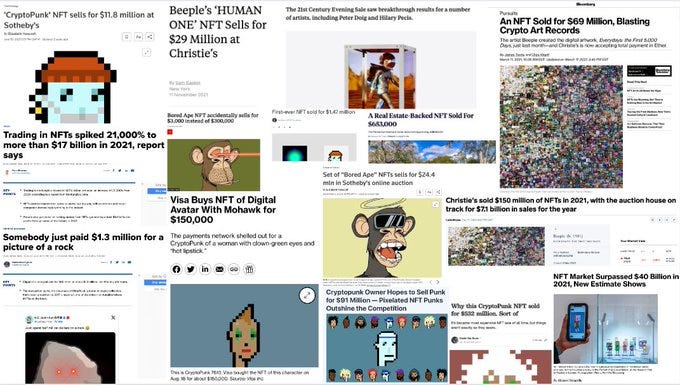
It got to the stage where I listened to a VC, on a podcast, suggest that NFTs for mortgage titles would destroy the incumbent mortgage business. While this hydro cannon of slurry continued to propagate public discourse, it was juxtaposed with the reality that people were just gambling on the greater fool theory. Nobody cared about the technology, just their wallets getting fatter. NFTs were yet another unpleasant mouthful the investing community swallowed up, digested, and moved on from. It’s now just an obscure piece of history.
But recency bias dictates that we will see many more crazes like NFTs in the not-so-distant future. Just as soon as we’re done laughing at the previous suckers, we are liable to become one ourselves. What can be done to avoid being the next fish at the table? So much of investing is about mentality; conviction, patience, and avoiding emotionally provoked decisions. Equally difficult, is maintaining an everpresent sense of rationality. Risk-seeking behaviour tends to increase during bull markets, and sometimes it creeps up on us silently.
What causes us to indulge in speculation?
When everything is going well, it’s natural to lower your guard. Standards slip, we rationalise a little speculation here and there, and we might stop thinking about the downside because the market hasn’t reminded us to for some time. That is when an investor is most prone to catastrophic outcomes; like the turkey who doesn’t know that tomorrow is Thanksgiving.
Risk-seeking behaviour increases during bull markets: When asset prices climb for years on end without major disruption, risk aversion dissolves. When mistakes that would crucify you in a bear market are forgiven quickly, the risk of exercising poor judgment appears less costly. The longer the good times roll, the higher the propensity for greed to seep into the system. The greater the length of the bull market, the shorter our time horizons become. It’s only natural. When you witness peers making a killing on unprofitable tech stocks with nonsensical valuations while you sit there earning market returns in consumer packaged goods companies, you might start to feel like a schmuck, and begin to look for ways to juice your returns. This is the market’s method of persuasion to coax you into ditching your game plan and chasing quick dollars.
Investor Amnesia: Another potent method of disarmament is our ability to forget the lessons of the past. Whether we choose to ignore them, forget them, or truly believe that this time is different, we are prone to amnesia. Irrespective of the catalyst, there are recurring signs in every bubble, every wave of mania, or speculative frenzy. You’d think it to be reasonable that a rational investor would look around and think to themself; “hang on, things are getting insane here”. But in reality;
We are not as rational as we give ourselves credit for: We just aren’t. While some are more rational than others, rationality is not a fixed state; it is a dynamic and everpresent battle. An army of biases wages a perpetual war in an attempt to penetrate your sense of rationality, and now and then one will win. The goal is not to be permanently rational, because there is no such thing. Rather, the goal is to remain as rational as possible while routinely, and objectively, scouting for times when you might be as the disposition of bias.
We are terrible at forecasting: Investors are often over-optimistic in the good times and over-correct with pessimism during the bad times. We also tend to lie to ourselves about potential upside. Everyone knows this, yet we still look to experts to provide forecasts. Morgan Housel describes this phenomenon as a longing for certainty; which is especially prominent in financial markets; and is ironic because it’s entirely unattainable. In his latest book, Same As Ever, Housel details that Professor Philip Tetlock has spent most of his career studying experts, self-proclaimed or otherwise. His research concludes that most political or economic forecasters are about as accurate as a shotgun from long range.
"We need to believe we live in a predictable, controllable world, so we turn to authoritative-sounding people who promise to satisfy that need. The inability to forecast the past has no impact on our desire to forecast the future. Certainty is so valuable that we'll never give up the quest for it, and most people couldn't get out of bed in the morning if they were honest about how uncertain the future is”.
Forecasting is hopeless, most people understand that. Even still, investors will forecast macroeconomic shifts, build multi-year discounted cash flow models, project a company’s free cash flow decades into the future, and so on. But as far as speculation is concerned, which you could argue modelling is but one form of, our present environment influences the relative optimism baked into our forecasts. Even if a perfectly rational man were to create forecasts, the future unfolds in a way that no amount of rationality could account for.
Confidence in timing: Someone once articulated it to me as follows; VCs and growth investors count on a great exit, while value investors count on a great entry. During speculative periods, it’s more often than not the growth names that capture the market’s attention. In this case, who cares what the entry price is? You’re going to sell that thing when it doubles, right? Sometimes people are fortunate enough to buy an expensive asset and sell it when it’s even more expensive. That said, over a lifetime of investing you can’t rely on luck and good timing. Investors often rationalise speculative investments by saying they’ll get out before the sentiment turns. Then the stock corrects, and they tell themselves it is a blip. Look at the chart, this will recover in no time, they might say. Eventually, the stock is down 50%, and only now do they begin to consider selling. Newsflash, people are terrible at timing when it comes to investments. For the average investor, the best chance you have is buying at reasonable prices to give yourself some margin of safety. Or as Warren Buffett would say:
"Never count on making a good sale. Have the purchase price be so attractive that even a mediocre sale gives good results."
Style Drift: Considering the items I have already discussed, it comes as no wonder that the number of investors hunting for 100 baggers seems more abundant during a bull market. Or the number of investors who are “dabbling” in derivatives, swing trading, or other newfound investment styles. Don’t get me wrong, 100-baggers are awesome; Chris Mayer’s book which bears the same name is a great read. I also happen to think double baggers are just as cool; which would require a ~20% CAGR over 4 years for the stock to double. You may notice that as corrections and bear markets occur, your style may flip from contemplating the most aggressive upside to pondering survival. While a tenured bull market can make a low single-digit CAGR feel minuscule, over most multidecade periods, this would outperform the S&P 500. Staying in the game, i.e., no blowing up, is the most critical factor in generating amicable lifelong returns. Forget multi-baggers, pitch me a business that won’t go down 50% over the next 6 months.

We rationalise risk differently in good times: “I know it’s speculative, but it’s only a few basis points”. I’ve fallen victim to this way of thinking a few times. A small speculative position has the benefit of a meaty risk-to-reward payoff. You can argue that it only takes one big payoff to pay for the 10-15 ideas that went to zero; and that those zeros don’t weigh too heavily on the portfolio’s overall performance. This is not a comment on whether or not that investment style is appropriate or not; I am sure it works for some. Instead, it’s a reminder that we tend to think more along these speculative lines during the good times. When this influences an increasingly large number of market participants, it becomes self-reinforcing and throws more fuel on the fire. That is until the market throws a blanket over it.
Boredom: Attention spans are getting shorter. It’s why younger generations feel compelled to pull out their phones and doomscroll YouTube shorts while they eat a burrito. This might be the advent of short-form media. Nonetheless, investors suffer from boredom too. One of the hardest things to do in this game is nothing. When people say laziness is a desirable trait for an investor, it doesn’t relate to their work ethic; it concerns their lack of desire to look for things to do when nothing is happening. Increasing your portfolio turnover certainly seems like a fun way to kill the boredom. You’re not doing nothing, you’re making investments, you’re rotating exposures, you’re getting ahead of a bad news cycle! To crush boredom, have hobbies, don’t make your portfolio your personality, don’t have a heavy news diet, stay hydrated, have other passions, exercise, and touch grass now and then.
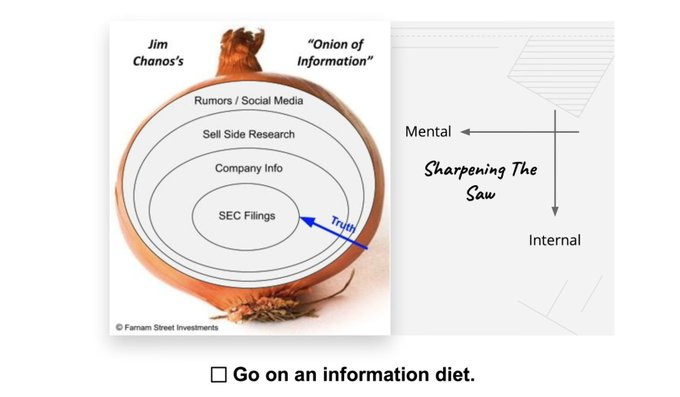
Heavy news diet: An addiction to news is a combatant to boredom. Over the decades news has mutated from a largely localised distribution to one that is global in scale. On a local level, not much interesting happens weekly. On a global basis, there is bad news every single day; which we are now subject to. In the market, if you are looking for an opinion, you will find one, because the rate of hyperbolic discussion about nothingburgers has exploded too. Increasing your consumption of news will not make you a more informed investor, it will make you a more anxious one. Financial news is largely there to fill time and keep people in employment. Occasionally, it will report on important events. When ingesting information, stick within the centre of the onion, as Chanos refers to it. The closer to the surface you get, the less valuable the information becomes.
Getting ahead of sentiment
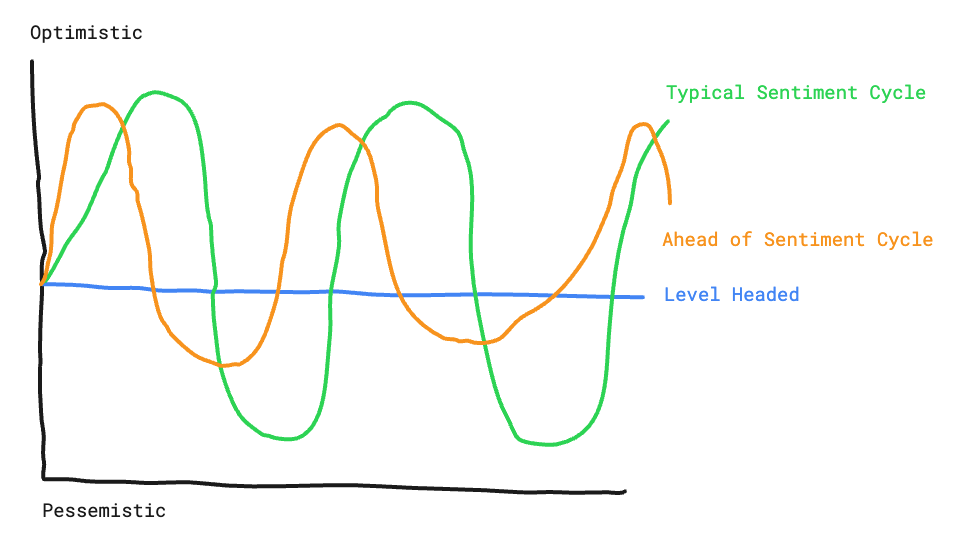
There is a very rare breed of investors that act as though are always one step ahead of sentiment. Soros and Druckenmiller are often credited with this superpower. Soros’ famous soundbite; “When I see a bubble forming, I rush in to buy, adding fuel to the fire” is something which he views as “not irrational”.
“And that is why we need regulators to counteract the market when a bubble is threatening to grow too big, because we cannot rely on market participants, however well informed and rational they are”.
In a hypothetical scenario, individuals who have the clairvoyance to predict sentiment cycles, market cycles, booms and busts, whatever you want to call it, would represent the orange line. They appear to know what way the sentiment will shift before it even does, so they get out in front of it, reigning it in before the peak.
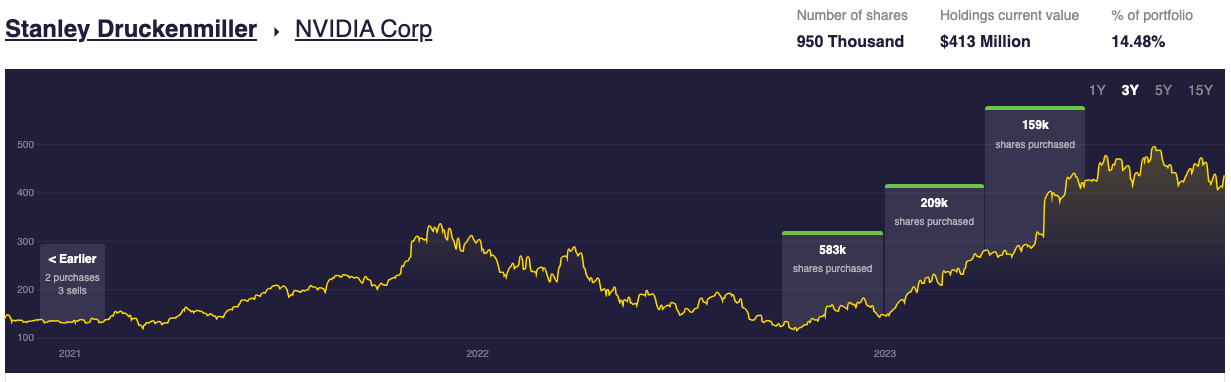
As a more recent example, Druckenmiller bought a new position at Nvidia sometime in Q4 2022. When he told the world he was buying more in Q1 and Q2 of 2023, the stock was considered to be expensive. Then came the “shock” revenue and sales revisions, and Druckenmiller suddenly appeared to be an oracle. This is not to say Nvidia was a speculation. Rather, Druckenmiller had the foresight to believe the sentiment in the business would shift in the next 12 to 18 months. He was right.
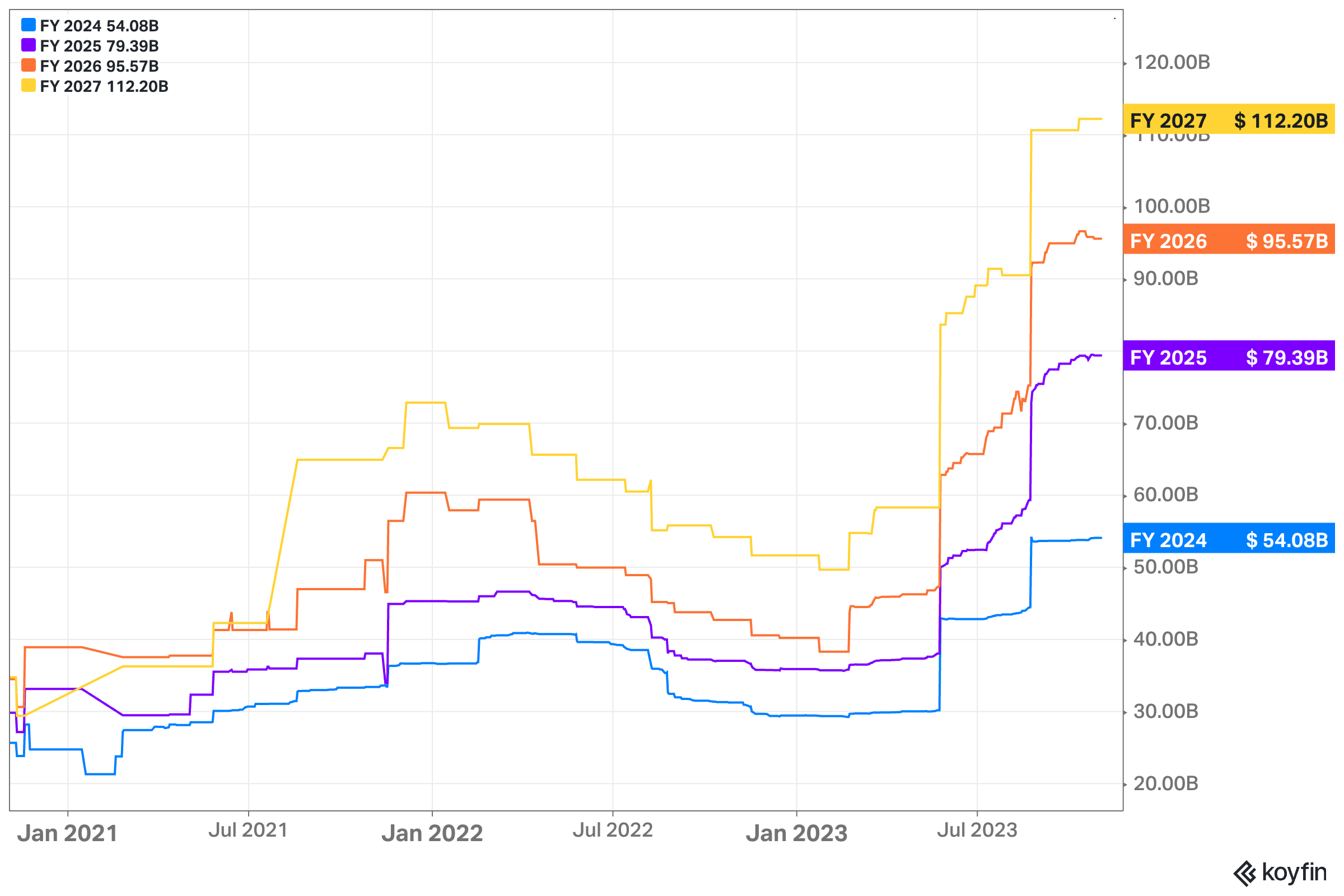
Of course, all of this assumes an investor is exceptional at market timing. While it’s hard to argue there are not some individuals blessed with a stronger fifth sense than others, there is a reason why so few investors can invest like Druckenmiller. History has shown that even the best are susceptible to speculative temptation. During Druckenmiller’s famous presentation given at the Lost Tree Club in 2015, he recollected about a time when he lost $3 billion in one trade during the tech bubble:
“So, I’ll never forget it. January of 2000 I go into Soros’s office and I say I’m selling all the tech stocks, selling everything. This is crazy at 104 times earnings. This is nuts. Just kind of as I explained earlier, we’re going to step aside, wait for the net fat pitch. I didn’t fire the two gunslingers. They didn’t have enough money to really hurt the fund, but they started making 3 per cent a day and I’m out. It is driving me nuts. I mean their little account is like up 50 per cent on the year. I think Quantum was up seven. It’s just sitting there.
So like around March I could feel it coming. I just – I had to play. I couldn’t help myself. And three times during the same week I pick up a phone, don’t do it. Don’t do it. Anyway, I pick up the phone finally. I think I missed the top by an hour. I bought $6 billion worth of tech stocks and in six weeks I had left Soros and I had lost $3 billion in that one play. You asked me what I learned. I didn’t learn anything. I already knew that I wasn’t supposed to do that. I was just an emotional basket case and couldn’t help myself. So, maybe I learned not to do it again. but I already knew that”.
When the good times appear to have no end in sight, it becomes increasingly easier to fall into speculative behaviour traps; whether that be due to a diminished sense of importance for downside risk, justification, or overconfidence. Every time you succeed in those speculative activities, your confidence grows, and the likelihood that you increase the ante for the next investment grows with it. This is a recipe for blowing up.
Evolving as you learn new processes and as times change is important, but so too is recognising personal growth vs environmentally charged style drift. Sticking to your guns might be boring when your impulses are telling you to change course. But consistency, patience, and the ability to remain rational are traits that most of the world’s greatest investors possess; and the reason they can have such long track records. A lot of thought is given to investments that will generate the greatest return, but less thought is given to investments and actions that might remove you from the game.
Thanks for reading,
Conor
Honourable Mentions
Here is some other great stuff worthy of your time.
Latest from Mauboussin and Callahan, which breaks out the calculation of total shareholder return, its nuances, and why it’s important.
Commentary from a Barron’s article where Peter Lynch and Seth Klarman describe their current views on the market. Klarman cites that the market is scary and vulnerable, while Lynch tells Barron’s he loves it when stocks go down.
Charlie Munger made a rare public appearance on the Acquired Podcast last week, worth a listen.
NFTs were quite a show ;)) ...
SEC fillings = hard work and time, hence not 'popular' ...
Love it! I will save this one to re-read from time to time.