


"The math isn't complicated. When the share count goes down, your interest in the businesses goes up. Every small bit helps if repurchases are made at value-accretive prices".
Warren Buffett
That was Warren Buffett describing why he likes companies that consume their shares aggressively and pragmatically; i.e. share cannibals. He continues to remark that while Berkshire repurchased 1.2% of their outstanding shares that year, several of Berkshire’s equity positions, notably Apple and American Express, had indirectly “increased Berkshire’s ownership a bit without any cost to us”. In plain English, these companies had repurchased their shares so aggressively, that Berkshire Hathaway, and thus Berkshire’s shareholders, had indirectly increased their stakes in these positions too.
The quotes come from Berkshire’s 2022 shareholder letter, but the oracle has been preaching the same gospel for decades. Now and then you will see the media run with the narrative that share repurchases are “bad” whereas when you are told all repurchases are harmful, “you are listening to either an economic illiterate or a silver-tongued demagogue”. Like all things finance-related, there are caveats.
What are share cannibals?
A share cannibal is a company which repurchases (or cannibalises) its share count in an aggressive fashion. Take Apple as an example. Over the last decade, Apple’s total return has compounded at ~27% per year (+967%). Over the same period, the company has repurchased an average of $16 billion in common stock each quarter; amounting to a 39% reduction in the outstanding sharecount.
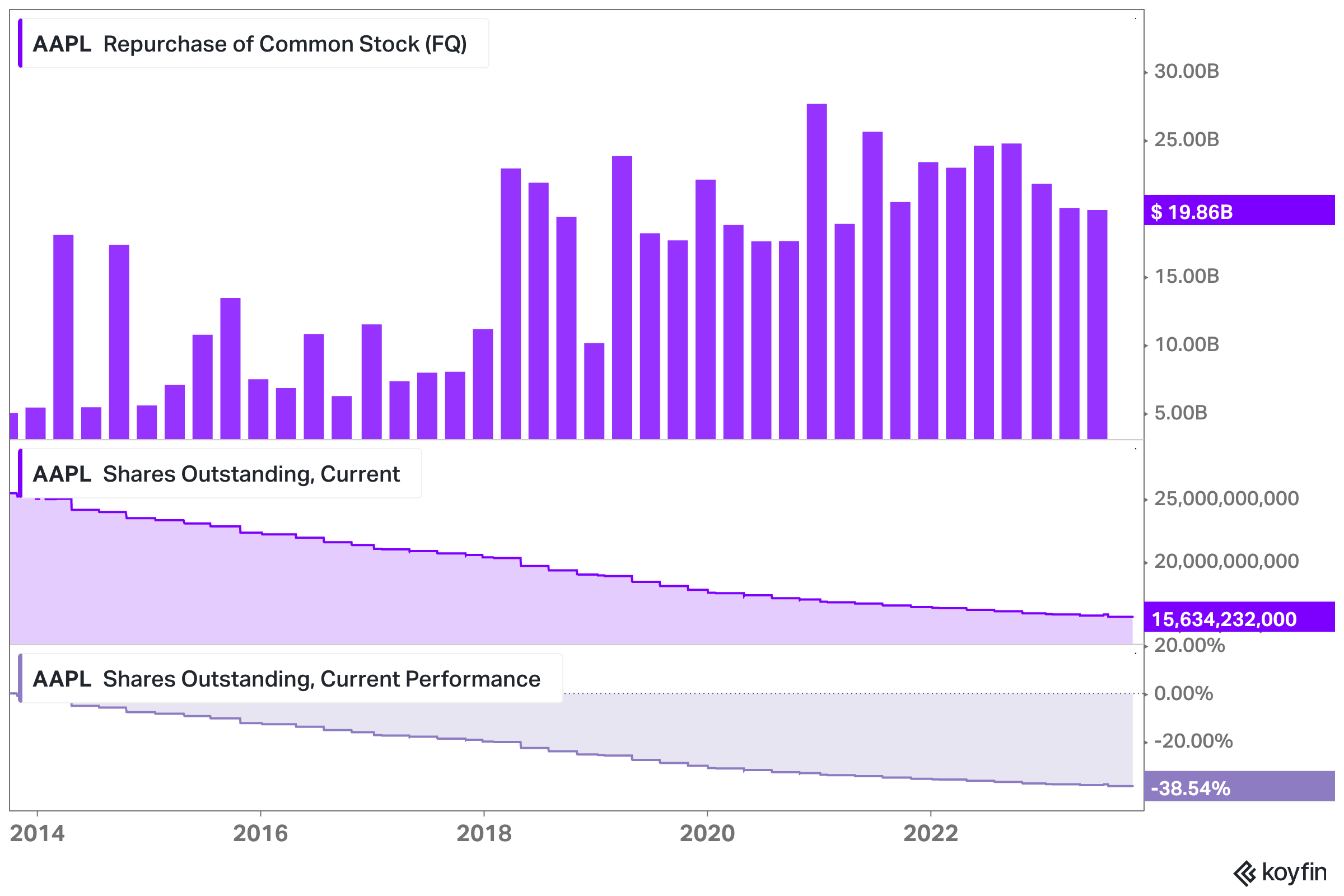
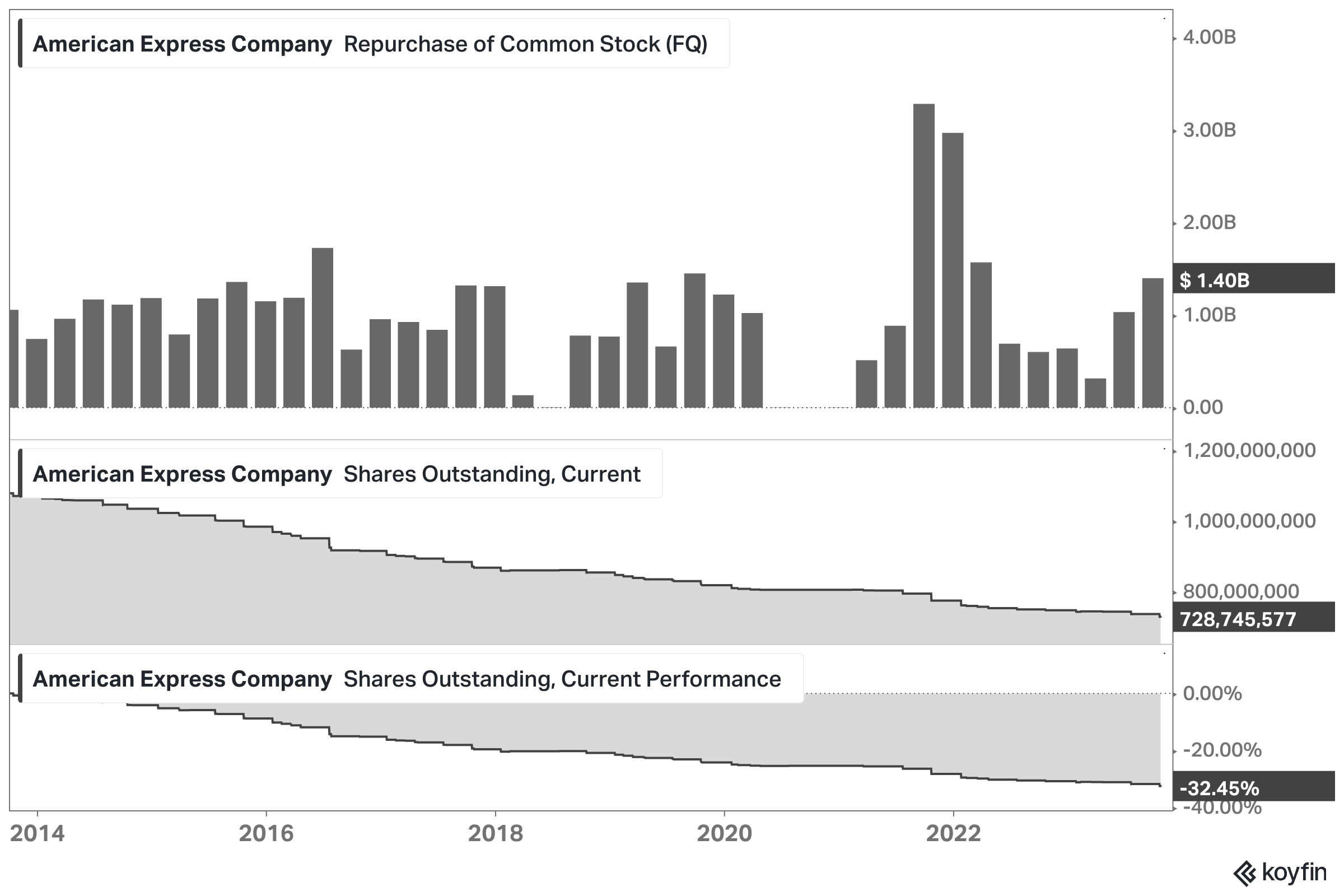
Relative to their dividend policy, which averages $3.4 billion per quarter, Apple has long favoured the buyback as a means of returning capital to shareholders. American Express is another example, another long-term holding of Buffett. Over the last decade, the card company has retired more than 32% of its outstanding sharecount, averaging just under $1 billion in buybacks each quarter.
Why care about share cannibals?
There can (emphasis on ‘can’) be a magical component to share repurchases. Suppose a business earns $5 per share in year 1 and then repurchases 20% of its outstanding sharecount in year 2. Ceteris paribus, the earnings per share in year 2 would be $6.25. Now assume it repurchases another 20% in year 3; ceteris paribus the earnings per share would be $7.81. Earnings per share is increasing, and all else equal, the share price is more than likely to follow suit.
In each of these three years, the notional earnings are identical.
(Year 1) 100 shares w/ $500 earnings = $5 per share
Less 20% sharecount
(Year 2) 80 shares w/ $500 earnings = $6.25 per share
Less 20% sharecount
(Year 3) 64 shares w/ $500 earnings = $7.81 per share
Now suppose the company improves their notional earnings each year, and the earnings per share will expand even faster.
(Year 1) 100 shares w/ $500 earnings = $5 per share
Less 20% sharecount, w/ 10% earnings growth
(Year 2) 80 shares w/ $550 earnings = $6.87 per share
Less 20% sharecount, w/ 10% earnings growth
(Year 3) 64 shares w/ $605 earnings = $9.45 per share

Naturally, the magic compounds the greater the amount of shares that are retired and the stronger the underlying earnings growth happens to be. Companies, and their shareholders, that execute this playbook over many years are often rewarded with solid returns. For demonstrative purposes, I created a portfolio of 14 well-known cannibals and equally weighted them starting in 2010, with no rebalancing. The portfolio consists of O’Reilly Automotive, AutoZone, Home Depot, Texas Instruments, NVR, Lowe’s, Apple, Tractor Supply Company, Fair Isaac, MSCI, Deckers, Domino’s, Visa, and The Children’s Place. All of whom have reduced their outstanding share count by 15% to 48% over the last decade.
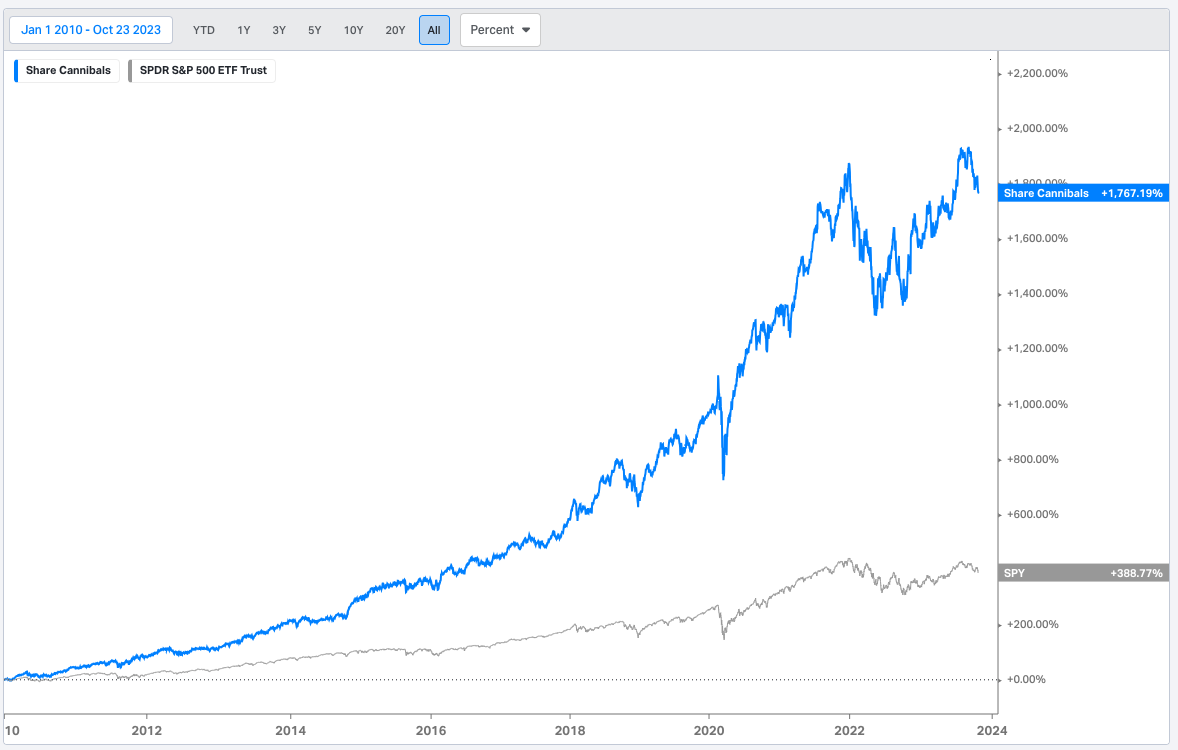
Over the portfolio’s lifetime, the share cannibals would have returned a compounded annual growth rate of 23.6% compared to the S&P 500’s 12.2% with fewer severe drawdowns. Furthermore, the portfolio would have outperformed in each year from 2010 to 2022.
Before anyone chirps at me about cherry-picking, selection bias, and look-forward bias, I understand that. This is not a backtest, it’s merely an example of how well successful share cannibals have performed. There have been some catastrophic failures from faux-share-cannibals. There are also criticisms of share repurchases related to their ability to create artificial results, be abused, and manipulate share prices. The focus of this article is companies that do share repurchases efficiently.
Not all buybacks are equal
A stock buyback is a conscious decision from management. When a business generates excess capital it has a few options; build a cash balance, reinvest into the business, pay down debt, acquire interest-bearing securities, pay dividends, conduct M&A, and repurchase shares. Investors hope that managers will deploy excess capital to wherever they see the highest rate of return. The ideal scenario would see the company have some kind of reinvestment opportunity that delivers returns above the cost of capital, for a long duration. This is often called a reinvestment runway. Particularly in the earlier stages of a company’s lifecycle, one would hope these superior returns are available through direct reinvestment; e.g, a restaurant business opting to expand its physical footprint, earn additional revenue, generate more cash flow, to then reinvest in operating expenses, CapEx, and so on. This virtuous cycle would ideally last for decades. In some instances, businesses may see greater ROI in share repurchases. To some, this signals a lack of attractive reinvestment opportunities.
I once asked1 Todd Wenning, former Ensemble Capital analyst, what the most telling signs a company’s reinvestment moat may be expiring, to which he replied:
“One thing you can look for is increasing shareholder distributions in the form of dividends and buybacks, as that likely means that management isn’t finding enough high-return projects to justify retaining all the capital”.
In a paper published2 by Michael Mauboussin, he remarked that “life cycle analysis also shows that the penchant for returning capital to shareholders in the form of dividends and buybacks increases as companies age”. This is partly related to the fact mature companies tend to generate excess capital once profitable. But an affinity for share repurchases is not necessarily a death sentence. While it may be a signal of a transition from a budding young enterprise to a mature business, there are many ways to earn a return on an investment. Management’s capital allocation is one of the most scrutinised aspects of running a public entity. When a company acquires another business for, say $10 billion, and two years later writes off $8 billion of the value, it looks bad. Investors question management’s judgement and ponder where that $10 billion could have been more effectively deployed. When it comes to share repurchases, price discipline is an area that investors watch closely. In other words, are they acquiring shares when fairly or undervalued, or are they utilising the buyback authorisation for the sake of it?
This year, in 2023, new rules for repurchase disclosures will be rolling out that are set to make these kinds of management decisions more transparent, with greater context, and open to greater scrutiny. Companies will soon be mandated to disclose the following:
A daily log of share repurchase activity, disclosed at the end of each quarter and exhibited in 10-Q and 10-K reports.
A description of the rationale and goals behind each repurchase, as well as an explanation of the criteria used to determine repurchase quantity.
Disclosure on whether directors or executives bought or sold stock within four days before or after the buyback.
More details about company stock trading agreements, including start and end dates, number of shares, and material terms of these plans.
How to find genuine share cannibals
I believe there is no way to know whether a company is going to be a share cannibal over the next ten to twenty years. But I do think there are characteristics an investor can look out for that increase the likelihood of bagging a share cannibal, and decrease the likelihood of acquiring an anti-cannibal.
They are telling you they are going to repurchase shares: It seems obvious, but when undertaking share repurchases, a company typically opens a repurchase authorisation, announces it to shareholders, and updates them on the authorisation each quarter. It may be expressed as a percentage of shares or a numerical dollar value. A quick rummage through the latest 10-Q or shareholder letter will tell you if a company has an existing authorisation and how close they are to retiring it. It’s important to note that an authorisation is just an allowance, not a mandate. I find that as you get to know a company long enough, you develop a sense of how important the share repurchase activity is to the management team. This can be ascertained through earnings calls and filings.
They are not borrowing to repurchase shares: Several of these items are going to refer to basic fundamental aspects of a business. Generally, if a company is using debt to finance share repurchases, this is not a sustainable practice and should be avoided. There are times when a company may temporarily use debt to repurchase shares and pay dividends, like many during the pandemic, but it’s not a long-term solution. Ideally, share repurchases are paid with excess capital that has been generated from within the operations of the business.
The repurchases are sustainable in relation to fundamentals: More broadly, some common sense needs to be applied here. If a company’s share repurchase activity is going up, and the earnings are going down, the two forces are going to collide at some point. During a liquidity crunch or an earnings drought, whatever you want to call it, share repurchases and dividends are usually one of the first things to disappear. There will always be a question of “Are they repurchasing too much?” vs “Are they repurchasing too little?” and there is no formula to ascertain the correct answer. But common sense will take you 95% of the way. Is there a moat? Are the fundamentals improving? Is the balance sheet able to support buybacks? Are cash flows sufficient? Are debt levels manageable? Etc.
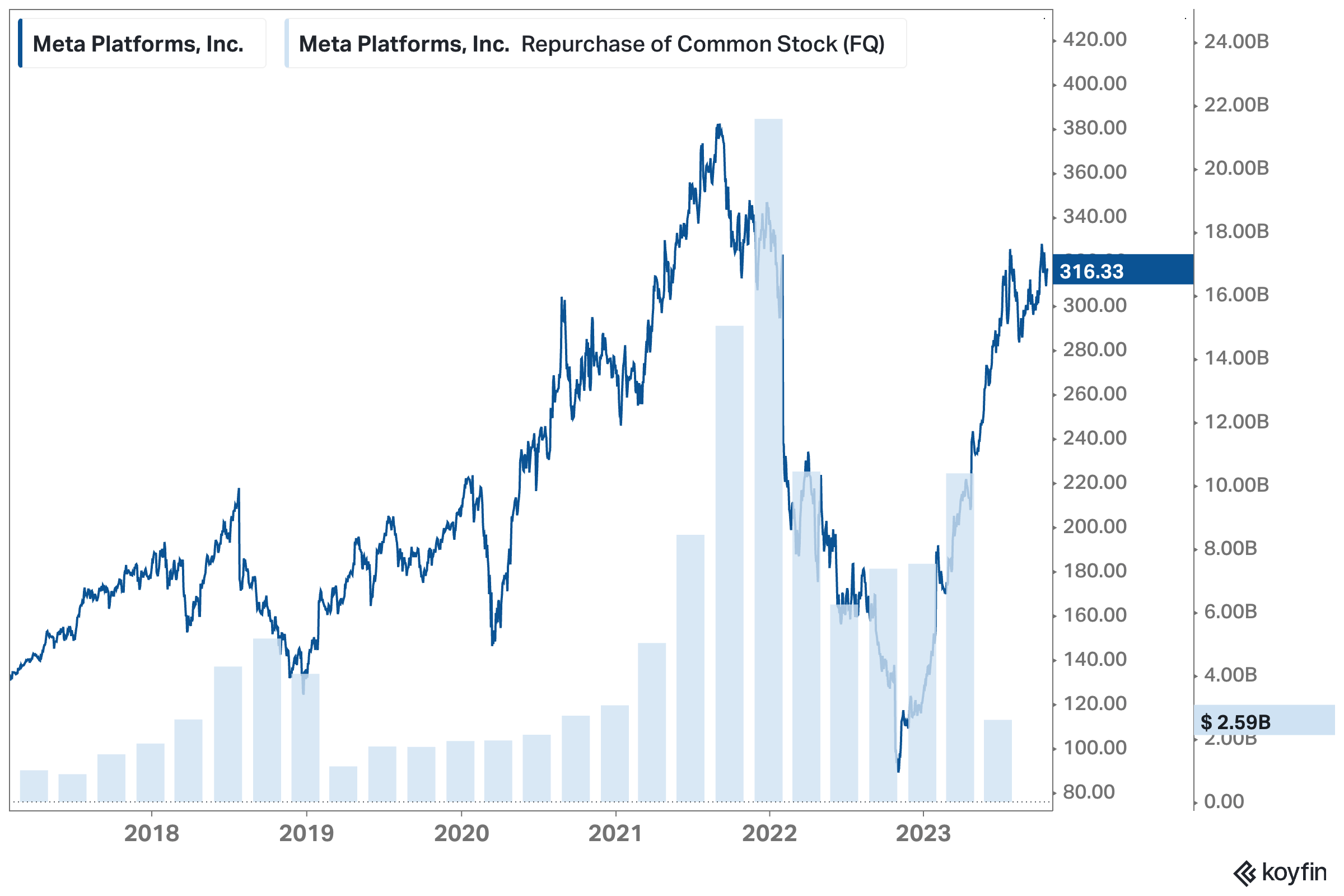
They have good price discipline: It is preferred that management repurchases shares when they are undervalued. The average cost basis and timing of repurchases are available in 10-Q filings, and will soon have even greater granularity with the proposed rule changes. As an example, the chart below shows Meta Platform executing the largest quarterly share repurchase in the company’s history in the same quarter that shares traded at all-time highs. A face-palm for Zuckerberg and Co.
Meta is by no means the worst offender of this, but here is what Warren Buffett has to say:
“Every small bit helps if repurchases are made at value-accretive prices. Just as surely, when a company overpays for repurchases, the continuing shareholders lose. At such times, gains flow only to the selling shareholders and to the friendly, but expensive, investment banker who recommended the foolish purchases. Gains from value-accretive repurchases, it should be emphasized, benefit all owners – in every respect.
Imagine, if you will, three fully-informed shareholders of a local auto dealership, one of whom manages the business. Imagine, further, that one of the passive owners wishes to sell his interest back to the company at a price attractive to the two continuing shareholders. When completed, has this transaction harmed anyone? Is the manager somehow favored over the continuing passive owners? Has the public been hurt?”.
They acquired 40% of their share count of the prior decade: I asked my Twitter followers what characteristics share cannibals possess and this was the humourous, yet true, response from Value Stock Geek. An affinity for deleting shares from existence is usually a good sign this behaviour will continue. Saying you are going to do something and doing it are two different things, so evidence of a track record can be important.
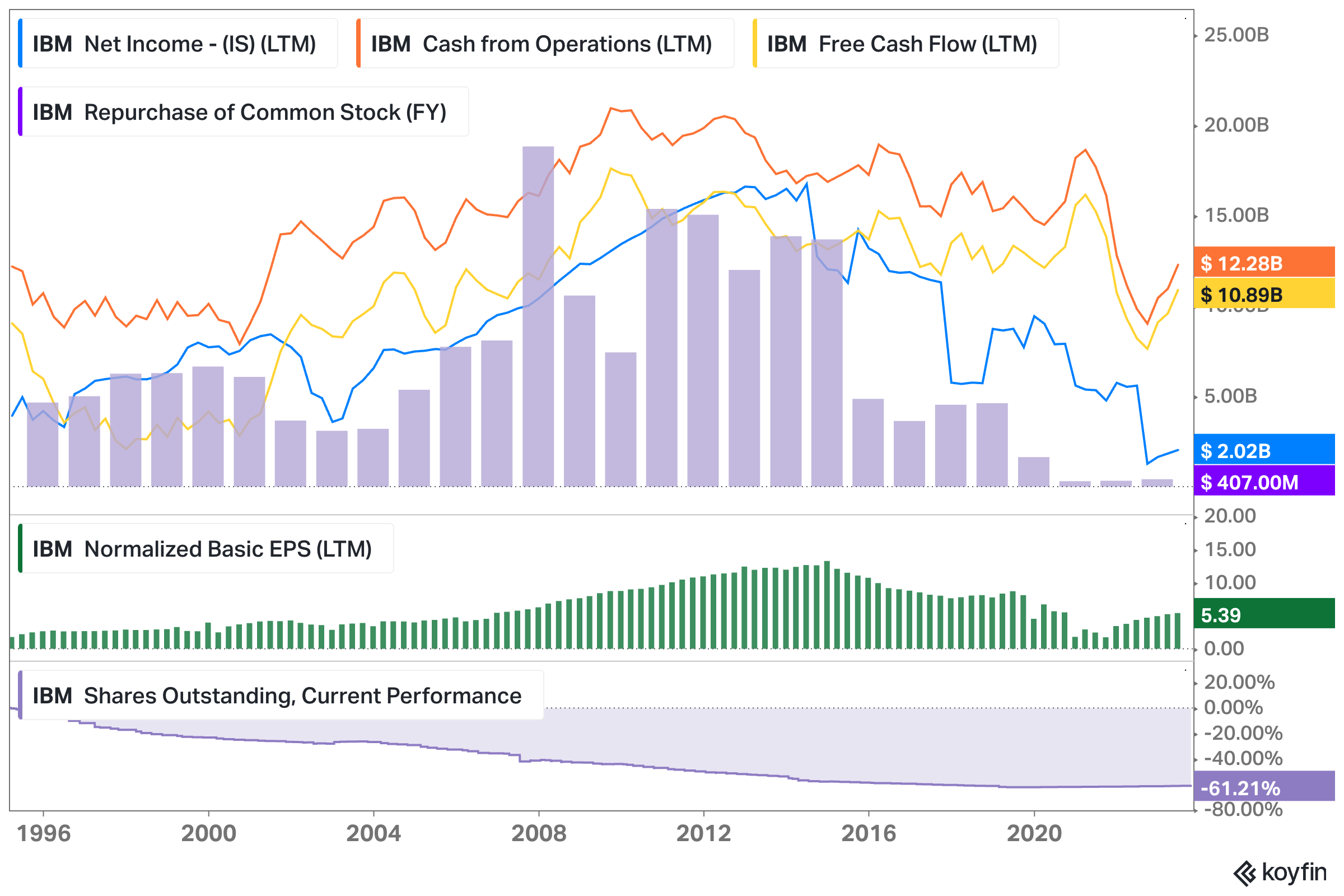
The outlook supports sustainability: An important caveat to points 3 & 5 is that history doesn’t always rhyme. If the company’s fundamentals deteriorate, its status as a share cannibal can too. Take IBM as an example, once lauded for its cannibal status. From 1995 to 2010 the company retired more than 45% of its share count while earnings and cash flows flourished. Sometime around 2012, the company’s revenues peaked, and their earnings soon followed. The chart shows that 2014 was roughly the point at which net income began to collapse, followed by share repurchases, and then earnings per share. The shares have performed dismally since. If the fundamentals sour, the whole magical component of repurchases reverses.
They are not serial diluters: Serial diluters are companies that increase their outstanding share count by issuing new stock to generate income. On the whole, this tends to be a bad practice, but as Genaro Gattuso once poetically articulated: “sometimes maybe good, sometimes maybe shit”3. The practice of stock issuance dilutes the ownership of existing shareholders. If the company is relying upon share issuance to fund its business in lieu of cash flow, with no reasonable expectation that the course of action is going to change, then it spells danger for investors because of unsustainability. PLBY Group, the reincarnation of the Playboy brand, completed its SPAC merger in February 2021 and was once again a public entity. With promises of recapturing the licensing values of a legacy brand and new revenue streams the company, with no profitability, began life trading at ~$12 per share with ~33.5 million shares outstanding. Fast forward to today, and those promises proved to be half-baked, the company has since increased its share count by more than 120%, trades at ~60 cents per share, and is down 95% and facing bankruptcy. In reality, PLBY Group were terrible capital allocators and had no sustainable cash flows to wean themselves off their addiction to stock issuance.
Funny/despressing story. I was suckered into this proposition. It was a small speculative position, but nonetheless a waste of time and capital. I eventually got out at ~$6.50 per share with a 50% haircut and my tail between my legs. Shares have since fallen a further 91%.
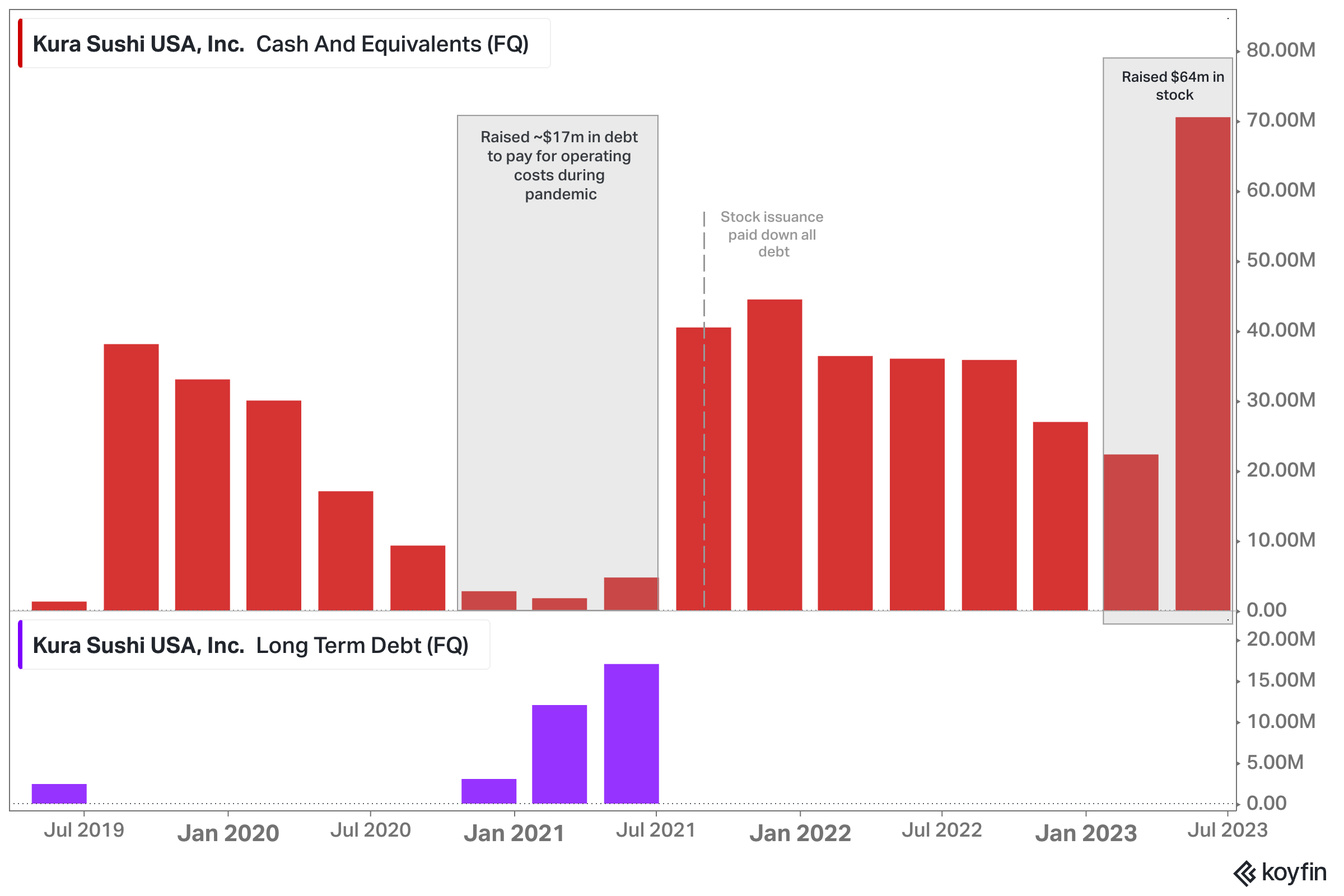
On the flip side, while dilution has a dirty image, it can be a net positive for investors and the company. When the additional capital is genuinely going to help a company become profitable in the medium term, then a little dilution is a worthy price to pay for superior long-term performance. Take Kura Sushi USA, a small conveyor belt sushi restaurant; the subsidiary of a successful parent in Japan. Since becoming a public entity in 2019, the company’s share count has increased by 40%. In their case, stock issuance has been utilised to repay debt acquired during the pandemic to pay for operating expenses, and once again to bolster their cash balance and give them ~3 years or runway to continue their expansion commitments.
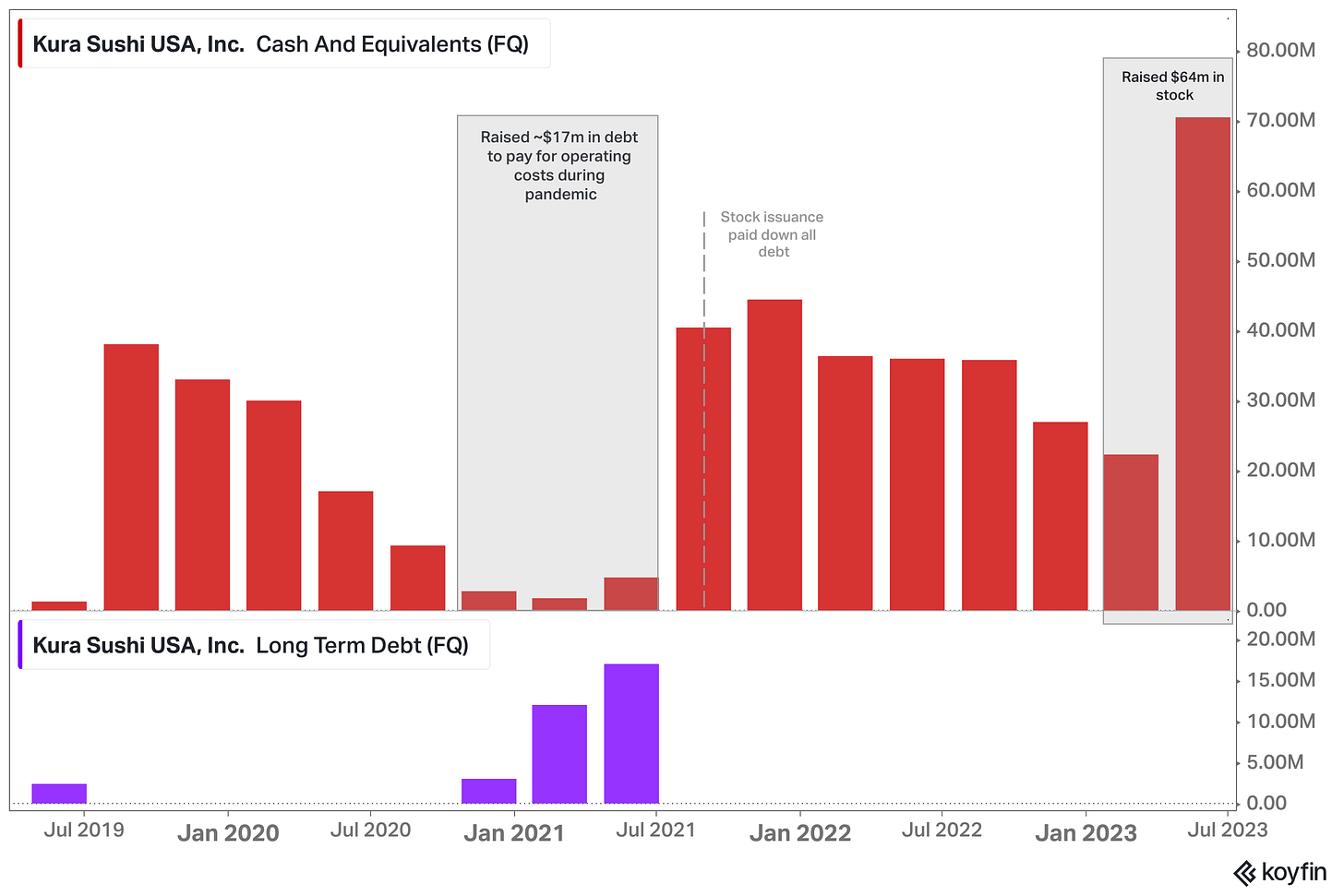
Kura Sushi cash & LT debt, via Koyfin Meanwhile, the company has recently turned profitable again, both operationally and on a net basis, following the pandemic. Restaurant-level margins, average unit volumes per store, and other fundamental data points are all looking positive. I am glossing over a lot of additional contexts here, like how the company has a support line from the well-capitalised parent, but the idea is that these factors instil greater confidence that the dilution is worth it in the long run. Time will decide if this particular example happens to be fruitful or not. That said, Kura Sushi is a diluter and does not in any way resemble a share cannibal.
They are not serial offsetters: The cousin of the diluter is the serial offsetter; a company that talks a big game concerning buybacks, but just uses them to offset dilution. PayPal is by no means the worst offender in this regard, but between 2018 and 2022 the company generated ~$23.4 billion in free cash flow and repurchased $17 billion in shares; about 73% normalised. You’d expect the share count to have fallen more than 6.8% over this period, yet the company issued close to $6 billion in stock-based compensation. Compare that to, say, American Express, who over the same period generated $56 billion in free cash flow, repurchased $18.5 billion in shares and issued $1.5 billion in stock-based comp. The repurchase to free cash flow ratio for Amex is 33%, significantly lower than PayPal’s 73%, yet American Express’ share count declined by 15% over the period, compared to PayPal’s 6.8%. This example simply suggests that a big fat repurchase authorisation is not the be-all and end-all.
Feel free to comment on anything I have missed. I saved one last slither of perspective for last because it’s one of the most important.
Share repurchases don’t magically bump EPS all on their own
If you are still reading you are likely to be triggered that I haven’t mentioned what I am about to mention, or you are sitting there thinking “Gee, this all seems quite magical”. While this all sounds great in practice, the conversation requires far more nuance than I have space for in this article. The presumption that share repurchases always increase earnings per share is too simple, a little naive, and doesn’t factor in how those buybacks are funded. Michael Mauboussin goes one step further and argues4 that there is no evidence that increasing earnings per share through buybacks alone creates shareholder value. Mauboussin continues to remark that “Change in EPS and value creation are separate concepts and an increase in EPS should not be used as a proxy for value creation”. It neglects the question of how these share repurchases are funded:
“Indeed, the presumption that buybacks always increase EPS is wrong. The common portrayal is that net income is divided by fewer shares and therefore automatically leads to a boost in EPS. This simplistic analysis neglects the fact that the company has to fund the buyback, either with excess cash or additional debt. Excess cash generates interest income, and debt comes with interest expense. As a result, buybacks affect net income as well as shares outstanding.
A buyback’s impact on EPS is a function of the earnings yield (E/P), and the after-tax rate either on the foregone income from excess cash or the additional expense from the debt used to fund the program. When the earnings yield is higher than the after-tax rate, buybacks lift EPS. Research shows that when the cost of debt is low companies are more likely to issue debt and buy back stock”.
The vast majority of CFOs believe that EPS is the most important metric in financial reporting. It follows that these same executives believe increasing EPS is an important factor in their decision to repurchase shares. There is also a common sentiment amongst investors that share repurchases are, most of the time, inherently “good”. Now, I’ve not been alive long enough to know from experience, but my research and gut tell me the widespread increase in the market adoption of share repurchases, as well as the greenwashing effect that big tech has conjured for buybacks over the past decade, has catalysed or reaffirmed this optimism.
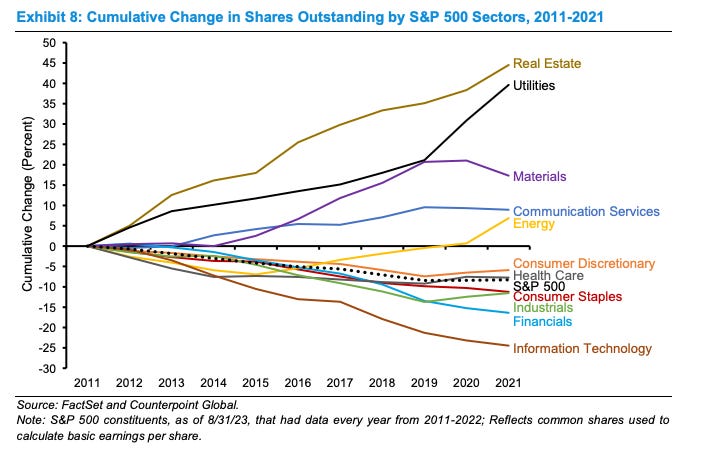
The above chart shows that information technology, as a sector, has seen a 25% decline in outstanding share count over the last decade. This is all to say that it’s not simply the case of “share repurchase good, eps increase good”. For explicit and exquisite detail and further insight into this topic, I recommend reading Michael Mauboussin’s paper listed in the footnotes.
Thanks for reading,
Conor
Hi Conor, great article as everything you write. Your blog is one of the best out there, really. What tools, software or websites do you use to screen for buybacks?
Hi Conor
You showed in a great way, that share buybacks can be a double edged sword.