

Good morning,
I was thinking a few days back at how surreal investing must appear to investors who may have only started in 2020. I have found myself having an ever increasing number of conversations with newer investors that contain the phrases; ‘this is not normal’ fairly often.

Common assumptions would dictate that markets tend to be fairly efficient in developed countries. However, it is no secret that equity markets are largely driven by human emotion during uncertainty, thus the supply and demand will be reflected in the share prices.
Bankrupt companies should not be trading at higher levels than before they were bankrupt, as we have seen this year. But what is an efficient market? Today, we seek to address that question, and beef up your insight in that area.
Market Efficiency
The idea behind an efficient market is one that would absorb new information in a fast and rational manner and then reflect this new information into asset prices. A fully efficient market should reflect all past and present information.

Lets quickly observe two ridiculously unrealistic examples for fun:
Example 1:
You own a house (outright) in the quiet village of Fakesville, and last year the house was valued at $250,000.
The city council have passed a bill that will allow to opening of a gigantic waste disposal center right next door to your house. The unit will allow residential and corporate users to utilize their skip services for a small fee, with no restriction on disposed contents. The unit operates heavy machinery to move the waste, and operates 7 days a week, from 8am to 8pm.
Your house, might just lose a little value if its situated a few seconds away from this new business. The market should react to this information and reflect that in the price others are willing to pay for your home. The demand for the house falls, therefore so does the price.
Example 2:
Let’s say you own some stock in ITCapital, a fictitious investment bank based in the US. You have owned the shares for a while and are happy to hold. They are currently valued at $50 per share.
The expected earnings for their up and coming earnings release was suggesting gross margins to remain flat, and earnings per share to grow by 5%. This is a widely held consensus.
When the earnings report rolls around, it turns out management had improved the bottom line by 5%, and earnings per share had increased 25%, causing a massive earnings surprise.
Markets tend to price out all known and expected information. If the market expected a fairly mundane performance from IT capital, then the realization of improved performance after their earnings report would be a surprise, something not previously known as public information. Therefore, the price would react as investors increase demand for the shares. In an efficient market this would likely happen the day the public information is released.
What Time Frame is Considered Efficient?
So, what kind of time frame does the new information need to be assimilated into the market prices before we can consider that time frame efficient?
Important to note before we begin. Markets are never truly considered to be fully efficient or fully inefficient. Typically, they will lie somewhere between the two extremes.
Investors are interested in knowing how efficient a market is, as this can lead to profitable decision making. Theory states, that in a fully efficient market, there are no opportunities to capitalize on discrepancies of price between market and actual value. Therefore, in a fully efficient market, a passive investing strategy may be preferred to an active strategy. By passive, i am referring to the investor’s decision to simply buy broad baskets of stocks and hold them. This largely relates to the lower transaction costs when compared to an active strategy.
On the other hand, in an inefficient market, pockets of potential pricing inefficiencies exist, that active and diligent investors can take advantage of. Thus, an active stance would be favored over a passive strategy. Imagine, for one moment, that the market takes one week to price in the changes from earnings reports. If the investor reads an earnings report, and decides the company should be trading higher, they could exploit that one week gap and buy the stock. Conversely, if they feel the market price should be lower, they can opt to short the stock, or remove exposure. In reality, the one week gap is not realistic.
This may be true in less liquid markets like real estate, but for highly liquid markets like equities (in developed markets) the time gap would likely be minutes, not days.
To reiterate a point we touched upon earlier: in an efficient market, market prices for securities should be expected to react only the information that was not already anticipated by the broader investing public. Market pricing should only be expected to react to surprise or unexpected information. As we said before, prior to the unexpected information, investors would have certain expectations or values assigned to the security. Should new information, that was a surprise, be released, investors would have to revise their sentiment, thus the supply and demand for the asset would shift accordingly.
Where does this leave market value and intrinsic value?
You may already be aware, but market value is simply the overall public value of the asset. For equities, this is the number of shares outstanding multiplied by the share price. Intrinsic Value on the other hand is more closely tied to the actual fundamentals of the company, and is an estimate figure.
Market value is the price at which an asset can currently be bought or sold. Intrinsic value (sometimes called fundamental value) is, broadly speaking, the value that would be placed on it by investors if they had a complete understanding of the asset’s investment characteristics. For an equity this figure may be derived from cash flows, the dividend payments, book values, and so on. For a bond, this may be derived from the coupon rate, default risk, timing of payments, the principal and so on. Note that we use the word estimate because there is no exact measure of intrinsic value. Whilst it contains quantitative analysis, it is also largely qualitative.
Active investors seek to gain from the discrepancies between market and intrinsic value. If they believe the intrinsic value is higher than the market value, they would buy the stock and wait for the market to realise the intrinsic value. In a fully efficient market, the discrepancy does not exist, thus active investing makes little sense.
Factors that Influence a Market’s Efficiency
As we said, efficient markets should correctly price in all available information in a hasty manner. As we also said, markets are never really considered to be fully inefficient or full efficient, they will lay within the spectrum. The degree of efficiency may also move around over time.
Take the recent corona crises of March 2020. The 31% decline and following retracement, were certainly large examples of markets pricing in information BUT it is highly likely they overreacted in the decline, and maybe overreacted on the way back up too. Markets are less efficient during uncertainty and panic.
Lets run through a few factors that can shift the overall efficiency of the market:
1. Market Participants
Market participants are a huge factor of market efficiency. Most importantly, the sheer number of participants and the volume of their trading.
Imagine we have a market for an asset class, by which there are a huge number of investors in the market, both retail and institutional. If these participants closely follow the markets daily, any pricing inefficiencies will be quickly resolved. Here, we can also consider the number of professional analysts following the security. You will notice if you search for a large cap stock, there will be a large number of analysts covering the stock, and examining the financials on a daily basis. Do a little digging, and find a small cap firm, with maybe only a handful of professional analysts covering the stock, and you already have more room for inefficiency. Less eyes = less opinions = less ability to spot inefficiencies that may exist.
Liquidity of the market also matters in that regard. If you imagine a stock that trades at very low volumes, as opposed to one that changes hands over 25 X more each day, there are less opportunities to spot inefficiencies with the lower volume security.
2. The Quality of Information
One of the core components of efficient markets is the availability and transparency of financial information, which includes financial reporting and media. Analysts cover technical, fundamental and economic aspects of the broader market daily, and those this tends to make these markets efficient. This is true for companies that are covered widely. For smaller, less covered stocks, the lack of news may open up inefficiencies in pricing. The investor may only have SEC filings and limited technical data to base their judgement from.
Depending on the security, companies are bound by law to report certain information and documentation. For equities we can expect quarterly financials, as well as other filings. For bonds, we can read through the bond indenture at the beginning of the sale.
The greater the quality and frequency of information, the more efficient the market.
3. Arbitrage
Some investors can take advantage of price arbitrage, where by a security trades in two separate markets. An arbitrage is a pair (or more) of transactions whereby the investor can seek riskless profits. If the investor spots price discrepancies between the two markets they can take advantage of that, and this act actually adds to market efficiency as they are spotting inefficiencies which will be resolved after they act and profit. They would effectively be buying the security in the market where the security is undervalued, and selling in the market where the same security is trading for a value that is overvalued. This act will bring the prices closer together. Therefore, investors who engage in such activity, will increase the efficiency of the market.
Costs Incurred in Transactions
So, as we have discussed, there will be investors who seek to identify market inefficiencies and exploit them, which will eventually impact the overall level of market efficiency. For the most part, there are costs associated with this action. Typically, these investors incur transaction costs or information related costs.
• Transaction Costs:
Transaction costs are simply the costs incurred in trading in such a manner that seeks to exploit any market pricing inefficiency. Let provide an example.
Let us say that we have two identical assets trading in market A and market B.
In Market A the price is $100
In Market B the price is $105
To exploit this circumstance, we could short the asset in market B and buy the asset in market A. Thereby shorting the asset in the higher priced market and buying it in the lower priced market.
Let us now say, that the transaction costs for making this trade are $6. In this event, the price discrepancy is less than the transaction cost, thus we can say that the prices are efficient within the bounds of arbitrage. We can’t really take advantage of this situation due to the pretty much equal price when we factor in transaction costs.
• Information Costs
Simply the ongoing costs of acquiring and analysing new information. However, strict theory would indicate that new information is reflected in market prices fairly quickly. So for the spot part, active investors who pay for information are already too late.
I don’t personally think this is so true, but we will get into this topic in a future newsletter!
The point i wanted to make here was that investors need to assess the costs of transactions and information when considering the efficiency of the market. A price inefficiency can only be exploited, if that discrepancy is large enough to leave the investor with profit.
The Three Forms of Market Efficiency
Recall this image from the beginning of the newsletter. We shall now discuss the three theoretic market efficiency forms; weak, semi-strong, and strong.

Weak Form

A great number of technical analyst’s would suggest that prices can, in fact, be used to extrapolate future movements. Technical analysis aims to make use of historic price data and ‘predict’ future patterns. I personally think this is more to do with the human nature of markets that can, at times, be driven largely by psychological factors.
Whilst a smaller number of technical analysts may be able to benefit from certain trends over time and earn profits, the wider evidence suggests that they can not make abnormal profits on a consistent basis.
However, there will always be outliers.
Semi-Strong Form
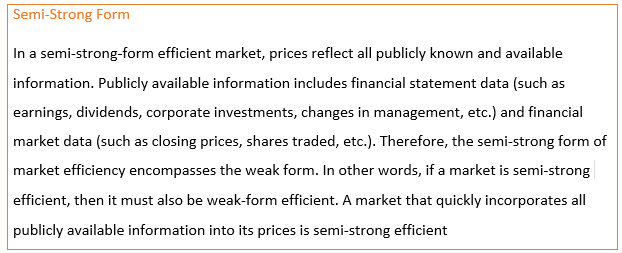
In the semi strong version of market efficiency, any attempts to analyse public information (like earnings reports) in order to find a price discrepancy, would be useless. If markets are semi-strong efficient, then the information you are reading is also available to all other market participants, therefore must be priced in already.
In the semi-strong form, market prices will absorb new public information quickly, thus removing the ability to earn super normal returns from events like earnings releases.
Most researchers tend to believe that developed markets typically are situated in semi-strong markets. We have fast information absorption, but there does exist room for discrepancy from time to time.
Strong Form
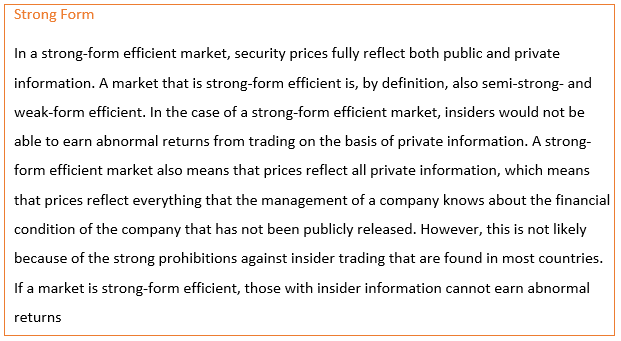
The strong form would indicate that investing passively is the only hope for earnings long term returns. The part about insider information being reflected may sound odd. Picture this. Management are aware of the day-to-day financial health of the company, if they are bullish, they may buy a lot of stock, which will be reflected in the share price, both on a technical factor, and the sentiment factor from other investors who see that management are buying shares.
Basically, in a strong form market, even if i had non-public information, i could not exploit that information to earn fatter returns, because, in theory, that information should already be priced in.
Summary
I hope that gave everyone a little insight into the theoretical backdrop of market efficiency. Personally, i tend to assume markets are semi-strong efficient here in the UK/US. There are some markets in developing markets, where may a weak form is present.
However, i hope today’s newsletter has been educational, have a great day.
Until next time
IT