

If you wish to read this as a webpage, and not an email, then follow this link, where you will be directed to all of the previous guest interviews.
I first met Chris in early to mid-2020. Within our first interaction, I could get a strong scent of this gentleman’s passion for investing.
High energy, high octane, and an almost OCD-like compulsion to drive his learning curve upwards and to the right (at a very steep angle).
I have learned a lot from Chris over that year, as I am sure many others who have interacted with him have too.
I stated, during edition 22 of this series, that the guest is the one who makes or breaks the quality of these interviews.
Anyone who knows Chris will have already known that when the time came for me to interview him, it would incredibly informative.
Like everything he does, the responses to my questions left no stones unturned. He was fully candid, took the time to really dig deep into his answers, and unleashed his boundless curiosity and energic mindset into this piece today.
I have to say a huge thanks to Chris for putting his all into this today, and a big thanks to Titan for ensuring that the compliance was up to scratch, and for allowing us to share this interview today.
Chris Seifel from Titan Global Capital Management
Chris was born and raised in Boston and is currently based in New York, now acting as an investment analyst for Titan Global Capital Management.
For compliance reasons, I must stress that the views and opinions shared in this interview today are Chris’ own. They are not the views held by Titan, nor are they in any way related to, or contributors to, the discussion that I held with Chris.
You can find the full disclosure at the foot of this piece.

I will refrain from explaining Titan, as Chris does a great job of this in the first question of the interview. If you are interested in Titan after reading this piece, then you can find more about them here:
Over the last year or so, Chris made the jump from private equity, to form his own investment research business, focussed on the public equity space, and now is situated within the team at Titan.
Prior to Titan, Chris ran his own investment research and analysis business at Seifel Capital Management.
Previously, Chris was a Senior Associate at Post Acute Partners, a middle-market family office. His experience also includes roles in corporate finance and investment banking. Chris graduated from the University of Miami with a bachelor’s degree in Finance and Economics.
You can find Chris over on Twitter under the handle @2ChaseGreatness.
I could not speak more highly of Chris, so I will let you now enjoy the piece.
Word of warning, this one is long, but let that not be a detractor. The amount of insight, context, and knowledge that is shared in today’s interview are immensely valuable.
The Interview

Investment Talk:
Good morning Chris.
We finally have you here to answer some questions!
When I first shared that I would be interviewing you, I got a boatload of Twitter questions, so I have tried my best to integrate those into the questions I will be asking you as well.
So, to kick this thing off, share with us a little context into your history and how you became involved in the investment industry.
Then, maybe you could give us a brief summary of what you will be doing in your new role at Titan?
Chris:
I was born and raised outside of Boston, Massachusetts.
I fell in love with the stock market after my baseball career ended prematurely (three elbow surgeries). After I graduated from the University of Miami, I got experience in banking and corporate finance before landing at a family office that specialized in acquiring seniors housing facilities and operations.
So, I was fortunate to get a master class in both real estate and business operations. This role was the most impactful for my career; I was fortunate to be taught a level of analytical rigour and critical thinking that would have been rare for me to get elsewhere. Fast-forward three or so years and I made the decision to pursue my passion, which was investing in public markets.
I was too constrained and unable to pursue my intellectual curiosity since the seniors housing market is extremely niche.
I broke out on my own in April 2020, with the intention of spending a few months reading and learning to start developing my own framework and investment process. I wanted the time to do so before pursuing a job at a buy-side fund, but COVID had other ideas.
I got involved with Twitter in June or July, ended up starting a newsletter to elaborate on my thoughts in August, and have now decided on the right next step for me.
I had been writing detailed research reports for the past few months, along with building out some core analytical infrastructure (i.e., financial model and valuation templates, watch list workbooks, news hubs, etc.).
It’s a feeling I can’t describe – finally being on the path that makes me feel fulfilled. It’s not the returns that I love, it is the process. Everything from company and industry research to portfolio management and position sizing, I can’t get enough of it. This is what I do in my free time, so I’m never really not “working” – but this doesn’t feel like work. It’s fun, it’s what I love.
Everyone familiar with my work knows that I’m on a mission to both understand how the world works and help others develop the fundamental skills to become successful investors. It became readily apparent that my mission was aligned with that of Titan Global Capital Management almost immediately after being introduced to the team. After about a month or so interview process, I was grateful to have been offered to join the team as an Investment Analyst covering equities.
So, what is Titan?
Titan is the investment management platform and operating system of the future, bringing active management to the broader retail public.
The hedge fund / active management product has historically been accessible by only wealthy individuals and institutions. Titan is flipping that paradigm on its head by providing active management across different product types. Current portfolios include large-cap domestic, small/mid-cap domestic, and international equity.
The team is also in process of launching the first actively managed crypto fund and other products are in development. The sign-up process is incredibly efficient, the platform UX is modern and sleek, and investor communication is the best I’ve seen. What excites me is not just the impressive performance but also that the platform helps everyone who signs up to become better investors.
My role will quite simply be that of any buy-side analyst.
Idea generation, managing coverage universe, research, valuation/modelling, investment memos/pitches, and an active role in portfolio management (i.e., position sizing and management, allocations, etc.).
As a positive for my Twitter followers, I will also be working on content generation with the team. I’m incredibly excited about the growth opportunities not only for myself within Titan but more so for Titan as a whole.
I believe that the team has identified a real need in the market and are meeting that need with an extremely high-quality offering. I was taking my time to find the right opportunity, and I am highly confident that joining Titan was the right opportunity for me.
There are no minimums or capital lockups, you can sign up for Titan here:

Investment Talk:
That is awesome Chris, thanks for that.
We have been talking for some time now, and I am genuinely pumped for you. Could not have happened to a better guy, and Titan just acquired a machine.
I know that you came from Private Equity originally, so why did you feel compelled to make the switch, and what are some of the biggest differences between the private and public markets?
Moreover, if you could maybe share with us some of the skills that you feel were transferable as you migrated, that would be cool too.
Chris:
I fell in love with finance and decided to switch my degree track to a Finance and Economics double major after getting exposure to the stock market during a freshman year internship.
It was the reason why I wanted to study finance; to me, it seemed like a source for endless learning. Learning is my why; it is what drives me every day.
The public markets quench my thirst for knowledge, while my experience in private equity had me studying and learning a very narrow industry vertical. So, I felt that passion whenever I had a chance to study public markets and companies, but not necessarily when I was at work.
We only have one life and time is our most valuable and scarce resource. However, all my time was allocated to something that didn’t give me meaning. So, what took me so long? It’s hard to pinpoint any singular reason. However, I have meditated quite a bit on it over the past year.
First and foremost, I lacked one of the most important skills a person can develop in their life: decision making.
I made very short-sighted career decisions, choosing the path of least resistance nearly every time I had to make a decision.
I was living in a state of fear and comfort for many years, doing what was easy instead of what was hard. The result was misery, for lack of a better term.
It’s interesting, right?
By doing what I felt was comfortable, I became uncomfortable. And this reminds me of a quote by Jerzy Gregorek, “Easy choices, hard life. Hard choices, easy life.”
Without going too deep down the rabbit hole, I have been on a mission to achieve peak performance since I broke out on my own. This includes mental, physical, and spiritual health.
As such, I have developed better decision-making skills, learned to embrace discomfort, and most importantly – continue to learn how to learn – to optimize everything in my life. I forget where I heard this, but it has always stuck with me: “discomfort is the price of admission to a meaningful life.”
Aside from the modelling skills, having to analyze both equity and credit has been helpful in the public markets to identify risk and potential downside.
For a little more context, we were acquiring assets with high turns of leverage since debt came in the form of mortgages given the OpCo/PropCo nature of these deals [Meaning, we were acquiring both the operating and property entities; OpCo cash flow was used to pay rent to the PropCo – sized in a way to meet DSCR and other covenants].
The circularity of this is really interesting, right?
Because the amount of debt we could underwrite was a direct result of PropCo NOI (i.e., Rent less Property Taxes and Other Property Expenses) and cap rates.
But PropCo NOI was directly the result of how much “rent” OpCo could pay to PropCo.
So, what we were really underwriting was OpCo EBITDAR (EBITDA and Rent). I was then forced to learn how to analyze operating companies inside and out, so we could ensure the EBITDAR forecasts provided enough margin of safety relative to the amount of “rent” OpCo had to pay Propco in order to generate sufficient NOI to service the mortgage.
The partners preferred to minimize their equity checks, so we were constantly doing scenario analyses to determine the maximum amount of leverage we could underwrite while still having a meaningful margin of safety.
As a result, the focus on downside risk protection being the first and foremost part of the analysis has been critical to my process in public markets. Food chain and competitive analyses were also core parts of our process that I have carried over.
In summary, it was really the high level of analytical rigour that was drilled into me that will pay off for the rest of my career.

Investment Talk:
I have been reading your newsletter for a while now after we connected about a year ago. Over there, you discuss a lot of topics that are quite technical, whether it be broad investing thematics or something like semiconductors.
What sparks the idea for what content matter you will discuss?
Is this more a process of, you finish studying a subject and share your insights, or perhaps one you already understand but wish to inform others about?
Would be great to hear some insight into that. Moreover, for readers who may not be familiar with the work you put out, what is The Polymath Pursuit newsletter, and what are your aspirations or intentions for that publication?
Chris:
The “what” goes back to my “why” – it’s really wherever my intellectual curiosity takes me. It is somewhat like the analogy Guy Spier gave when talking about his idea generation; it’s like a drunk guy stumbling around a bar.
A lot of the time I am just trying to learn, and I get taken down certain roads that I find fascinating.
Using semiconductors as an example.
I love Shane Parrish and the work he does at Farnam Street. He released a special podcast breaking down the chip industry with Jon Bathgate and Brinton Johns from NZS Capital back in November or December last year.
It may have been the way Jon and Brinton broke down the industry or something else, but I was completely captivated. I am very obsessive-compulsive; I attack everything I do with all of my energy and focus to an almost unhealthy level.
I believe that how you do anything is how you do everything. When I become captivated, I dive ALL the way in.
Many people say it, I’m not one to say if they actually do it, but I take a genuine Feynman Approach to learn about anything (another h/t to Shane Parrish).
So, I try to dumb it down to the most basic principles so that I can explain them easily to myself.
For semis, it may not have been necessary, but I started with the actual manufacturing process and built it up from there.
For any company I analyze, I don’t begin the company analysis before I understand its technology at a fundamental level.
Then once I understand the technology, I attempt to diagram (literally draw) the company’s technology and business model as a system. I was highly influenced by the book ‘Thinking in Systems’ and it is the lens through which I attempt to view any company, industry, or business model.
Then I proceed to rip through a company’s financial statements top-down, do the same for a few competitors, then return back to the industry view.
I am using the newsletter more as a medium to teach others as I learn about an industry myself.
I certainly didn’t understand AI or semiconductors before I started writing about it. I try to make that clear too – I am learning about these industries just like everyone else. I am going to make mistakes and I have a lot to learn. But this is my best shot at a current understanding that I wish to share.
Moreover, I want people to reach out to me and tell me where I may be wrong. Or point me towards a different perspective for how to understand the topic. My motivation is to learn, so I want people to correct me if I am wrong. I very much attempt to live with a growth mindset – learning and effort are the key benchmarks for me.
Writing is one of the best mechanisms for someone to flesh out ideas and identify blind spots. The newsletter has not only given me the opportunity to share my ideas and knowledge with others, but it has forced me to be a better thinker and analyst. Most importantly, it is a vehicle through which I can attempt to help others become better investors; giving them the tools to do the analysis themselves. I would like to continue the newsletter with as much detail as I can once I am working at an investment management firm.
However, it is not a long-term career aspiration.

Investment Talk:
Now moving on to your actual investment approach here. In a nutshell, what would you say you are looking to achieve with your allocation to individual companies?
How do you approach investing in general, whether this be a mindset or a specific school of thought?
Then lastly, what kind of companies, are you most attracted to, what are you seeking out there amongst a plethora of public entities?
Chris:
Maybe I’m not understanding the question, but from an absolute return perspective, I am looking to achieve greater than a 20-25% IRR on each investment.
From a relative return perspective, I am seeing risk-adjusted returns greater than the Nasdaq since my personal portfolios are weighted towards tech. I don’t get too fancy, just tracking my Sharpe, Jensen’s Alpha, etc. The point with relative returns is to always be beta and factor aware.
This approach to investing in general question is going to take a while here.
I don’t think I have ever collated my thoughts into a single repository, so this will be quite a lengthy exercise for me.
To start, there is no specific school of thought that I subscribe to. Rather, I have amalgamated the principles and frameworks from some of the best investors I have come across.
However, there is one caveat.
I only adopt those frameworks which resonate with my personality and worldview (which I am also always refining). While I have a core investing system, I am constantly refining and optimizing my views by evaluating what works and what doesn’t work.
The key for doing this is what is referred to as “Feedback Analysis”, which I use in all areas of my life. It requires writing down my expectations when making a key decision or taking a key action, then revisiting this note in 9-12 months to compare reality to my expectations.
From this, I can identify my strengths, weaknesses, and how I can improve. I do this in investing with a simple journal. I have a written investment process through which I need to identify the critical factors that I believe will dictate the investment outcome. So, by writing it down I not only create a system for keeping myself honest but also for more clearly evaluating the role that skill and luck played in an investment.
This then leads to the importance of pre-and postmortems in my process. I can feel myself going on a tangent here; reeling myself back in.
If it is ok with you, I will create some bullets here to outline my mindset:
• Concentration: I have written on this quite a bit and I am not trying to trigger anyone here, so I won’t go into too much detail. To play off Buffett’s views on the subject, if you feel the need to have a lot of different companies in your portfolio as a means of “risk protection” – you’re better off investing in an index-based ETF (which I think the overwhelming majority of investors are better off doing anyways). If you are trying to manage money, no one is paying you to hug a benchmark and generate market returns by investing in 30, 50, 100 names with ~equal weighting.
- Concentration refers to percentages. You can own 50 names, but if the top 10 investments account for 90% of your portfolio – you are concentrated.
- “Deworsification”: You dilute your portfolio with companies you have less conviction in, in exchange for companies in which you have an expectation of higher expected returns.
• Forecasting Folly’s: I would urge everyone to read “Superforecasting” by Philip Tetlock to drive home the point that even experts are horrible at making accurate predictions. Actually, we would be better off just forecasting based on the base rate.
Additionally, humans have an exceedingly difficult time understanding exponential/nonlinear behaviour. All of this is to say, compare the forecast period of a model you built a few years ago to a company’s actual results – I doubt you were even close to right.
The analogy I use is that I am the expert on my own bank account, but I have no clue how it is going to look in twelve months.
How am I supposed to correctly forecast a multibillion-dollar, international enterprise?
- With that being said, I believe building models have a very specific utility in the analytical process. Specifically, building a model is the best way for me to understand the business:
1) How does a dollar flow through from sales to cash flow?
2) What are the unit economics? Is there upside here?
3) Is there operating leverage in the business model? How sensitive is profitability to changes in Revenue (be it price, volume, or mix)?
Additionally, the model does allow me to express my directional views of the future while knowing that I am likely to be incorrect.
Your question on the types of companies I’m looking for – I can summarize pretty quickly. This has certainly evolved pretty rapidly, from the broad to the narrow. I have simplified my framework, much of which is informed by Yen Liow of Aravt Global.
I think that having a truly “differentiated view” is pretty rare. So flipping that on its head, I am focused on finding monopolies or functional oligopolies.
Two indications of this dynamic are;
1) pricing power, and
2) the potential for high returns on invested capital.
It is not enough for the company to have this structural advantage; it needs to have a runway of reinvestment opportunities at which its return on incremental invested capital is also greater than its cost of capital. I think this is somewhat a differentiated perspective because a successful investment in these companies requires longer time horizons, and time arbitrage is real.
I’m not going to dive in a lot deeper, but these monopolies can manifest in a few different ways. I am drawn specifically to asset-light and/or vertically integrated compounders. It all comes down to one of my core mental models, which is there are two things to figure out for every investment:
1) what is important and
2) what is knowable.
Monopolies, by definition, have a more “knowable” distribution of outcomes because you are isolating one of the key variables that hinder value creation is competition. The outcomes from competitive dynamics are always wider and more uncertain. By eliminating this variable, you can take bigger bets and increase the probability of a successful investment.

Investment Talk:
Has this style changed at all over the years? If so, what do you feel have been some of the most significant learning experiences, or failures (same thing), that have shaped the way you invest in the current day?
Chris:
A part of the reason why and how I have evolved is simply learning and consolidating my mental models into archetypes. I’ll be a little more concrete. I started out practising what is commonly referred to as the “value” approach since that’s how we were trained in college. I don’t necessarily have a timeline of my evolution, so I’m going to end up just rambling on this.
My first major evolution was from traditional “value” to “growth” after I was introduced to Bill O’Neil and read “How to Make Money in Stocks”. The growth framework just resonated with me.
Value seemed constrained by simply how cheap you could first buy the stock and, by definition, there is a lower bound on returns. If you’re buying fifty-cent dollars and selling once you are back to a dollar, your returns are capped at 100%.
However, growth investing seemed unconstrained and provided for higher returns overall. But what got me hooked was the type of companies that aligned with a growth framework (i.e., technology, Internet and eCommerce, healthcare, communications, etc. - all the industries that I’m interested in.).
I started focusing solely on public markets a little over a year ago and I can candidly say that the slope of my learning curve has inflected vertically.
Just the pure volume of research and writing I have done has had a material impact on my development. But more so, it has been the time I have taken to read and learn from prominent money managers who have demonstrated success over long periods of time.
While I may not have a formal mentor (yet!), I have been able to learn directly from these investors through the variety of podcasts, write-ups, and presentations that are freely available on the Internet. It’s remarkable how many resources are available to us.
To be brief (hold the jokes), the following investors have had the biggest influence on me. I’ve also included one of the many ways my framework has evolved because of them.
• Yen Liow (Aravt Global): Studying right tail business models and strategies; changing my focus from differentiated perspectives to unfair fights (I can elaborate with specifics). I love how he refers to investing as a “blood sport”. Even more important is that Yen indirectly showed me how to be a peak performer through various resource recommendations and mindset shifts.
• John Huber (Saber Capital): His work on ROIC has helped me refine my own thoughts on the topic.
• Dennis Hong (ShawSpring Partners): I could listen to Dennis talk about stocks and investing on repeat. Dennis’ frameworks around ecosystem control and cognitive referents were transformative for me.
• Gavin Baker (Atreides Management): Gavin was one of the sparks for me to start looking into semiconductors. Over and above semis, Gavin’s domain knowledge around technology is second to none. His concept of being in the top 1% of knowledge for any given stock is a strong motivator for me.
• Brad Gerstner (Altimeter): Brad introduced me to the concept of essentialism opened my eyes to a whole new way of thinking.
• Countless Analysts: Countless analysts on Twitter have taught me a lot.
I would describe my current framework as GARP. I still focus on growth stocks but understand the importance of valuation on shorter-term time horizons. I endeavour to hold my personal investments over long time periods, and as the time horizon lengthens, the importance of price paid diminishes (this is simple math, don’t at me).
However, I am also realistic. Not every company I personally invest in will be worthy of me holding long-term, I will end up exiting over 6, 12, 36 months, etc. for a few different specific reasons. Given that reality, the price I pay has to be sensible.
My mistakes, and the associated lessons learned, are countless and varied:
• Positioning Around Earnings: I learned to exit or drastically reduce my position size if the delta between my unrealized gain and max loss rule (~8%) is less than the implied downside move around the earnings event. The big learning moment was Q2 2020 earnings for both Alteryx and Datadog.
• Know the Technology: Speaking of Alteryx, I made a massive mistake in not fully understanding the underlying technology. Even worse was not understanding the technology relative to competitors. Now I start with the technology and its place in the market. Maybe, more importantly, I use my network in the VC community to understand the new technologies that are evolving.
• Patience: I sold both FUTU and APPS before their massive runs because I was not patient enough to let the idea work despite having conviction. After FUTU retraced after a stellar CY Q3 2020 ER, I gave up on it. I thought that sentiment was telling me the market wasn’t agreeing with me. That was before the stock proceeded to 4x. Lesson learned.
Those are just a few of my errors of commission and omission.

Investment Talk:
Okay, so I had to ask you about semis at some point.
I really enjoy the work you put out there in this industry, as it is one that is definitely not in my circle of competence.
I gather your own portfolio is somewhat exposed to various companies across the semiconductor value chain.
Firstly, why do you feel this to be an attractive industry at this moment in time, or rather why does it interest you?
Then secondly, for the noobwhales among us, what is your take on the recent shortfall in supply in this space?
I recall Intel’s CEO suggesting that this issue will persist for years still.
Some thoughts on that would be super.
Chris:
Noobwhales is a beautiful term.
So, maybe it’s helpful for me to start with how / why I became enamoured with the space.
Then coming forward chronologically I can answer the questions. I knew about NVDA and AMD, maybe some others, because they were typical “growth” stocks. But recall my comment on knowing the technology – I had absolutely no idea of what the hell they really did.
I came across Gavin Baker’s appearance on the Koyfin Podcast sometime in the fall of 2020, which was the first time I heard him speak and was blown away. He touched on semiconductors briefly in the interview, discussing how semiconductors “are the closest thing to magic”. That caught my attention but I never followed through from there… until a few weeks later.
I love The Knowledge Project, a learning engine developed by Shane Parrish. He released a special podcast on semiconductors featuring Jon Bathgate and Brinton Johns from NZS Capital in November 2020. It was while listening to this show that I got hooked.
I think it was specifically Brinton’s explanation of ASML’s EUV technology that had me laughing in bewilderment and amazement. I immediately looked into and learned the basics of the EUV tech and immediately fell in love with the space.
I can answer the first question in a few different ways.
It interests me for I’d say two main reasons:
1) the progress of civilization rests on the industry’s ability to advance IC technology and
2) there is a natural overlap with quantum mechanics, which I have become fascinated with, as well.
These two factors make it easy for me to do deep dives since it is highly applicable to economic progress and the physics behind the engineering is remarkable.
I feel it is an attractive industry for one pretty simple reason. I believe that there will be a persistent supply and demand imbalance for the next ten years (who knows beyond that).
Supply: I’m not going to debate the merits of whether or not Moore’s Law is dead. The fact is that PPAC (power, performance, area, cost) improvement is becoming more difficult as the industry moves towards lower (advanced) process nodes.
To overly simplify, transistor sizes (thus, densities) are shrinking too slowly – currently around 12nm – which means the technical definition of doubling transistor density every 18-24 months is no longer possible. So, geometry scaling is a hurdle for continued innovation.
The industry has thus had to develop other methodologies to keep pace with the performance per watt requirement of Moore’s Law. Such methodologies include heterogeneous integration, 2.5D/3D packaging, etc.
However, these methodologies are significantly more difficult and expensive, which provides a headwind on production capabilities. There are certainly interesting innovations taking hold, such as Gate-All-Around and the aforementioned packaging innovations.
A blatant issue resides in photolithography. I won’t go into the particulars of EUV technology and ASML’s monopoly, but even with their next-gen HNA machines, EUV technology is only feasible for the next decade or so. The industry does not yet have a solution for continuing to shrink form factors with higher processing capabilities beyond that time horizon.
Demand: There are the obvious buzz words associated with semiconductor demand: 5G, IoT, AI, etc. etc.
But the real driver of forward demand is the latter.
The computational intensity of AI applications is staggering, and it is not waiting for the chip industry. AI model parameters are doubling every 3.4 months, meaning the performance and power requirements of these models is scaling exponentially.
AI hasn’t even started the first inning in its renaissance, I don’t think the majority of people can conceptualize what this means from a computing standpoint. On a related note, data will continue to grow exponentially, which will all have to be calculated, stored, and processed by semiconductors.
All of the above doesn’t even include the fact that silicon content per unit across a variety of industries (i.e., automotive, smartphones, etc.) will also be growing rapidly – with some areas expected to double by 2025.
While there certainly could be double-ordering and inventory corrections short-term, the long-term trend seems obvious to me.

Investment Talk:
A Twitter user asked me this one, but I felt it was so important, I may as well include it in the main body of the interview.
One of the biggest roadblocks to picking individual companies is a solid understanding of how to perform fundamental analysis. For a new investor, the scope of what they might need to know feels like a never-ending expanse of variables, as they delve further.
At first, you might assume you have to understand the accounting side. Then you realise you have to understand the marketplace and the competitors too.
Following on from that you realise you need to understand the unit economics, the management teams, the capital allocation, competitive advantages, and so on. It can be quite daunting.
So, for a new investor, who is looking to get started in learning how to efficiently conduct fundamental analysis, what would your advice be?
Chris:
Tell them to let me know if they figure it out.
I could write a book on this topic and could answer in a variety of ways.
Essentially, there is a short-form (“quick cut”) process and a long-form process that I follow.
The quick cut is to either rapidly get up to speed on a name or serves as a filtering mechanism to either continue my analysis or move on to a different idea.
The long-form process is the logical evolution of the short-form process assuming it makes it past that quick-cut filter. The first thing you must do before starting any project is identify the goal – understand why you are doing something.
Let me start with the conceptual nature of the work.
It all starts with, what is the question being asked – what is the debate that the stock revolves around?
Meaning, there is always one or two things that truly drive a stock. Your job is to figure out what that is and then form a falsifiable view around it.
This leads me to my first point, and confusion I see everywhere on Twitter.
A good business does not equal a good stock. It certainly may be the case, but those are two different ideas.
If you consider yourself an analyst, you need to realize that you are a stock analyst, not a business analyst.
One of the great aspects of the buy-side is that there is a scoreboard by which we can all be measured. Luck plays an increasingly larger role in returns as average levels of skill increase, but you are only successful if your stock pick goes up.
If you find a great business but the stock goes down, you were wrong. So the logical question then follows, what makes a stock go up?
It’s one thing: increases / upward revisions in the expectations of a company’s future cash flows.
I’m not going to go deep into valuation theory; however, this makes a lot of sense intuitively. Bifurcate company value between historical and future performance.
Historical performance is set in stone, there is no risk to the value that has been created, how the market values historical performance is relatively static.
So then all changes in value must be related to the company’s future cash flows. The volatility in stock prices can be thought of as the market simply changing how it values the average expected future cash flows.
When the level of average expected future cash flows increases, so too must the new baseline of the market’s view of future value. So, your job is to find the companies that the market will have to increase its expectations of future cash flows. To encapsulate that diatribe simply, you have to do three things:
1. Understand the expectations that are currently baked into the stock price.
2. Determine what you believe is the company’s most likely future performance. This requires both financial and strategic analysis.
3. Finally, make buy/sell/pass decisions based on the difference between your view and the market’s expectations of the company’s future cash flows/fundamentals.
There’s a lot I’m leaving out here, but that is the gist of the goal. For those of you “long-term” investors chastising me under your breath, let me be clear that time-horizon can be a “differentiated view” or “competitive advantage”. Read on.
With all that being said, I can briefly explain my quick cut process:
• Start with a blank model and read both the 8K and presentation of the latest earnings report
- You are not building a full model; you are looking at KPI trends. This gives you clues into the key questions (i.e., why is the take rate declining Q/Q?
• Read last Earnings Call to figure out, then focus on, the main debate/question.
• Read the “Business Overview” section of the Company’s 10-K.
• Read at least 2 sell-side initiation reports.
• Read or listen to the company’s last 2-4 earnings conference calls.
• Read the company’s latest investor presentation.
• Read the last 2 years of press releases via the company’s website.
• Financial Analysis*
- Top, down, line-by-line through the three financial statements
- Do the same process for competitors; benchmark against a target
- Should then understand industry basics; invert and look top-down. Which is the current leader? Which will be the winner? Why?
• Read the last 6 months of sell-side equity research.
• Learn about the industry and company competition.
• Understand the general investor sentiment around the company (i.e., are sophisticated investors bullish or bearish on the stock?).
To summarize and simplify: if you start by focusing on the key 2-3 critical factors that truly drive the stock (think of Pareto’s Principle), and research those factors to the best of your ability and form a quantitative, falsifiable view around those things, you are well on your way.

Investment Talk:
I think that the overhang in high-growth tech valuations from 2020 into 2021 has shown that sometimes, it can be strategic to trim or sell a position if it especially overextended relative to its fundamental value.
You know, a basket like this might have earned triple digits last year, but then might be down or flat this year, if left alone. Curbing that exposure could have prevented some loss of capital.
Market timing is never as easy as it appears to be in hindsight, however. But the price you pay always determines your return.
So, what is your position on selling?
Do you have any preferences for when is the appropriate time to sell? Do you favour buy and hold mentality? Would be great to hear your take on the idea of ‘when to sell’.
Chris:
There was a study done on active management, and the conclusion was essentially that investors are talented at buying (stock selection) but are terrible at selling.
I won’t argue with that. It’s definitely something I struggle with on the offensive side.
This is a nuanced topic that depends on an investor’s strategy. I’ll start by fundamentally disagreeing with the premise that the price you pay always determines your return.
This is potentially true over shorter time horizons (let’s say less than 5 years); however, once you start getting to holding periods over 7, 10+ years, multiple paid can play a negligible impact on returns.
I believe what can contribute to driving returns over longer time periods is the compounding of earnings power (intrinsic value).
This is the reason why I focus so intently on ROIC. With that being said, I think it is important for readers to keep in mind, as with every topic I have discussed in this interview, that I am still very much evolving as an analyst and am continuously coming up a steep learning curve.
I’ll focus my response through the lens of active management.
One point of emphasis that I want to make that I haven’t mentioned is that you should know when, or under which circumstances, will you buy more or sell a position before you even make an investment in the first place.
You need to go in with an objective plan to remove as much emotion from the investment process as possible. There is an unavoidable fact that our brains evolved over time. When we sense danger, our sympathetic nervous system triggers a response to “protect us”.
In investing, this could manifest as panic selling when the bottom is falling out of stocks. By having a plan for each investment before you put capital at risk (i.e., yourself in “danger”), you can increase the odds of a successful investment.
“Don’t start the day until you have it finished. Don’t start the week until you have it finished. Don’t start the month until you have it finished. Plan your day.” – Jim Rohn
Active Management
Professional investors usually don’t have the competitive advantage of long duration of capital, unless you have very strategically chosen LPs that truly have a longer time horizon. So, this framework is more related to active managers that are really on one-year sprints to demonstrate returns.
Additionally, what I am talking about here is for long-only strategies. I don’t have anywhere near enough experience or expertise to opine on L/S from a portfolio management perspective.
A fascinating aspect of investing was something I heard Gavin Baker say, something along the lines of, “you have to have the humility to admit when you’re wrong, and the conviction to hold through volatility.”
I don’t think that’s the exact quote, but the idea is right. Additionally, look at the 52-week trading range for a lot of stocks, especially stocks with the best returns. You will see really wide ranges with sizable average drawdowns.
So, it is easy to get shaken out, but the market also offers attractive buying opportunities since the intrinsic value of a company is not changing at the pace of market prices.
Short-term stock moves are mostly noise, so how do you know when you’re wrong as opposed to just volatility? You must do what I discussed above, have a falsifiable thesis with catalysts around specific time horizons.
At a minimum, this gives you control of tracking a thesis, which is one of the main reasons why you should sell a stock. However, whether you like it or not, the market is always right. As Joel Greenblatt says, if you do the best valuation work on a stock and get the intrinsic value in the ballpark of correct, the stock will most likely get to your price, you just don’t know when. And so that’s tricky, what if it takes 3 years and a month? Well, if you adopt the Phil Fisher rule and wait three years for an investment to work, you would have sold out before the market came around to your view.
Starting at a high level, the decision-making framework must always revolve around relative risk and return.
Holding a concentrated portfolio means you are only investing in your best ideas, and there is an extremely high bar of excellence for a stock to have a position in the portfolio. Let me start by addressing the people (who have done so on Twitter) commenting on “how do you know what your best idea is before you even invest, you can’t know which stocks will do best”.
I find this argument sophomoric, at best.
By definition, any investment analysis and evaluation is ex-ante – so, you are determining your best ideas at a point in time!
I actually do this thought experiment every day and week, constantly evaluating the merits of your portfolio. No, this doesn’t result in high turnover because
1) the only way I make an investment is if I have developed extremely high conviction in an investment idea based on thorough research and analysis – which doesn’t happen overnight,
2) having an annual return threshold of 25% by definition eliminates a lot of companies, and 3) having an objective and well-constructed process will identify flaws in a thesis (through pre-mortems, red teams, etc.).
• Defensive Selling: A common piece of advice from some of the best investors and traders that I have studied is their insistence on cutting losses short and letting winners run.
The logic and math behind this are quite simple: by cutting losses short, you create a natural positive skew in the distribution of your returns. There are different ways to achieve this objective. I use stop losses in my active portfolio, no greater than 8% of cost (rule adopted from William O’Neil).
Of course, many readers are probably thinking this is absurd due to natural swings in the market. While I agree with the observation, I mitigate this risk by using technical analysis to buy stocks at high probability inflection points. If I get stopped out of a position but the thesis hasn’t changed, I will get back in with slightly more size when it gets back to that original selling price. Essentially, you have to figure out at what point the market is telling you that you are wrong.
• Offensive Selling: While defensive selling is emotionally difficult, offensive selling is an art form. The most important point is that you should never, ever, sell just because a stock hits your arbitrary (and imprecise) price target. That’s exactly how to not let your winners run and lose out on potentially massive returns.
The best piece of advice I have here is that you have to constantly be evaluating R/R. When a stock price rises, all else equal, forward returns come down and the risk of loss increases. So you need to always be asking yourself, what is the market currently implying in terms of forward fundamentals? How reasonable are these assumptions based on your analysis of the company? What has to happen to make these assumptions come to fruition?
- I will usually start realizing some returns once a position appreciates by 20%, but that is all dependent on my R/R analysis.
- A rule of thumb that I learned from the great Jim Roppel is that from a more macro perspective, the Nasdaq will start pulling back when it is more than 7% above its 50-day SMA. Of course, this isn’t a hard and fast rule, as we saw in September/October last year, but the majority of the time you would do well to take some chips off the table when the composite index is extended.
- All this is to say that offensive selling is very much an art and requires a lot of experience, diligence, and decisiveness to effectuate a strategy.
I do want to comment on the “buy and hold” question, which I am sure you asked to trigger a response out of me! [Investment Talk: Correct lol]
So, let me lead with the fact that individual investors have a structural advantage over professional money managers: time arbitrage.
In other words, they have the longevity of duration with their own capital. As I mentioned above, over long periods of time, it is the compounding of underlying fundamental cash flows that drive returns, not the price paid.
So, all individual investors have to do is find the highest quality businesses that will compound its capital at rates above its cost of capital, while also having sizable reinvestment opportunities through which it can plough its earnings back into the business at incremental rates of return also above the cost of capital.
I hope the extremely difficult task of doing so is evident to readers.
It provides that you can correctly determine
1) future rates of return on existing capital,
2) rates of return on incremental capital,
3) the magnitude of incremental investments, and
4) the duration over which the company can invest this incremental capital at rates of return above its cost of capital. Whew.
So, I see everyone citing how you would have to hold Amazon* through two 90% drawdowns to have capitalized on the company’s unique long-term returns. That sounds like a great argument for buy and hold, until you realize the profound bias in the statement.
*Amazon.com, Inc. is a strategy holding of Titan Global Capital Management
These include but are not limited to sample selection bias, confirmation bias, survivorship bias, and recency bias.
How many companies have ever suffered, say, even 60% drawdowns (pick a number)?
Now what was the path of companies that suffered such a drawdown – what’s the base rate? What is the outside view? All of sudden, you start realizing that Amazon is a “unicorn”.
Just look at the largest companies each decade, there is extremely high turnover there.
Now, I do believe that modern business models have changed the game and these companies now become somewhat natural monopolies through flywheels, network effects, etc.
However, the vast majority of businesses, especially those suffering drawdowns like 90%, are not going to survive (at worst) or will at least not generate great forward returns.
I think the literal definition of buy and hold is mostly misguided, but I think the idea has a lot of merits. Don’t be fooled by n of 1 anecdotes.
So, for individual investors, I would urge them to still have a quantifiable thesis to make sure that these “buy and hold” or “coffee can” companies are at least tracking to their belief about the company.
The last kind of point here is that a lot of these high growth companies should not yet be in this category, although if they are genuinely great companies, they will be there one day.
The reason is that a buy and hold stock should have a narrow distribution of potential outcomes, they should be highly predictable.
Amazon may be a buy and hold stock now, but would you really make that argument when they were just selling books online? It’s easy to say, but if you only had the information available at the time, there is no way most people would say it’s buy and hold. Don’t fall for hindsight bias. Be intellectually honest.

Investment Talk:
You are really going to town on these questions Chris, thank you for that.
What are your thoughts on concentration, and why have you chosen the allocation that you currently adopt?
Chris:
I think the conversation surrounding concentration, at least on Twitter, has been somewhat misguided.
Because similar to most arguments, the term is never clearly defined. Then people operate under the assumption that concentration and diversification are mutually exclusive, which is lazy thinking. So, let’s start with a general definition to serve as guardrails.
To be clear, this view applies only to active investors who do this professionally. Individual investors simply do not have the time required to perform the proper research to hold a concentrated portfolio.
In my view, there is no mathematical definition of concentration i.e., max # of positions or minimum % allocation to your top [x] # of positions.
Of course, there are the obvious instances where someone owns (as an example) 10 or 15 stocks – that person has a concentrated portfolio. But someone like Warren Buffett (Berkshire) is also highly concentrated.
Apple** alone comprises nearly 50% of the Berkshire portfolio. One company… how is that not concentrated? The top four names comprise 75% of the portfolio. That is concentrated. Some of the best performing PMs I know run concentrated portfolios, some less than 10 names for a multi-billion-dollar portfolio. Now, of course, you need to have LP alignment both on portfolio construction and investment horizon.
** Apple Inc. is a strategy holding of Titan Global Capital Management
Let’s start with the empirical fact that according to a study performed by Professor Hendrik Bessembinder from the University of Arizona, of ~26K stocks from 1926 to 2016, ~4% of stocks accounted for all of the $32T in wealth creation.
Even more remarkable was that just 86 companies generated $16T (50%) of all the wealth. This is a real example of power laws at work.
Over half of stocks had negative lifetime returns and the median lifetime of a stock is only 7.5 years.
So, you have a very low probability of actually picking a winning stock. Most people think that the right approach is to then just spread out their scarce investing capital over a wide range of bets (50-100 stocks) and that way they will at least have a handful of winners.
But then taking that thought process to its logical conclusion, let’s say you have 100 stocks for simplicity, you have 1% of the total AUM in each.
You could have a 10 bagger and it only moves your portfolio 10%. This here is a lesson I try to get across to people: portfolio construction is more important than security selection. You can pick the best stocks in the market, but if you size those positions poorly, it may have a negligible impact on returns.
If you claim you are an investor that knows what you are doing, why do you have to spread out your wealth like that? Risk management? That “risk management” construct is cover for not knowing what you are doing.
Study after study shows that the maximum “diversification benefits”, measured by portfolio standard deviation, is achieved at ~30 stocks. 90% of these benefits are achieved with 12-18 stocks.
Correlations go to 1 in market corrections, so no matter what your portfolio looks like you are going to suffer a drawdown.
So, if portfolio standard deviation (which is not risk, but we can leave that aside) is drastically reduced around 12-18 positions, and you will then have a larger weight for each so that you can participate in the upside, then I really don’t understand an argument for holding more names.
The excuse that there are a lot of good companies out there is part of the problem – a good company does not necessarily make for a good stock. If you can’t identify your 10-20 best ideas, you don’t know the companies (or the market) well enough. I have more thoughts on the topic, but let’s move on.
For many of the aforementioned reasons, coupled with discussions with many portfolio managers who have achieved sustainably high-quality performance over long periods of time, has led me to also run a concentrated (active) portfolio.
I hold anywhere from 6-10 positions in my personal portfolio at any given time.
The maximum position size I’m comfortable with is around 25% but that can run up to 30%. Instead of focusing on the number of positions I hold, I look at the correlations among my stocks, as well as beta and other factor exposures. The latter is important because multiple regression analyses, by definition, are backwards-looking.
There is no guarantee these relationships hold moving forward, so by tracking my beta exposure and understanding the attribution of my returns to different factors, I can better understand my exposure to market risks. Additionally, if I wanted to just spray and pray, I would just invest in an index ETF.

Investment Talk:
I have heard you discussing this notion that taking the path often less walked will lead to greater return on investment. I think that shows in the way you decide to invest.
I am wondering then, what does your idea generation process look like, with that in mind?
Chris:
I think Guy Spier had the aptest analogy, it’s like a drunk guy stumbling around a bar. A lot of the time I am just reading a variety of blogs, newsletters, articles, etc. on topics that I find interesting.
Talking with other really smart investors and reviewing 13Fs also sparks some ideas. It is extremely rare to find new or novel ideas on Twitter, only a select handful of accounts actually provide unique insights.
The best way, in my view, is to just be curious and read a lot. I have done certain things to build out certain business model archetypes that have proven to result in successful stocks in the long run. That way, I can more quickly sift through ideas and either dig deeper or move on quickly. The overarching operational objective I have is to maximize the ROI on my time spent. Without a framework to quickly review and make the decision to analyze or move on, I will end up waiting a significant amount of time doing non-value-add work.
The most important thing to remember is that the market is a complex, adaptive system. Things are rarely as they seem, and power laws dominate outcomes. If a system (company or market) is in a critical state, small changes or disruptions can cause unimaginable outcomes. So, even if you think you know exactly what the inputs to a system will be (e.g., sales), it is nearly impossible to know what the outcome will be.
So, to summarize, I have certain business model archetypes that have a higher probability of being a successful investment and then try to identify those within the reading I do result from intellectual curiosity.

Investment Talk:
Big tech now. Right now, the likes of Apple, Facebook, Alphabet, and Microsoft look stronger than ever. During Buffet’s Berkshire annual meeting prose, he shared an image of the largest 20 companies today, versus the largest 20 companies 20 years ago.
People often find it hard to resist forecasting the future based on what is well-known, or accepted, in the current day.
Do you feel any of those four companies mentioned will be in the top 20, two decades from now, and feel free to ad-lib on that question if you like?
Chris:
Who said that “forecasting is hard, especially the future”? I highly echo those sentiments – I could elaborate on my previous comment on the market as a complex adaptive system. But to truly understand the ramifications of thinking of the world in a systems context, understanding stocks, flows, and feedback loops, it becomes evident that small changes to the system can cause unpredictable outcomes.
What’s going to happen with the adoption of blockchain and Web3? How will the buildout of the Metaverse impact markets? I think those two questions alone yield much uncertainty.
Something I don’t think many people brought up in reference to this chart is the different business model of the 20 companies today.
So, historically we have all understood capitalism to result in ROI reverting to the mean as new companies enter markets where they see excess profits, which drives down prices through excess supply, and excess returns are competed away.
However, this economic phenomenon was endemic to tangible capital businesses, which were not only constrained by physical production processes but also suffered from the effect of lag on inventory levels when building out additional capacity. Lag in systems is a common source of wide oscillations in system output. So, you had the issue of high cyclicality and resource constraints. If you look at the past 10-15 years, the ROI of companies with asset-light business models have not been mean-reverting.
So, these mega-cap companies are much better positioned today to maintain high ROI, which drives long-term returns, than your previous mega-cap companies. So, given that not even experts can accurately predict the future (and more information only increases confidence, not accuracy!), and the market is a complex, adaptive system, so that even having perfect information today is irrelevant for the future, I would be the first to say I have no freaking clue.
Of those four, it pains me to say Apple is the most likely name to not be up there simply due to the hardware nature of their business. But I also wouldn’t feel comfortable betting against them.
So then what’s the solution? It goes back to what I have said drives my process, which is having quantifiable and objective investing theses based on a few critical factors that drive business outcomes and stock returns. It’s interesting, that exact graphic is why “buy and hold” is folly.

Investment Talk:
It seems to me like a lot of investors, when first finding suitable literature to further their understanding of investing, first stumble on more value-centric books. For me, it was largely Benjamin Graham and Phillip Fisher, to begin with. As time passed, I later found Aswath Damodaran, Mark Miniverni, Lynch and so on.
So, I am wondering which investors, past or present, or even mentors outside of the investing space have had the most significant impact on your own approach?
Chris:
Oh, man. Shoot. This is a long list. I’m going to have to go bullet form here. Of course, Common Stocks and Uncommon Profits, the Berkshire Shareholder letters, etc. all have had a great impact on me. But here are some that maybe a lot of people aren’t as familiar with. I believe that build a multidisciplinary skill set is critical to success in investing and in life.
• Michael Mauboussin: I try to read everything he has published and will publish. The concepts of expectations investing and viewing the market as a complex adaptive system are probably two of the most profound lessons I have learned from the investing community. Couple that with real options pricing and frameworks for deconstructing valuation multiples to understand value drivers are just some of the massive influences he has had on me.
• Yen Liow: Easily one of the most brilliant investors I have ever met, he has had a fundamental impact on not just my investing skill set, but more importantly my entire life. Yen was the first person who got me into meta-learning or learning how to learn. That led me to develop mechanisms to enhance my memory and developing speed reading (and better retention) capabilities. Additionally, his breakdowns of right-tail strategies and the certain business model archetypes were extremely helpful. But I think the most profound impact he had on me is what he describes as shifting your focus from competitive advantages to unfair fights. Completely changed the way I view investing, which, as he says, “is a blood sport.”
• John Huber: I have learned a significant amount from his work on ROIC and GARP investing.
• Dan Kahneman / Gary Klein / Annie Duke: Focusing on the behavioural component of investing, and thinking through decisions in terms of probabilities, all come from these people (and more). Gary Klein’s pre-mortem concept is huge to my risk analysis.
• Donella Meadows: Her book Thinking in Systems may be the most important book I have ever read. It fundamentally changed the way I view the world.
• Scott Page / Shane Parrish / Munger: Adopting a variety of mental models, and creating a lattice of them to solve individual problems, is a critical component of my problem-solving process.

Investment Talk:
Four of the most important variables in investing are time, luck, skill, and mindset.
Where would you rank each of these variables over both the short and long-term, in relation to investing performance?
Chris:
Mindset is everything, in investing and in life. That comes first and foremost in the short and long term. Without the right mindset, you’ll make poor decisions in the short term and won’t have the patience for the long term.
By definition, time would be last in the short-term but is the second most important thing in the long-term. Valuation always matters, but its effect is de minimis over 10+ year horizons if the underlying business compounds cash flow at high rates of return. So, if you can stay in the game long enough and you invest in a company that can compound cash flows at rates above its cost of capital, you will have a successful investment. Buffett is certainly brilliant, and part of his brilliance is the design of Berkshire and his patience, but his immense wealth is a result of exponential growth as a result of his long-time horizon.
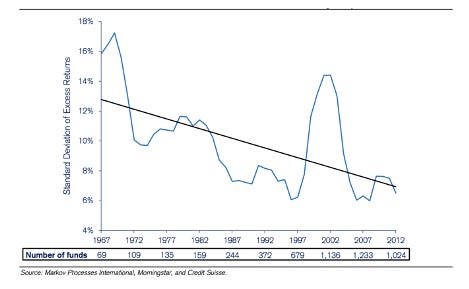
Luck is the next most important variable. I recommend everyone read Michael Mauboussin’s “The Paradox of Skill” to better understand how the higher and narrower level of talent in the market makes luck a more dominant determinant of returns than skill. All else equal, this makes mathematical sense. If you think of the distribution of skill simply as a confidence interval, and the standard deviation of returns narrows (due to narrower levels of skill), then all else equal, your standard error will be lower and the confidence interval will narrow. So, you must be an even greater outlier today than you had to be in the past for your returns to be a result of skill. This can be seen in the decline of the standard deviation of excess returns in the market.
Then skill, of course, matters. Research, stock selection, position-sizing, etc.

Investment Talk:
Lastly, I always conclude these interviews with some quotes. My favourite will always be Graham’s weighing machine analogy. So, to finish this off, what are some of your favourite quotes, and why?
Chris:
• Buffett: "Diversification is a protection against ignorance... [It] makes very little sense for those who know what they're doing."
- See my comments above
• "Easy choices, hard life. Hard choices, easy life." - Jerzy Gregorek
- I live for this – do the hard thing and endure pain in the short term to make the LT better.
• “The only easy day was yesterday.” – Navy SEALs
- Today is a new day, get after it, and improve just 1% every day. The compounding of those 1% improvements will follow a power law over time.
• "We suffer more often in imagination than in reality." – Seneca
- I could share many stoic quotes that I try to live by, but I love this one by Seneca. People literally wake up in the mornings, worrying about things from their past and anticipating their future, and live in a constant state of fear and sensitive parasympathetic states. Stop worrying about things you can’t control, which are both things in the past and future. Control what you can control and respond to the outcomes.
• "Experience is not what happens to a man; it is what a man does with what happens to him." - Aldous Huxley
- Along the same lines of “it’s not about how often a man gets knocked down, but how fast he can get back up.” Following the Seneca quote, I can’t control o what happens to me that is out of my control. But I can control how I respond to that event and make the most of it.
• "Don't start the day before it's finished." - Jim Rohn
- I’m OCD and plan out my days, weeks, years, etc. The closer I get to the present day, the smaller my tasks and goals are. Get the little things, which are designed to achieve larger goals, right and the big things take care of themselves.
• "It's not about who you are today. It's about who you want to become and the price you're willing to pay to get there. And I promise you, the day that you're willing to pay any price, you'll achieve what you want to achieve. If you truly believe that human potential is limitless, what do you want to become? And what price are you willing to pay to get there?" - Tom Bilyeu
- Gets me fired up to be my best.
• "What are you willing to do and what are you willing to give up to be the best you can be? You only have so much energy and the clock ticks on all of us. If you're going to compete against me, you better be willing to give up your life because I'm giving up mine." - Tom Brady
- Same thing – gets me fired up to give it my all. Plus, Tommy is the greatest living American.
• "Before I can solve a problem I must state it to myself. When I think I have found the solution I must prove I am right." - Reminiscences of a Stock Operator, pg. 52
• "If I had an hour to solve a problem I'd spend 55 minutes thinking about the problem and five minutes thinking about solutions.” – Einstein
- Both of these very much aligns with my approach to solving a problem, which is you must first fully understand the question being asked.
• "I must not fear. Fear is the mind-killer. Fear is the little-death that brings total obliteration. I will face my fear. I will permit it to pass over me and through me. And when it has gone past I will turn the inner eye to see its path. Where the fear has gone there will be nothing. Only I will remain."
- I’m not sure where I got this one, but facing your fears allows you to grow.
• "You cannot do extraordinary things, doing ordinary things." - Yen Liow
• “To be successful you don’t need to do extraordinary things, you just need to do ordinary things extraordinarily well.” ― Jim Rohn
Questions from Twitter
In this segment, we collected questions from the Twittersphere, and present them to Chris.

@MinionCapital: “Chris how do you do an efficient deep dive into a new area? Feels like you cover a lot of ground and the hardest thing to do is expand the circle of competence, so how do you do that in a consistent and efficient manner?”
Chris:
Consistency is all about intellectual curiosity. If something is interesting to me, diving deep is easy – I just want to know everything. So that part is easy.
The efficiency, I think, is the tough part. I mentioned above the different meta tools I have developed, speed reading, note-taking, and memory.
These skills are a huge part of my ability to learn things quickly. Creating mind maps and such are very helpful, but I can only do this once I have gone through my Feynman approach. So, it is all about being able to simplify the topic to its fundamental principles in a way that anyone can understand - understanding the foundational elements of the topic.
So one I can do that, then it goes back to one of the quotes I had above, which is I need to define the key question or questions being asked. As an example, for AI the key question I was trying to answer was how is AI transforming the business landscape? And so that led me down the path of understanding the different types of AI, how each can manifest in business, etc. so my research becomes focused. It is the application and writing on the topic that really helps me learn it well.
Finally, I utilize both active learning and spaced repetition to make sure I don’t forget topics.

@FiduciaInvest: “What is the transition like fundamentally looking at businesses from PE to public equities?”
Chris:
The biggest difference is the lack of the emotional/behavioural component in PE.
I also had access to every bit of operational data in PE, so it was easy to model out really anything for the partners. In public markets though, 95% of that stuff doesn’t matter. So the difficult thing in public markets is identifying those few critical items – as Marks says, “what’s the most important thing?” And the biggest thing is that evaluation in public markets is expectations-based, PE is simply what is the full value we can pay for the business while achieving an IRR target. You have a lot larger room for error in private markets IMO.
We were always in a control position in PE, so we had the power to make operational changes as we see fit. Not having that power makes the evaluation of management critical in public markets.

@tylerlastovich: “With so many names mentioned on Twitter, how do you choose where to deep dive?”
Chris:
I think repetitions helps you develop a BS detector. My view of the person mentioning the name will also drive my reaction (for better or worse). We all have to have a filtering mechanism, just as our brains do through the Reticular Activation System. Otherwise, we would suffer from data deluge and analysis paralysis.
So, having that filter in place and focusing only on business models that are “right-tail” strategies to me is really helpful. It helps that usually it is the same group of stocks always mentioned on Twitter.

@fatacodniklabug: “What are the positive & negative impacts of bringing back the semi manufacturing to US shores and how critical is the need?”
Chris:
Positives: Aside from jobs, supply chain reliability is certainly a factor. I have mixed thoughts on onshoring – the fact is that over the past 20, 30 or so years, the globalization of the chip supply chain resulted in geographic specialization, which made for a more efficient industry. Onshoring the supply chain would cause inefficiencies that I don’t think are thought of by politicians. I am not a geopolitical expert though, so I am probably missing some important factors. However, given the number of steps involved in creating a chip (1,000+), onshoring may streamline the process. It is also beneficial for the semi cap companies because the inefficiencies will result in more buildouts and required services.
Negatives: Aside from geographic specialization, lower labour costs can somewhat dampen wage pressures on the total cost structure. Additionally, access to certain materials is more widely available overseas. I could see innovation taking a hit also.

@Dividendwave: “Amazon has a history of turning cost centres into profit centres. They have a partnership with AVGO in networking and bought Annapurna Labs in 2015. How likely do you see them becoming a fabless player, and if you could consult for them what would be your strategy?”
Chris:
AMZN is already a fabless player with Trainium and Inferentia – their custom AI chips for training and processing AI models. This is a logical evolution for the hyperscalers, to optimize AI processing and training on their cloud platforms (for AMZN, on EC2). AMZN just launched Trainium last year, I believe, but it makes complete sense that the hyperscalers develop their own chips.
This phenomenon is probably most evident in Google’s*** development of the Tensor Processing Unit (TPU) – after their engineers realized that if something like all Android users used Google cloud services for just a few minutes (I am generalizing), then they would have to build out a staggering amount of new data centres. The TPU handicaps this problem by yielding better processing speeds.
*** Alphabet Inc. is a strategy holding of Titan Global Capital Management

@RichardMoglen: “What is Chris’s favourite non-stock market + non-self improvement book?”
Chris:
Thinking in Systems – which I mentioned above – completely changed the way that I view the world.
Thinking Fast and Slow is a classic
Finite and Infinite Games is a metaphysical masterpiece
Decisive (by the Heath brothers) – an invaluable framework for making better decisions
Seven Brief Lessons in Physics – I am a nerd
Meditations – my introduction to stoic philosophy
I like to read… a lot

@Plantmath1: “How does an idea become action? We all knew SaaS and other high multiple growth stocks were at unsustainable levels in the beginning of this year, but only a few took action. Decisiveness is difficult.”
Chris:
Well, the first step would be understanding why action wasn’t taken. I think inaction is a result of either a lack of conviction or fear. If we all knew, what prevented you (generally, not specifically) from pivoting? Lack of conviction is the byproduct of a poor process, or not understanding what the purpose of your process is. I understand that someone can’t take action if they are not evaluating forward risk/reward – then there is no measurable medium to decide whether or not to act.
If it’s fear, then there is internal work you need to do. Fear is crippling and prevents good decision making.

@Iglilaci: “What principles should an investor have in our world today?”
Chris:
• Mindset: Humility and self-awareness – be prepared to be wrong and learn from it
• Intellectual curiosity
• Discipline
• Critical thinking / unique thoughts
• Patience
• Competitive spirit/hunger
Concluding Remarks
Once again, a huge thank you to Chris for taking the time to write down all those thoughts on digital paper. Knowing him, it must have been a labour of love.
At 25 pages, and over 12,000 words, this was by far the lengthiest interview I have done yet, and not an ounce of quality was diluted as a result.
I imagine I will be re-reading this piece a number of times over the coming year. A lot to takeaway from this one.
Be sure to reach out to Chris over at @2ChaseGreatness, and stay tuned for future guests.
You can access all of the previous guest interviews in using this link, where you will be directed to an exclusive guest interview feed.
New to the newsletter? Sign up here.
Want to learn more? Browse the about page.
If you have any ideas related to the information you’d like to see each week, or perhaps where you feel it could improve, please reply to this email, or drop me a DM on Twitter @investmenttalkk.

Conor,
Lead Analyst at Occasio Capital Ltd
You can also reach out to us here:
Twitter: @Investmenttalkk & @TheITNewsletter
Facebook: @TheInvestmentTalkNewsletter
Pinterest: @InvestmentTalkkk
Email: Investmenttalkk@gmail.com