

If you wish to read this as a webpage, and not an email, then follow this link, where you will be directed to all of the previous guest interviews.
Earlier this year, sometime in February, I tweeted a tongue in cheek comment that MatchGroup’s acquisition of Hyperconnect would result in the company eating Facebook’s lunch, as a contrast to Facebook absorbing dating market share from MatchGroup.
Someone responded, asking for me to define the opportunity I saw in the acquisition, asking me to share some thoughts about what I had learned from studying the deal.
I sent over my rough notes, we discussed the acquisition further, as well as some other things, and became acquainted. Twitter doing its thing once again, and I was now connected with an intelligent investor.
That investor was Alex Morris, or as some of you might know him, “The Science of Hitting” (@TSOH_Investing).
Alex Morris, The Science of Hitting
Alex’s investing interest began during his tertiary education year in 2007. After a change in major to finance, he began to write articles for Guru Focus (which he continued for 11 years) alongside becoming an equities analyst.
During that stretch, he picked up both an MBA and his CFA designation, before putting an end to his full-time analyst position, as well as his work at Guru Focus.
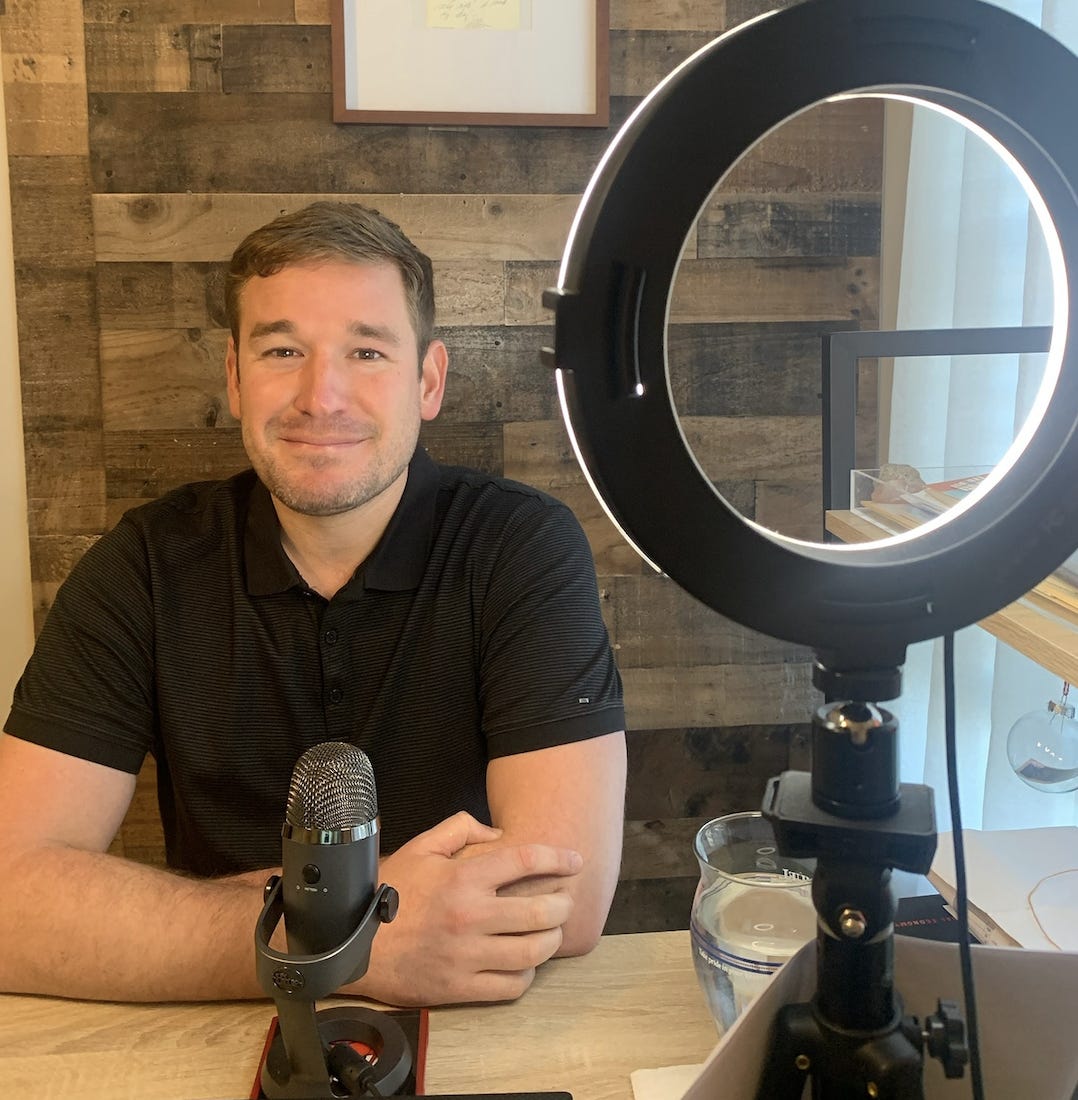
Focussing mostly on a concentrated basket of high-quality companies, run by exceptional management, Alex now shares the full extent of his research and allocation activity over at TSOH Investment Research, the service which he now operates full-time after striking out on his own.


I have read Alex’s work, and objectively, I am not surprised he was able to go it alone. Long before I had read his work, I had been listening to him. I think the first time I recall hearing him talk was on Toby’s value after hours podcast last year. I will leave a few links below to a couple of episodes, where you can a) understand how Alex invests, and b) simply learn from listening to other great investors discuss their process and experiences.
We are going to move on to discuss a little bit more about Alex’s story, his transition to writing on his own, and his overall process. So without further adieu, let us get into the interview.
“On business quality, a common thread from past investment failures has been situations where, at the time of my investment, it was already evident that the company had lost some of its standing in the eyes of customers relative to the competition. Naturally, the reason I got involved anyways was because I felt the price paid still provided sufficient compensation relative to the risk incurred (I was wrong). Over time, it has led to a tweak in my process: while a reasonable valuation is important to long-term investment success, it should ALWAYS be of secondary consideration in the research process. The first filter MUST be business quality.”
The Interview

Investment Talk:
Good morning Alex, I have been longing to have you on here for a while, so thanks for taking the time.
Before we get stuck in, perhaps you could share with us a little about your backstory, and maybe what sparked the interest in investing? I know that, for you, the journey began in 2007 during your early years as a student at the University of Florida. So maybe you could start there?
Alex:
First off, thanks for giving me the chance to tell my story Conor (to me, you will always be Investment Talk!).
My life as an investor started in college. After wandering aimlessly for a few years, I found my passion when a friend and I stumbled across the work of Buffett, Munger, and Peter Lynch. The next year, we drove from Gainesville, Florida to Omaha, Nebraska for the Berkshire Hathaway Annual Meeting (about 20 hours each way). Needless to say, I was hooked – and I’ve been thinking about investing ever since.
Shortly thereafter, I changed my major to Finance, and in 2010, I began writing articles for Gurufocus. I quickly realized that writing and publicly sharing my thoughts about the world of business and investing improved my analytical abilities and communication skills. Over the past 11 years, I’ve posted close to 800 articles on Gurufocus. I also tacked on the CFA designation and an MBA along the way.
In April 2021, I decided to go directly to my audience. I launched the TSOH Investment Research Service, where I provide complete access to my research process and all portfolio decision-making. I basically see myself as an analyst working full-time on behalf of subscribers. The first month was a memorable one – a big thank you to all of the people who signed up! – and I look forward to what it will become in the years ahead.

Investment Talk:
Before we start getting into investment approaches and such, I wanted to first congratulate you on your career change, where you are now writing full-time. Was stoked to hear you made the jump.
We touched on it in the opening remarks, but you run the TSOH Investment Research Service. So, a few questions on that.
You have obviously been writing for a number of years, but it would be interesting to hear why you made the jump to writing independently.
First, how does it feel now you have made the switch, and what drove you to pursue this full-time gig? Maybe even discuss what you have learned so far, after only a short time after making the jump.
Second, can you share with us what the premise of TSOH IRS is, and how that is structured?
Then lastly, where do you this going in the next year to five years? What are your goals, or aspirations with this?
Alex:
Launching the service was a bit nerve-racking. I went from having a “real” (full-time) job as an equities analyst, with Gurufocus as a side gig, to focus 100% of my time on this new venture (and with no idea if readers / subscribers would be willing to join me on the other side).
As you can imagine - and know from personal experience Conor - walking away from a salary/job that offers a comfortable lifestyle can be a difficult decision. All I can say now is that I couldn’t be happier with the early reception to the service.
I have learned many lessons over the course of the past month and a half. Here are three that come to mind: (1) It has been a lot of work. I’m constantly thinking about how to improve the quality of the output and how to grow the service.
It’s a big commitment - but if your passionate about the subject matter and believe in what you’re doing, it’s ultimately worth it; (2) Marketing yourself and your product/service demands and deserves a lot of time and effort (a skillset that doesn’t come naturally to someone like myself); (3) The people on FinTwit are even more generous and supportive than I thought previously (and I already held them in high esteem).
It truly is an amazing community to be a part of, and it has 100% changed my life. A huge thank you to FinTwit.
Through the service, I hope to provide a combination of high-quality investment research and a level of transparency that, in my experience, is atypical in the finance industry.
I come from the RIA (registered investment advisor) world, and I reflect on the minimal amount of time and attention that is truly devoted to the pertinent questions for an active investor. Some that come to mind: “What do you own and why do you own it? How do you think about position sizing? What are your investment objectives? How have your results over the past 5-10 years compared to your stated objectives?” Etc.
I’m comfortable with publicly answering these questions with complete honesty.
Part of the reason is selfish – I think being completely open about my process and past results is one of the best ways to improve as an investor (even if that openness can be painful when an investment doesn’t work out). But I also think my willingness to speak openly and honestly about everything that I do as an investor when combined with my industry knowledge and experience, could be additive to the process of other investors, analysts, CIO’s, etc. – people who need to answer these questions when they look at their own portfolio if they want to improve over time and (hopefully) generate better results.
Lastly, my goals. I always chuckle at this question, because I’ve been asked it over the years in job interviews and always say the same thing – “I want to become a better investor. As long as I have the opportunity to do that, I don’t care if I’m an analyst or the PM.” I feel similarly about the TSOH service. My professional goals are the same today as they were a decade ago – put in the time and effort to become a better investor.

Investment Talk:
Super responses there.
Moving on to your actual investment approach. In a nutshell, what would you say you are looking to achieve with your allocation to individual companies?
How do you approach investing in general, whether this be a mindset or a specific school of thought?
Then lastly, what kind of companies, are you most attracted to, what are you seeking out there amongst a plethora of public entities?
Alex:
My primary investment objective is to generate outsized returns relative to the S&P 500 over the long run. I believe my best shot at achieving that goal is through the ownership of high-quality businesses that can produce outsized growth in per-share intrinsic value, while simultaneously ensuring that I acquire (and continue to hold) my minority interest in the business only when it is available to me at a discount to intrinsic value (which in theory is based on an absolute hurdle rate, but in practice tends to be a relative hurdle).
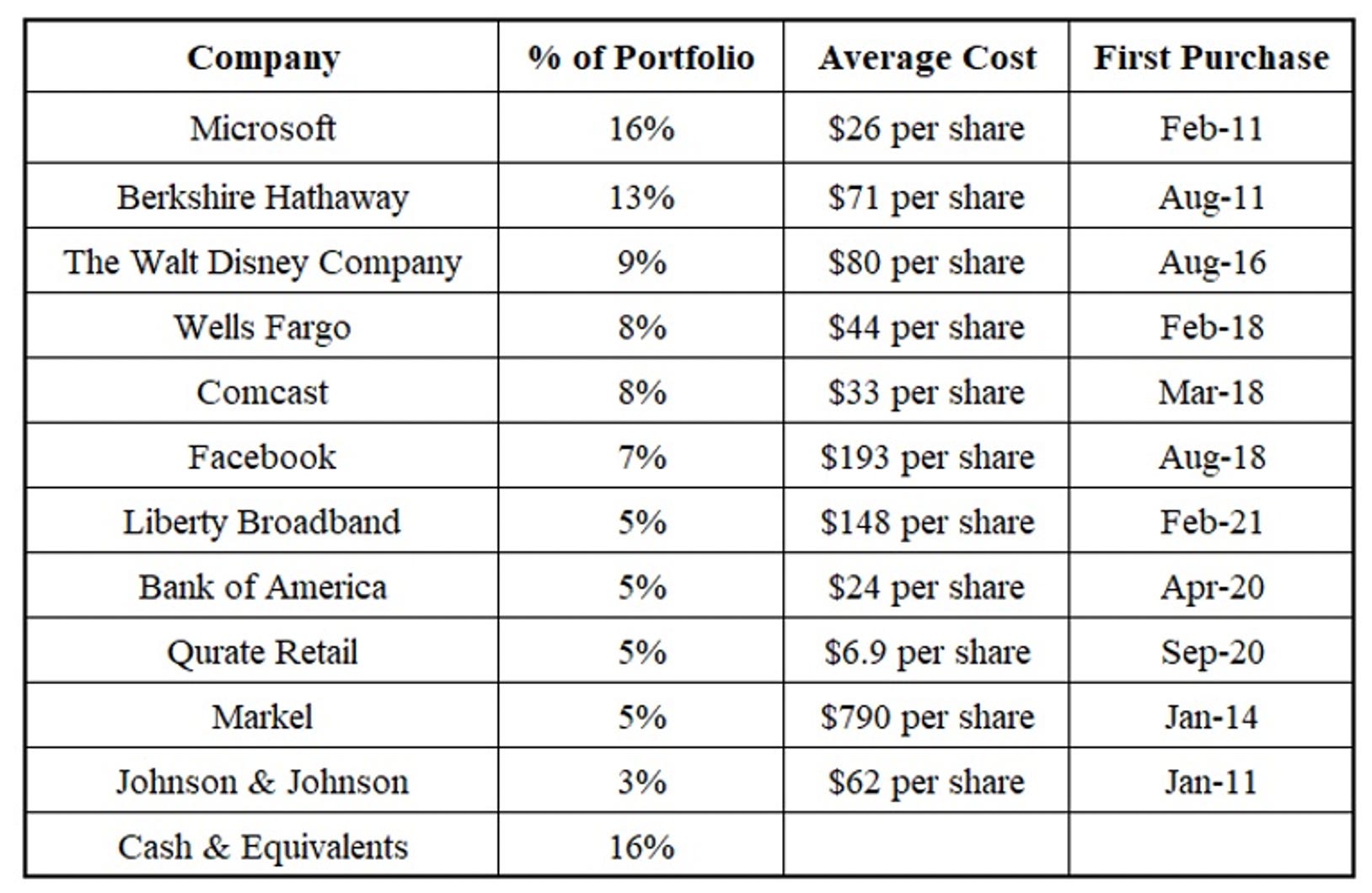
In terms of position sizing, I prefer concentration. From the perspective of a business owner, I believe that I can ensure sufficient diversification with 5-10 positions. As shown below, as of 03/31/2021, my five largest positions accounted for more than 50% of my portfolio (I’d also note that I’ve owned each of these five positions for 3+ years, with the two largest positions – Microsoft and Berkshire Hathaway – dating back to 2011).
In terms of the kind of companies I’m looking for, my ideal investment would meet the following criteria: (1) operates in an industry expected to experience structural growth; (2) with attractive unit economics and high returns on incremental invested capital (ROIIC) as a result of sustainable competitive advantages; (3) run by individuals with skill, integrity, and a long-term time horizon; and (4) offered by Mr Market at a reasonable price.

Investment Talk:
Has this style changed at all over the years? If so, what do you feel have been some of the most significant learning experiences, or failures (same thing), that have shaped the way you invest in the current day?
Alex:
The most notable change to my investment style over time has been a growing emphasis on the quality of the business and the importance of best-in-class management.
On business quality, a common thread from past investment failures has been situations where, at the time of my investment, it was already evident that the company had lost some of its standing in the eyes of customers relative to the competition. Naturally, the reason I got involved anyways was because I felt the price paid still provided sufficient compensation relative to the risk incurred (I was wrong). Over time, it has led to a tweak in my process: while a reasonable valuation is important to long-term investment success, it should ALWAYS be of secondary consideration in the research process. The first filter MUST be business quality.
As it relates to management, there was a period in my career where I was all-in on this idea of only investing in businesses that “any idiot” could run (to paraphrase Peter Lynch). Another way it’s often phrased is to only invest in businesses that even a “ham sandwich” could run, like Coca-Cola (a comment often attributed to Buffett, but he’s denied having ever said that). I took it to mean that I should only invest in businesses where the decisions of the CEO didn’t matter too much (they’d have to try to destroy the franchise).
But with some experience under my belt, I’ve settled on the exact opposite conclusion: the person at the top is incredibly important to the investment decision. Consider someone like Jeff Bezos. You could argue that the business Amazon was initially in – a new kind of retailing – would be a tough place to compete. But there are two important things that he realized: (1) what truly mattered to customers – price, selection, free delivery, etc.; and (2) how to build business operations that are actually quite attractive within and around a seemingly tough business (think 3P sales / FBA, Prime, AWS, etc.).
The sweet spot, in my opinion, is when you find that combination of a great business, a huge TAM, and a leader who can figure out how to effectively capitalize on it (for example, Satya Nadella at Microsoft).
So, those are probably the most notable tweaks I’ve made in the past 5-10 years.

Investment Talk:
From my understanding, you run a fairly concentrated portfolio, typically between 9 to 12 names at any given time, based solely on what I have seen.
What are your thoughts on concentration, and why have you chosen the allocation that you currently adopt?
Alex:
As an active investor who appreciates the risks associated with placing large bets, I am a big believer in concentration (for me). It’s pretty straightforward: I want to allocate as much as possible to the investment ideas that I’m most confident in.
Now, with that said, it’s not like I’m completely indifferent to the benefits of diversification or risk exposures. A good example is my investments in Wells Fargo and Bank of America. This isn’t the only reason why I own them, but I wrote the following in my April 2021 Portfolio Review:
“Of course, what if permanently lower NIM’s [net interest margins] have become the “new normal” in this interest rate environment? In that scenario, I assume the remainder of my portfolio - where future cash flows are less sensitive to rates – is likely to benefit (all else equal, a lower discount rate will result in a higher present value). In the context of a portfolio, I believe Wells and Bank of America (discussed below) are reasonable ways to hedge against interest rate risk (that assumes through-the-cycle deposit betas hold at 35% - 40%, similar to the 2015 – 2019 hiking cycle).”
Generally speaking, that’s how I think about risk: I’m much more concerned with the portfolio-level implications than the security-level risks. And, as a corollary to that idea, I have no problems with being out of step with the market (an index). You have to be willing to underperform if you want any shot at trying to outperform. You can’t get there if you’re always hugging a benchmark.

Investment Talk:
Within those larger positions, you hold some fairly solid staples in Microsoft, Berkshire, and Disney. You have owned the two formers since 2011, and the one latter since 2016.
I know that you recently sold Qurate Retail, after having first purchased shares in September 2020. Now, this might be a “special situation” of sorts, from my limited understanding of what the value proposition was there last year.
So, first, can you take us through the thesis behind that relatively short-term investment? What was the initial catalyst to purchasing shares, and what is the reason for, now, selling that position?
Secondly, on a more holistic level, when we think about time horizons and holding periods, what determines your holding period and the potential impetus for a sale?
Is it valuation-based, is it more so that you prefer to hold great companies for the long-term, but equally take advantage of special situations where an asset might be trading at a huge discount to its intrinsic value?
Some colour there would be great.
Alex:
At a high level, the investment thesis was an exceedingly low valuation and a clear path to value creation. To your point, this investment was a bit different from the opportunities that I’m normally drawn to.
What got me over the finish line on this idea, with help from my friends Bill Brewster (@BillBrewsterSCG) and Mike Mitchell (@IgnoreNarrative), was a clear understanding of the likely capital allocation decisions over the next few years.
In this specific situation, I only held the stock for 8-9 months. Typically, my holding period is measured in years (and I’m shooting for decades!).
The reasons why this situation was different are three-fold: (1) The price went up a lot in a short period of time; (2) I have real concerns about what this business looks like once we get past a period that has been a huge tailwind for Qurate; and (3) There’s a lot of financial leverage involved.
In summary, I’m glad it worked well, but it’s more of a one-off than anything else.

Investment Talk:
I know that you recently took a position in Spotify. I had noticed you sharing a lot of research on this across your Twitter timeline, as well as in your TSOH service.
What did you find compelling at Spotify?
Also, how do you feel Apple’s new Podcast Subscription service will impact the dynamic of that marketplace, as well maybe other new mediums of audio content such as ClubHouse, Twitter Spaces, and so on?
Alex:
The thing that I find most compelling about Spotify is its industry leadership position both in terms of users and engagement. CEO Daniel Ek once told members of the company’s management team that “Everything changes at scale.” As I look at the results over the past 5+ years, as well as the strategic decisions that the company has made in the past 2-3 years, I think we’re starting to see what that truly means. And over the next 5-10 years, I expect those changes to accelerate further.
In terms of Apple’s new Podcast Subscription service and Clubhouse / Twitter Spaces, I come from the perspective that for hundreds of millions of people around the world, the Spotify app on their phone is where they go (primarily) when they want to listen to music and podcasts (and over time that may include other categories like live audio). Of course, Spotify’s hold on this valuable real estate is not guaranteed; they will need to continue to improve the service to keep users. My bet is that the company, under the stewardship of Daniel Ek, will continue to improve its competitive position in the years ahead.
[ As a side note, I have dropped a link to a fairly recent discussion that Alex had on the yet another value blog podcast where he discusses his Spotify thesis at great length.]

Investment Talk:
Idea generation is sometimes tough. At times, we might only find one great idea each year. I have personally found that Twitter has been a great source of idea generation.
I had Pythia Capital on this segment a few weeks back, and he admitted that his portfolio was exclusively built upon ideas sourced mostly from Twitter. After doing his own legwork, of course.
So, my question(s) to you.
What does your idea generation process look like? Is it split across multiple mediums at all?
Second, do you feel Twitter is a useful source of interaction, idea generation, bouncing ideas, and so on? If so, would you care to share how you view some of the benefits and consequences of utilising Twitter?
Alex:
My idea generation tends to be scattered. One benefit of having lived and breathed investments for the past 10+ years is that I’ve built up a good understanding of a large number of businesses (rough guesstimate of 50 – 100) where I can get up to speed on the story quickly and can make a decision if Mr Market presents an opportunity.
In the past few years, a major source of idea generation has been my network.
As I said earlier, Qurate was sourced from Bill Brewster and Mike Mitchell.
On Spotify, I’ve talked about the company for a year with my friends Francisco Olivera (@FrancoOlivera), Andy (@bizalmanac), and Sleepwell Capital (@SleepwellCap).
And even on names that I’ve never bought, friends from FinTwit have been a huge help along the way – I’m thinking of TDG (@willis_cap), ALLY (@cultivatewealth), ROKU (@ElliotTurn), ANGI (@jerrycap), and MTCH (@TidefallCap) and you Conor (@investmenttalkk), to name a few.
It’s difficult to overstate how valuable it can be to stand on the shoulders of some of the smartest people I’ve met in investing.

Investment Talk:
Quick hot take, but I recall you discussing inflation rate hedging some time ago, mainly through the acquisition of the big banks, such as Bank of America and Wells Fargo (the two you specifically cited).
Can you elaborate on that, for some of the readers who might not understand what that means?
Alex:
I spoke about this a bit earlier in terms of portfolio construction. I’ve long operated under the idea that banks, over the long run, should benefit from a steeper curve (there are a few assumptions embedded in that comment, but the idea is that it would support higher NIM’s over time).
On the other hand, higher long-term rates would be a negative for equities, all else equal (higher discount rate = lower PV). So, I’ve long believed companies like Wells and Bank of America could act as an interest rate hedge of sorts if rates ever went up again (for many years, rates didn’t go up, and that “hedge” hurt). Well, that’s changed a bit in the past 12 months (2/10 spread has widened by >100BPS since mid-2020). If that continues, we’re going to find out if my theory holds up in practice!

Investment Talk:
With the uncertainty (which always exists) surrounding the general macro environment, supply chains, inflation, and interest rates, etc, do you believe that a portfolio should allow one to sleep better at night?
Alex:
I think you should always hold a portfolio that enables you to sleep at night.
As Buffett famously wrote in the 2008 shareholder letter, “We never want to count on the kindness of strangers in order to meet tomorrow’s obligations.”
I think one should approach their investments with a similar view. To me, that means concentrating my investments in companies that are able to withstand periodic bouts of uncertainty (economic distress), as well as avoiding the personal use of leverage (margin), options, etc. I never want to be in a position where a 10%, 20%, or 50% drawdown over the next week, month, or year can kill me. And if I were in that position today, I’d do something about it NOW.

Investment Talk:
I notice that you hold a fair weighting towards media and financials. Would you say these are your areas of competence, or is there another reason why you opt to allocate so heavily in these areas?
Alex:
Yes, I believe these industries are in my circle of competence. As an example, when I look at Disney, I believe I have a clear understanding of why they were successful in the past and why they have an opportunity to be successful in the future (importantly, I also think I have an understanding of why they’ve faltered at times in the past as well). And in terms of the economics of the business, I believe I have a good grasp on the factors that give the company a sustainable competitive advantage over some of its peers. I really think about it from a company-specific point of view, and less so from an industry perspective.

Investment Talk:
Lastly, I always conclude these interviews with some quotes. My favourite will always be Graham’s weighing machine analogy. So, to finish this off, what are some of your favourite quotes, and why?
Alex:
Great question! I’ll go with an old favourite from Charlie Munger:
“It is remarkable how much long-term advantage people like us have gotten by trying to be consistently not stupid instead of trying to be very intelligent.”
Questions from Twitter
In this segment, we collected questions from the Twittersphere, and present them to Alex.

@NegDiscountRt: “Has Alex ever shorted a stock?”
Alex:
I’ve shorted one stock in my entire career – a small amount of Salesforce (CRM). It went down by 10% or so over the next few weeks, and I covered. I don’t remember the exact timing, but it has to be up at least 4x since then. So, yeah, it was incredibly stupid, but I got lucky. I don't think I'll be playing that game again anytime soon...

@SEWilliams9: “TSOH’s current views on valuation of MSFT?”
Alex:
Microsoft’s valuation assumes that the company will be able to deliver double-digit EPS growth for a good number of years. Given recent trends in the business, as well as the massive TAM ahead of them (and one that becomes larger as they continue to reinvest in the business and take advantage of inorganic growth opportunities), I think it’s likely that the company will meet or exceed those expectations. That said, market sentiment on this company has done a complete 180 since I first invested back in 2011. Maybe it’s just something quirky about me, but I was more comfortable when nobody liked it...

@pchodas9: “Views on FB ecommerce opportunity, and AR/VR?”
Alex:
The company is investing aggressively to capitalize on these opportunities, among others. The idea that commerce will play a bigger role across FB’s platforms (like Instagram) in the years ahead makes sense to me (the fact that FB Marketplace now has over 1 billion MAU’s is a good example). I think it’s only a matter of time before they figure it out.
On AR / VR, the company appears well-positioned. It’s clearly an area of focus for Zuckerberg, and the things he said about the Quest 2 on the most recent call were quite encouraging.
But whether it takes 5 years or 20 years for this to become a mainstream market, I just don’t have any idea. That said, I completely support management in terms of investing aggressively ahead of what they believe could be a massive opportunity at some point in the future. If the stars align, it doesn’t seem outlandish (to me) that they could potentially build an AR / VR business that is incredibly valuable.

@pchodas9: “Why are you not long Twitter?”
Alex:
The short answer is that it’s on my list. I looked 2-3 years ago, but it sounds like the story has changed. Considering how much time I spend on the service, it shouldn’t take me too long to get up to speed with the thesis!

@pchodas9: “Long-Term, Spotify Gross Margin up a little or a lot?”
Alex:
Long-term, I think they’re up a lot. But when I say long-term, I mean long-term. It would not surprise me at all if gross margins were flat over the next 2-3 years as they ramp their investments in non-music categories like podcasts and live audio. This is a good example of needing to have a clear thesis, while also recognizing when the thesis not “working” is actually a good thing (or at least potentially a good thing).
Thanks for the time, everybody!
And thanks for having me Conor!
Concluding Remarks
Would just like to close this out by saying thank you to Alex for taking the time to answer these questions today.
I have long stated that I want these guest interviews to be populated with quality investors, who share meaningful responses.
Alex delivered on that, and I feel like I was able to take away a few nuggets from this conversation, and I hope you did too.
Be sure to reach out to Alex over at @TSOH_Investing, and stay tuned for future guests.
You can access all of the previous guest interviews in using this link, where you will be directed to an exclusive guest interview feed.
Awesome interview. Learned a lot more about Alex :) still thankful to him for sending me a book “Shoe Dog”